Free guide for parents
How to help with math homework when you're not a math person
Stop dreading math homework. The Parent's Math Guide explains how math is taught today in plain English, gives you the exact words to say when your student is stuck, and shows you how to find and fill gaps, from kindergarten counting to high school algebra.
- 100% free
- 35 printable pages
- 5-minute summary up front
- No card needed
¿Prefiere leer en español? Guía de matemáticas para padres · Prefere ler em português? Guia de matemática para pais
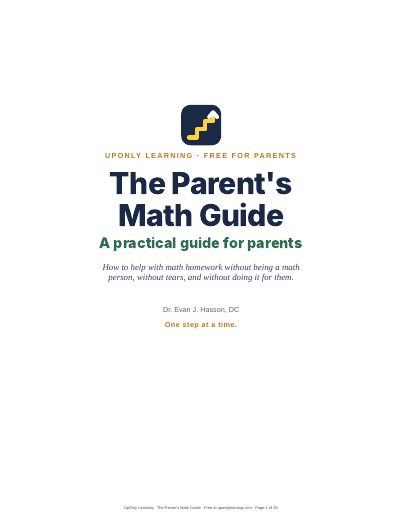
Math homework doesn't have to end in tears
A worksheet comes home that looks nothing like the math you learned. You show the way you were taught, and you hear "That's not how my teacher does it." Ten minutes later somebody is upset.
You don't need to be good at math to help. You need a calm voice, a few good questions, and a rough idea of what your student is being taught. This free guide gives you all three. It's written for the parent, not the student, in short chapters you can read in a few minutes each.
What's inside the guide
It opens with a one-page, 5-minute summary for busy parents, so you can start helping tonight. Plus a K–12 grade-by-grade map of what's taught each year, a glossary of math words for parents, and a fridge card with what to say when your student is stuck.
Helping with math, grade by grade
The job changes as your student grows. Here's a preview of what the guide covers for each stage.
Kindergarten to 2nd grade: counting, making ten, place value
Today's early math is built on number bonds (7 is 5 and 2) and making ten: to add 8 + 5, take 2 from the 5 to make 10, then add the 3 that's left. The single most important idea is place value: 47 means 4 tens and 7 ones. Ask "In 63, what does the 6 mean?" If the answer is "six" instead of "sixty," that's where to practice.
3rd to 5th grade: multiplication, division and fractions
Students multiply with the area model (36 × 7 is 30 × 7 plus 6 × 7, which is 210 + 42 = 252) before the stacked method. They learn fractions as numbers on a number line. The most common mistake at every age is adding tops and bottoms, as in ½ + ⅓ = 2/5. Quick check: the answer has to be bigger than ½, and 2/5 isn't.
Middle school: ratios, negative numbers and equations
Math shifts from calculating to relationships: ratios, unit rates, percents and solving equations like a balance scale, where whatever you do to one side you do to the other. Many middle school struggles are really fraction gaps from 4th and 5th grade in disguise.
High school: Algebra 1, Geometry, Algebra 2 and beyond
You don't need to remember algebra to help a teenager. Your job becomes managing the conditions for learning: time, habits, resources and asking for help early. Ask your teen to teach you what they're working on. It's one of the best ways to study.
What to say instead of giving the answer
These questions work even if you don't know how to solve the problem yourself. After you ask, wait ten seconds before you say anything else.
- "What is the question asking you to find?"
- "What do you already know?"
- "Can you draw it?"
- "Show me what you've done so far."
- "Is there an example like this in your notes?"
- "Try it with smaller numbers first."
- "How did you get that?"
- "How could you check it?"
- "Does that answer make sense?"
- "Explain it to me like I'm in your class."
Words that lower math anxiety
| Instead of | Try |
|---|---|
| "You're so smart!" | "You kept going when that got tricky. That's how it's done." |
| "No, that's wrong." | "Walk me through how you got that." |
| "I was never good at math either." | "Math was hard for me too. Let's figure this out together." |
| "Hurry up." | "Take your time. Getting it right matters more than getting it fast." |
| "I can't do fractions." (from your student) | "You can't do fractions yet." |
Questions parents ask
Is the Parent's Math Guide really free?
Do I need to be good at math to use it?
What grades does it cover?
Does it explain Common Core math?
How do I stop math homework battles?
How do I know if my student needs a tutor?
Is it available in Spanish or Portuguese?
Get the free Parent's Math Guide
35 printable pages for parents of students from kindergarten through high school. Read it tonight; use the fridge card tomorrow.
The companion guide for reading
Worried about reading too? The Parent's Reading Guide is free as well: how to build real reading comprehension at home, the questions to ask before, during and after reading, and when to get extra help, from kindergarten through high school.
Free practice built on the same methods
Want practice material that matches the guide? Read a free workbook sample for any subject and grade from kindergarten to 5th grade, print free practice sheets, or see everything we give away free. For the summer between grades, our Prepare books start with a Readiness Check that finds the gaps for you.
Spotted a mistake in the guide? Photograph the page and email it to support@uponlylearning.com. We read every message.