Free guide for parents
They can read the words, but do they understand them?
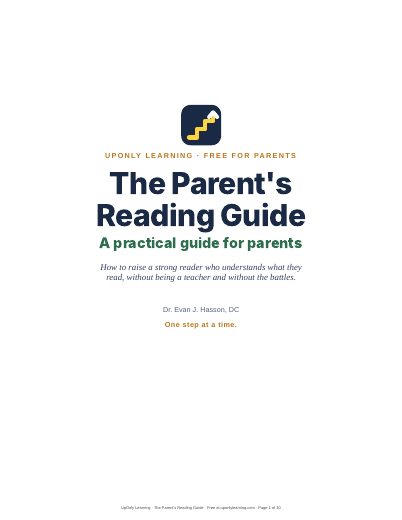
The Parent's Reading Guide shows you how to build real reading comprehension at home: the questions to ask before, during and after reading, how to help with harder texts without doing the work, and how to tell when your student needs extra help. From learning to read in kindergarten to analyzing Shakespeare in high school.
- 100% free
- 30 printable pages
- 5-minute summary up front
- No card needed
¿Prefiere leer en español? Guía de lectura para padres · Prefere ler em português? Guia de leitura para pais
"Just read more" isn't a plan
Your student reads a page aloud perfectly and can't tell you what it was about. Or reading is slow and painful, the reading log is a nightly argument, and the book report is due tomorrow.
You don't need to be a teacher or a reading specialist to help. Reading is two skills, getting the words off the page and understanding what they mean, and most trouble comes from one side being weaker than the other. This free guide shows you how to tell which side, and what to do about it, in short chapters written for busy parents.
What's inside the guide
It opens with a one-page, 5-minute summary for busy parents, so you can start helping tonight. Plus a K–12 grade-by-grade reading map, a glossary of reading words for parents, and a fridge card of questions for any book.
The two sides of reading
Researchers describe reading as decoding × comprehension. Decoding is turning letters into words: sounds, phonics, blending and reading smoothly (fluency). Comprehension is understanding the words: vocabulary, background knowledge and thinking while reading. It's multiplication, not addition, so a student needs both.
| What you notice | Likely weak side | What helps |
|---|---|---|
| Reads slowly, stumbles, guesses at words | Decoding | Phonics practice, rereading, reading aloud together |
| Reads smoothly but can't say what it was about | Comprehension | Questions while reading, vocabulary, summarizing |
| Understands when you read to them, not alone | Decoding | Decoding practice plus audiobooks |
| Struggles with science or history reading, not stories | Background knowledge | Build knowledge of the topic first |
Helping with reading, grade by grade
Kindergarten to 2nd grade: learning to read
Early reading is built on hearing the sounds in words, then phonics (which letters make which sounds), then blending sounds into words. When your student is stuck on a word, sound it out together rather than guessing from the picture. And keep reading aloud to them every day: listening builds the vocabulary their reading will need later.
3rd to 5th grade: reading to learn
Around third grade, students shift from learning to read to reading to learn. Textbooks and longer novels arrive, and hidden decoding gaps often show up. Main idea, summarizing, theme and nonfiction text features are the big skills. Ask your student to tell you what they read in two sentences. That's summarizing.
Middle school: reading between the lines
Students learn to infer what the author implies, cite text evidence, and judge an argument. Teach the inference formula: It says… + I know… = So… and ask "What in the book made you think that?" after every answer.
High school: analysis, argument and complex texts
High school English asks how and why an author wrote something, not just what it says. You can help by talking about books and the news like adults do: "What's the argument? Do you buy it?" Previewing a summary or performance before reading Shakespeare makes a hard text far easier, as long as it's a preview, not a replacement.
Reading comprehension questions to ask at home
You don't need to have read the book to ask these. Pick two or three per reading session. Keep it a conversation, not a quiz.
| Before reading | During reading | After reading |
|---|---|---|
| "What do you think this is about?" | "What do you picture in your head?" | "Tell me about it in two sentences." |
| "What do you already know about this?" | "Why did the character do that?" | "What was the most important part?" |
| "What happened last time?" | "What do you think happens next?" | "What does the author want us to learn?" |
| "Let's look at the headings first." | "Did that part make sense?" | "What would you have done?" |
Questions parents ask
Is the Parent's Reading Guide really free?
My student reads fluently but doesn't understand. What should I do?
What grades does it cover?
Do audiobooks and graphic novels count as reading?
How do I stop reading-log and book-report battles?
How do I know if my student needs a reading tutor or has dyslexia?
Is it available in Spanish or Portuguese?
Get the free Parent's Reading Guide
30 printable pages for parents of students from kindergarten through high school. Read it tonight; put the fridge card up tomorrow.
The companion guide for math
Math homework causing trouble too? The Parent's Math Guide is free as well: how math is taught today in plain English, what to say when your student is stuck, and how to end homework battles, from kindergarten through high school.
Free reading practice
Read a free Reading or English & Writing workbook sample for any grade from kindergarten to 5th, print free practice sheets, or see everything we give away free.
Spotted a mistake in the guide? Photograph the page and email it to support@uponlylearning.com. We read every message.