
Free for everyone
Earth & Space Science
A free Earth and space science reference for kindergarten to 8th grade: our planet, water and weather, Earth’s resources, the Sun and Moon, the solar system and space exploration. Short, clear facts, each with its source.
Earth science for kids, from UpOnly Learning
Why Earth and space science matter
Right now, somewhere under your student’s feet, the ground is moving. Our planet never sits still, most of the seafloor is still a mystery, and the sky is fuller than anyone guessed. Earth and space science is how students learn to read all of it.
Four facts to start
- 20,000
Earth shakes all the time. The USGS locates about 20,000 earthquakes around the world each year, about 55 a day.[1]
- 28.7%
As of April 2026, only 28.7 percent of the global seafloor had been mapped in high detail.[2]
- 293
NASA counts 293 confirmed moons around Saturn as of August 2026, more than any other planet. Counts change as astronomers find more.[3]
- 31%
In 2024, 31 percent of U.S. eighth graders scored at or above NAEP Proficient in science, and their Earth and space sciences score was 4 points lower than in 2019.[4]
What you’ll find here: six parts and 32 topics, from Earth’s layers and the water cycle to the Moon, the planets and space travel. Short facts for kindergarten to 8th grade, each with its source, plus key words in English, Spanish and Portuguese. Free for everyone.
Not sure where your student stands? Try our free K–8 placement test (math, reading, English). It adapts to your student.
The six parts
Part 2Water, Air and Weather7 topics
Part 3Earth's Resources3 topics
Part 4Earth in Space5 topics
Part 5The Solar System and Beyond5 topics
Part 6Exploring Space4 topics
All 32 topics
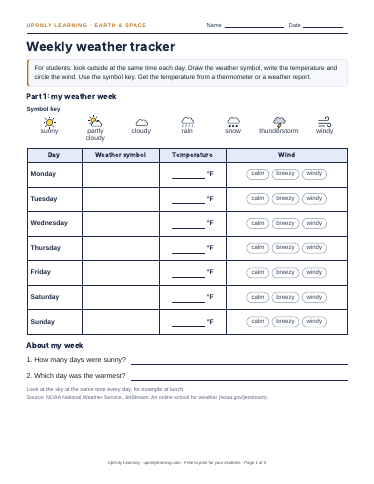
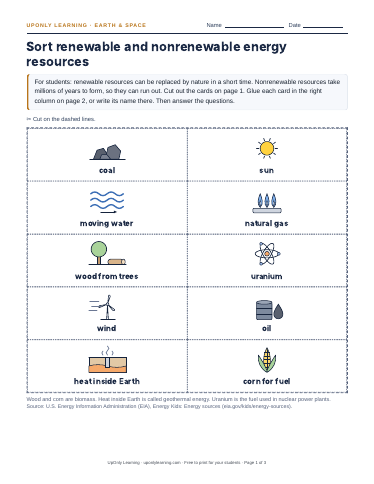
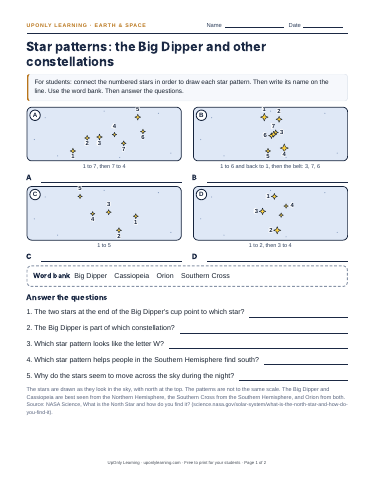
Free printable Earth and space worksheets
(15)
Print-ready science pages for your students, with the recommended grades.
Printables with a black and white button also come in a low-ink version, good for coloring and filling in.
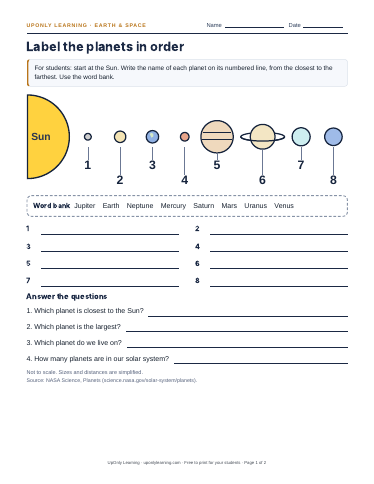
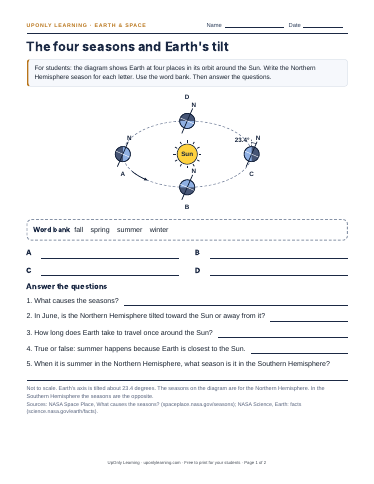
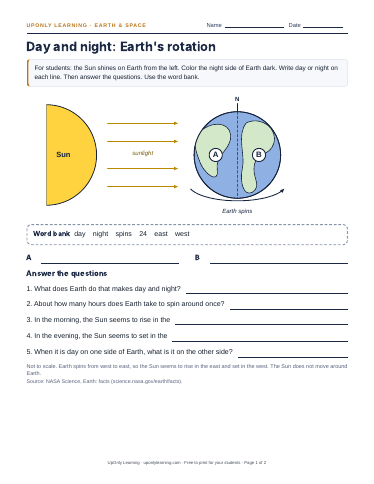
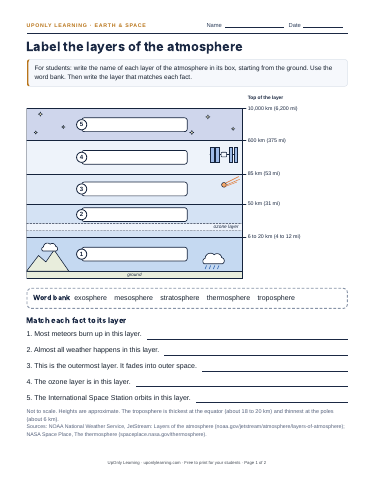
What your student will learn
- Describe Earth’s layers, the three kinds of rock and how plates move
- Explain how volcanoes, earthquakes, weathering and erosion shape the land
- Follow water through the water cycle, the oceans, rivers and ice
- Name the layers of the air, read the clouds and know what to do in a storm
- Tell renewable from nonrenewable resources and find ways to care for land, water and air
- Explain day and night, the seasons, the Moon’s phases and eclipses
- Know the planets in order and what makes each one special
- Meet stars, galaxies, telescopes, rockets and the people who explore space
- Check a fact by reading its source
Also practice
Free first. Lessons in the library are for members.
- Science worksheets by gradeFree practice questions with answers, kindergarten to 8th gradeFree
- The Experiments You RunFree science game: Kitchen Lab is free for everyoneFree
- Lesson library: ScienceFull lessons with practice and checksMembers
- Family Emergency GuideStep-by-step safety pages for families, from UpOnly Learning:Free
Coming soon
We are building these next. They will link from here when they are ready.
- Interactive explorerA clickable solar system, an Earth-layers cutaway, a volcano cutaway and a live USGS earthquake mapComing soon
- Free printablesPrint-ready science pages, with the recommended gradesOpen the printables
- Lessons and practiceNew lessons and question banks for the topics our library does not cover yetComing soon
- FlashcardsKey words in English, Spanish and PortugueseComing soon
Sources for this page
(4)
- U.S. Geological Survey · Why are we having so many earthquakes? Has naturally occurring earthquake activity been increasing? · usgs.gov/faqs/why-are-we-having-so-many-earthquakes-has-naturally-occurring-earthquake-activity-been (page updated Feb 5, 2026; checked Oct 30, 2026)
- NOAA Ocean Exploration · How much of the ocean has been explored? · oceanexplorer.noaa.gov/ocean-fact/explored (page updated Apr 20, 2026; checked Oct 30, 2026)
- NASA Science · Saturn Moons · science.nasa.gov/saturn/moons (page updated Sep 22, 2026; checked Oct 30, 2026)
- National Center for Education Statistics (NCES), The Nation's Report Card · National Trends and Student Skills: 2024 NAEP Science Assessment · nationsreportcard.gov/reports/science/2024/national-trends (checked Oct 30, 2026)