Earth & Space Science · free reference
Part 5: The Solar System and Beyond
The planets, Dwarf planets, moons, asteroids and comets, Stars and constellations, Galaxies and the universe and Gravity in space. Every fact lists its source, and you can share a link to any topic.
In short: Eight planets circle the Sun. The four inner planets are rocky; the four outer planets are giants made of gas and ice.[1]
Facts
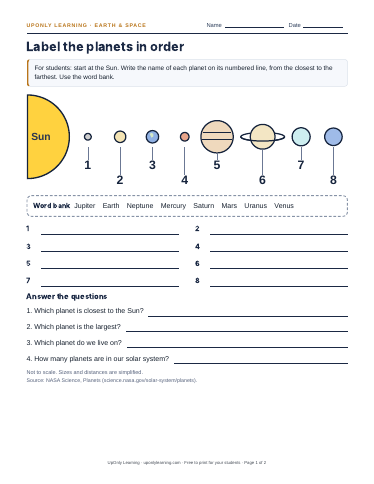
- Our solar system has eight planets. In order from the Sun: Mercury, Venus, Earth, Mars, Jupiter, Saturn, Uranus, Neptune.[1]
- Mercury, Venus, Earth and Mars are the inner planets. They are called terrestrial planets because they have solid, rocky surfaces.[1]
- The outer giants have no hard surface. Jupiter and Saturn are called gas giants, while Uranus and Neptune are called ice giants.[1]
- Hundreds of moons are known to circle planets and dwarf planets in our solar system.[2]
Planet by planet
(8)
Mercury
#mercury- Place in line
- Mercury is the closest planet to the Sun and the smallest planet.[1]
- Size
- Mercury is a little more than one-third as wide as Earth (radius about 1,516 miles or 2,440 km).[3]
- Distance from the Sun
- Mercury is about 36 million miles (58 million km) from the Sun, or 0.4 AU.[3]
- Length of a day
- One full day-and-night on Mercury lasts 176 Earth days.[3]
- Length of a year
- Mercury is the fastest planet. Its year is 88 Earth days.[3]
- Moons
- Mercury has no moons.[3]Count from NASA’s page, updated Apr 25, 2025. Moon counts change as new moons are found.
- Rings
- Mercury has no rings.[3]
- Temperature
- Days on Mercury can reach 800 °F (430 °C), and nights can drop to -290 °F (-180 °C).[3]
Venus
#venus- Place in line
- Counting out from the Sun, Venus is planet number two.[1]
- Size
- Venus is about 7,521 miles (12,104 km) across, a little smaller than Earth.[4]
- Distance from the Sun
- Venus is about 67 million miles (108 million km) from the Sun, or 0.72 AU.[4]
- Length of a day
- Venus spins so slowly that one turn takes 243 Earth days.[4]
- Length of a year
- A year on Venus is 225 Earth days, so its day is longer than its year.[4]
- Moons
- Venus has no moon.[4]Count from NASA’s page, updated Oct 15, 2026. Moon counts change as new moons are found.
- Rings
- There are no rings around Venus.[4]
- Hottest planet
- Venus is the hottest planet. Its surface is about 872 °F (467 °C), hot enough to melt lead.[4]
- Spin
- Venus spins backward compared with most planets.[4]
Earth
#earth- Place in line
- Earth, our home, is third in line from the Sun and fifth in size.[1]
- Size
- Earth is about 7,926 miles (12,756 km) across at the equator.[5]
- Distance from the Sun
- Earth is about 93 million miles (150 million km) from the Sun.[5]
- Length of a day
- Earth spins once about every 23.9 hours.[5]
- Length of a year
- Earth's year is about 365.25 days.[5]
- Moons
- Earth has one moon.[5]Count from NASA’s page, updated Dec 5, 2025. Moon counts change as new moons are found.
- Water
- Earth is an ocean planet: water covers about 70 percent of its surface.[6]
Mars
#mars- Place in line
- Mars is fourth in line from the Sun.[1]
- Size
- Mars is about half as wide as Earth (radius about 2,106 miles or 3,390 km).[7]
- Distance from the Sun
- Mars is about 142 million miles (228 million km) from the Sun, or 1.5 AU.[7]
- Length of a day
- A day on Mars is called a sol.[7]
- Length of a year
- A year on Mars is 687 Earth days.[7]
- Moons
- Two small moons, Phobos and Deimos, circle Mars.[7]Count from NASA’s page, updated Jul 10, 2026. Moon counts change as new moons are found.
- Biggest volcano
- Olympus Mons on Mars is the biggest volcano in the solar system.[7]
- Color
- Mars looks red because iron in its rocks has rusted.[7]
Jupiter
#jupiter- Place in line
- Jupiter is fifth in line from the Sun and the largest planet.[1]
- Size
- Jupiter is 11 times wider than Earth (radius about 43,440.7 miles or 69,911 km).[8]
- Distance from the Sun
- Jupiter is about 484 million miles (778 million km) from the Sun, or 5.2 AU.[8]
- Length of a day
- A day on Jupiter is only about 9.9 hours.[8]
- Length of a year
- Jupiter needs 4,333 Earth days, roughly 12 Earth years, to circle the Sun once.[8]
- Moons
- Jupiter has 115 moons recognized by the IAU.[8]Count from NASA’s page, updated Oct 15, 2026. Moon counts change as new moons are found.
- Rings
- Jupiter has faint rings, found by Voyager 1 in 1979.[8]
- Great Red Spot
- The Great Red Spot is a storm on Jupiter that is bigger than Earth.[8]
Saturn
#saturn- Place in line
- Saturn is sixth in line from the Sun and second in size.[1]
- Size
- Saturn is about 9 times wider than Earth (about 74,897 miles or 120,500 km across).[9]
- Distance from the Sun
- Saturn is about 886 million miles (1.4 billion km) from the Sun, or 9.5 AU.[9]
- Length of a day
- A day on Saturn is about 10.7 hours.[9]
- Length of a year
- Saturn needs 10,756 Earth days, roughly 29.4 Earth years, to circle the Sun once.[9]
- Moons
- NASA counts 293 confirmed moons around Saturn as of August 2026, more than any other planet.[15]Count from NASA’s page, updated Sep 22, 2026. Moon counts change as new moons are found.
- Rings
- Saturn's rings are made of billions of chunks of ice and rock.[9]
- Made of
- Saturn is mostly hydrogen and helium, like Jupiter.[9]
Uranus
#uranus- Place in line
- Uranus is seventh in line from the Sun and third in size.[1]
- Size
- Uranus is about four times wider than Earth (31,763 miles or 51,118 km across).[10]
- Distance from the Sun
- Uranus is about 1.8 billion miles (2.9 billion km) from the Sun, or about 19 AU.[10]
- Length of a day
- A day on Uranus is about 17 hours.[10]
- Length of a year
- A year on Uranus is about 84 Earth years.[10]
- Moons
- NASA counts 29 officially recognized moons around Uranus as of August 2026.[16]Count from NASA’s page, updated Sep 22, 2026. Moon counts change as new moons are found.
- Rings
- Uranus has two separate sets of rings.[10]
- Tilt
- Uranus seems to spin on its side.[10]
- Color
- Methane gas gives Uranus its blue-green color.[10]
Neptune
#neptune- Place in line
- Neptune is the eighth planet and the farthest from the Sun.[1]
- Size
- Neptune is roughly four times as wide as Earth (30,775 miles or 49,528 km across).[11]
- Distance from the Sun
- Neptune is about 2.8 billion miles (4.5 billion km) from the Sun, or 30 AU.[11]
- Length of a day
- A day on Neptune is about 16 hours.[11]
- Length of a year
- A year on Neptune is about 165 Earth years.[11]
- Moons
- NASA counts 16 known moons around Neptune.[11]Count from NASA’s page, updated Oct 15, 2026. Moon counts change as new moons are found.
- Rings
- Neptune has at least five main rings.[11]
- Wind
- Neptune is the windiest planet in the solar system.[11]
- Kind of planet
- Neptune is one of the two ice giants.[11]
Key words in three languages
(16)
| English | Spanish | Portuguese |
|---|---|---|
| Solar System[12] | Sistema Solar[13] | Sistema solar[14] |
| Planet[12] | Planeta[13] | Planeta[14] |
| Mercury[12] | Mercurio[13] | Mercúrio[14] |
| Venus[12] | Venus[13] | Vênus[14] |
| Earth[12] | Tierra[13] | Terra[14] |
| Mars[12] | Marte[13] | Marte[14] |
| Jupiter[12] | Júpiter[13] | Júpiter[14] |
| Saturn[12] | Saturno[13] | Saturno[14] |
| Uranus[12] | Urano[13] | Urano[14] |
| Neptune[12] | Neptuno[13] | Netuno[14] |
| Terrestrial Planet[12] | Planeta terrestre[13] | Planeta terrestre[14] |
| Gas Giant[12] | Gigante gaseoso[13] | Gigante gasoso[14] |
| Ice Giant[12] | Gigante de hielo[13] | Gigante Gelado[14] |
| Ring[12] | Anillo[13] | Anel[14] |
| Great Red Spot[12] | La Gran Mancha Roja[13] | Grande Mancha Vermelha[14] |
| Moons[12] | Lunas[13] | Luas[14] |
Each word cites a page that uses it.
Practice this
We do not have a lesson on this yet. The facts above are the teaching here.
Sources (16)
- NASA Science · About the Planets · science.nasa.gov/solar-system/planets (page updated Oct 14, 2026; checked Oct 26, 2026)
- NASA Science · Moons · science.nasa.gov/solar-system/moons (page updated Oct 13, 2026; checked Oct 26, 2026)
- NASA Science · Mercury: Facts · science.nasa.gov/mercury/facts (page updated Apr 25, 2025; checked Oct 26, 2026)
- NASA Science · Venus: Facts · science.nasa.gov/venus/venus-facts (page updated Oct 15, 2026; checked Oct 26, 2026)
- NASA Science · Facts About Earth · science.nasa.gov/earth/facts (page updated Dec 5, 2025; checked Oct 26, 2026)
- NASA Science (Kids) · Earth · science.nasa.gov/kids/earth (page updated Sep 26, 2025; checked Oct 26, 2026)
- NASA Science · Mars: Facts · science.nasa.gov/mars/facts (page updated Jul 10, 2026; checked Oct 26, 2026)
- NASA Science · Jupiter Facts · science.nasa.gov/jupiter/jupiter-facts (page updated Oct 15, 2026; checked Oct 26, 2026)
- NASA Science · Saturn: Facts · science.nasa.gov/saturn/facts (page updated Oct 15, 2026; checked Oct 26, 2026)
- NASA Science · Uranus: Facts · science.nasa.gov/uranus/facts (page updated Oct 15, 2026; checked Oct 26, 2026)
- NASA Science · Neptune: Facts · science.nasa.gov/neptune/neptune-facts (page updated Oct 15, 2026; checked Oct 26, 2026)
- IAU Office of Astronomy for Education (OAE) · Astronomy Translation Network glossary: English term list · astro4edu.org/resources/glossary/search (checked Oct 26, 2026)
- IAU Office of Astronomy for Education (OAE) · Glosario: lista de términos en español · astro4edu.org/es/resources/glossary/search (checked Oct 26, 2026)
- IAU Office of Astronomy for Education (OAE) · Glossário: lista de termos em português do Brasil · astro4edu.org/pt-br/resources/glossary/search (checked Oct 26, 2026)
- NASA Science · Saturn Moons · science.nasa.gov/saturn/moons (page updated Sep 22, 2026; checked Oct 30, 2026)
- NASA Science · Uranus Moons · science.nasa.gov/uranus/moons (page updated Sep 22, 2026; checked Oct 30, 2026)
See something we should correct about “The planets”? Tell us.
In short: Besides planets, the solar system has dwarf planets like Pluto, rocky asteroids, icy comets and many moons. Shooting stars are bits of space rock burning up in our air.[1][2][3][4][5]
Facts
- The International Astronomical Union (IAU) says a planet must go around the Sun, be heavy enough to pull itself into a nearly round shape, and have cleared other objects out of its path.[6]
- A dwarf planet goes around the Sun and is big enough to be nearly round, but it has not cleared its path of other objects.[6]
- Pluto is now classed as a dwarf planet.[6]
More facts
(20)
- NASA lists five dwarf planets. From closest to the Sun to farthest: Ceres, Pluto, Haumea, Makemake and Eris.[1]
- Ceres, the biggest object in the asteroid belt, orbits between Mars and Jupiter.[1]
- Makemake is one of the brightest objects in the Kuiper Belt, far beyond Neptune.[1]
- Pluto is in the faraway Kuiper Belt.[7]
- The IAU moved Pluto into the dwarf planet group in 2006.[7]
- Pluto is about 1,477 miles (2,377 kilometers) wide.[7]
- Pluto is about 39 times farther from the Sun than Earth is.[7]
- Pluto takes about 248 Earth years to go around the Sun once, on an oval path.[7]
- Pluto has five known moons. The biggest is Charon.[7]
- NASA's New Horizons spacecraft flew past Pluto and its moons in 2015.[7]
- Asteroids are rocky leftovers from when our solar system formed. They are sometimes called minor planets.[2]
- Most asteroids circle the Sun in the main asteroid belt, between Mars and Jupiter.[2]
- Scientists estimate the belt has about 1.1 to 1.9 million asteroids wider than 1 kilometer.[2]
- A comet can have two tails: one made of dust and one made of gas.[3]
- Many comets that take a very long time to orbit come from a far-off region called the Oort Cloud.[3]
- Beyond Neptune is the Kuiper Belt, a flat ring of icy objects.[3]
- NASA describes comets as "dirty snowballs."[3]
- Meteoroids are space rocks, from dust-sized up to small-asteroid-sized.[4]
- When a meteoroid zooms into the atmosphere and burns up, the streak of light is a meteor, often called a shooting star.[4]
- If a piece survives and lands on the ground, it is a meteorite.[4]
Key words in three languages
(14)
| English | Spanish | Portuguese |
|---|---|---|
| Planet[8] | Planeta[9] | Planeta[10] |
| Moons[8] | Lunas[9] | Luas[10] |
| Dwarf Planet[8] | Planeta enano[9] | Planeta anão[10] |
| Pluto[8] | Plutón[9] | Plutão[10] |
| Asteroid[8] | Asteroide[9] | Asteroide[10] |
| Asteroid Belt[8] | Cinturón de Asteroides[9] | Cinturão de asteroides[10] |
| Kuiper Belt[8] | Cinturón de Kuiper[9] | Cinturão de Kuiper[10] |
| Oort Cloud[8] | Nube de Oort[9] | Nuvem Oort[10] |
| Comet[8] | Cometa[9] | Cometa[10] |
| Cometary Tail[8] | Cola de un cometa[9] | Cauda de cometa[10] |
| Meteoroid[8] | Meteoroide[9] | Meteoroide[10] |
| Shooting Star[8] | Estrella fugaz[9] | Estrela cadente[10] |
| Meteorite[8] | Meteorito[9] | Meteoritos[10] |
| International Astronomical Union[8] | Unión Astronómica Internacional[9] | União Astronômica Internacional[10] |
Each word cites a page that uses it.
Practice this
We do not have a lesson on this yet. The facts above are the teaching here.
Sources (10)
- NASA Science · Pluto & Dwarf Planets · science.nasa.gov/dwarf-planets (page updated Sep 21, 2026; checked Oct 26, 2026)
- NASA Science · Asteroid Facts · science.nasa.gov/solar-system/asteroids/facts (page updated Sep 21, 2026; checked Oct 26, 2026)
- NASA Science · Comet Facts · science.nasa.gov/solar-system/comets/facts (page updated Sep 21, 2026; checked Oct 26, 2026)
- NASA Science · Meteors and Meteorites: Facts · science.nasa.gov/solar-system/meteors-meteorites/facts (page updated Feb 14, 2025; checked Oct 26, 2026)
- NASA Science · Moons · science.nasa.gov/solar-system/moons (page updated Oct 13, 2026; checked Oct 26, 2026)
- International Astronomical Union · Pluto and the Developing Landscape of Our Solar System · iau.org/public/themes/pluto (checked Oct 26, 2026)
- NASA Science · Pluto: Facts · science.nasa.gov/dwarf-planets/pluto/facts (page updated Apr 22, 2025; checked Oct 26, 2026)
- IAU Office of Astronomy for Education (OAE) · Astronomy Translation Network glossary: English term list · astro4edu.org/resources/glossary/search (checked Oct 26, 2026)
- IAU Office of Astronomy for Education (OAE) · Glosario: lista de términos en español · astro4edu.org/es/resources/glossary/search (checked Oct 26, 2026)
- IAU Office of Astronomy for Education (OAE) · Glossário: lista de termos em português do Brasil · astro4edu.org/pt-br/resources/glossary/search (checked Oct 26, 2026)
See something we should correct about “Dwarf planets, moons, asteroids and comets”? Tell us.
In short: Stars are giant balls of hot gas that shine because of nuclear fusion. People group stars into named patterns called constellations, and there are 88 official ones.[1][2]
Facts
- Stars are giant balls of very hot gas, mostly hydrogen with some helium.[1]
- Deep inside a star, hydrogen is squeezed together to make helium. This is nuclear fusion, and the energy it gives off heats the star and keeps gravity from crushing it.[1]
- Our Sun is a main sequence star, about halfway through that long stage of its life.[1]
More facts
(8)
- When a star like the Sun finally runs low on fuel, what remains is a white dwarf, a leftover about the size of Earth.[1]
- Very massive stars end in a giant explosion called a supernova.[1]
- What is left can be a neutron star or a black hole, both extremely dense.[1]
- A constellation is a group of stars that seems to make a shape in the sky and has a name.[2]
- There are 88 official constellations.[2]
- Stars in the same constellation are not always near each other. Some are much farther away than others.[2]
- Three stars form the belt of Orion, the hunter.[2]
- The Big Dipper is a well-known star pattern.[2]
Key words in three languages
(12)
| English | Spanish | Portuguese |
|---|---|---|
| Star[3] | Estrella[4] | Estrela[5] |
| Nuclear Fusion[3] | Fusión nuclear[4] | Fusão nuclear[5] |
| Constellation[3] | Constelación[4] | Constelação[5] |
| Orion[3] | Orión[4] | Órion[5] |
| Big Dipper[3] | Osa Mayor[4] | A Grande Concha (Big Dipper, em inglês)[5] |
| Polaris[3] | Polaris[4] | Polaris[5] |
| White Dwarf[3] | Enana blanca[4] | Anã Branca[5] |
| Red Giant[3] | Gigante roja[4] | Gigante Vermelha[5] |
| Supernova[3] | Supernova[4] | Supernova[5] |
| Neutron Star[3] | Estrella de neutrones[4] | Estrela de nêutrons[5] |
| Black Hole[3] | Agujero negro[4] | Buraco negro[5] |
| Nebula[3] | Nebulosa[4] | Nebulosa[5] |
Each word cites a page that uses it.
More practice
(6)
- Science game: Sun, moon and stars patternsThe Experiments You Run · free, no account neededFree
- Science game: Shadows, day and nightThe Experiments You Run · free, no account neededFree
- Grade 1 science practice questionsQuestions from every science topic in the grade, with answers · freeFree
- Grade 5 science practice questionsQuestions from every science topic in the grade, with answers · freeFree
- Lesson: Sun, moon and stars patternsGrade 1 · full lesson with practice and a checkMembers
- Lesson: Shadows, day and nightGrade 5 · full lesson with practice and a checkMembers
Members-only items are marked. The science game and the worksheets by grade are free.
Sources (5)
- NASA Science · Stars (Star Basics) · science.nasa.gov/universe/stars (page updated Aug 12, 2026; checked Oct 26, 2026)
- NASA Space Place · What Are Constellations? · spaceplace.nasa.gov/constellations/en (page updated Dec 6, 2022; checked Oct 26, 2026)
- IAU Office of Astronomy for Education (OAE) · Astronomy Translation Network glossary: English term list · astro4edu.org/resources/glossary/search (checked Oct 26, 2026)
- IAU Office of Astronomy for Education (OAE) · Glosario: lista de términos en español · astro4edu.org/es/resources/glossary/search (checked Oct 26, 2026)
- IAU Office of Astronomy for Education (OAE) · Glossário: lista de termos em português do Brasil · astro4edu.org/pt-br/resources/glossary/search (checked Oct 26, 2026)
See something we should correct about “Stars and constellations”? Tell us.
In short: A galaxy is a huge family of stars, gas and dust held together by gravity. We live in the Milky Way, a spiral galaxy.[1]
Facts
- A galaxy is a huge group of stars, planets, gas and dust held together by gravity.[1]
- Most galaxies are spiral or elliptical in shape. Ones without a neat shape are called irregular.[1]
- We live in the Milky Way, a spiral galaxy whose disk of stars is more than 100,000 light-years across.[1]
More facts
(5)
- The biggest galaxies have trillions of stars and stretch more than a million light-years.[1]
- The Milky Way has more than 50 neighbor galaxies. Together they are the Local Group.[1]
- Galaxy clusters can hold thousands of galaxies.[1]
- A light-year is a distance, not a time: it is how far light travels in one year.[2]
- An astronomical unit (AU) is the average distance from Earth to the Sun: 149,597,870 kilometers.[2]
Key words in three languages
(9)
| English | Spanish | Portuguese |
|---|---|---|
| Black Hole[3] | Agujero negro[4] | Buraco negro[5] |
| Galaxy[3] | Galaxia[4] | Galáxia[5] |
| Milky Way[3] | Vía Láctea[4] | Via Láctea[5] |
| Spiral Galaxy[3] | Galaxia espiral[4] | Galáxia espiral[5] |
| Elliptical Galaxy[3] | Galaxia elíptica[4] | Galáxia Elíptica[5] |
| Irregular Galaxy[3] | Galaxia irregular[4] | Galáxia Irregular[5] |
| Light Year[3] | Año luz[4] | Ano-luz[5] |
| Astronomical Unit[3] | Unidad Astronómica[4] | Unidade astronômica[5] |
| Universe[3] | Universo[4] | Universo[5] |
Each word cites a page that uses it.
Practice this
We do not have a lesson on this yet. The facts above are the teaching here.
Sources (5)
- NASA Science · Galaxies (Galaxy Basics) · science.nasa.gov/universe/galaxies (page updated Aug 12, 2026; checked Oct 26, 2026)
- NASA Science · Basics of Spaceflight: Glossary · science.nasa.gov/learn/basics-of-space-flight/glossary (page updated Jan 31, 2025; checked Oct 26, 2026)
- IAU Office of Astronomy for Education (OAE) · Astronomy Translation Network glossary: English term list · astro4edu.org/resources/glossary/search (checked Oct 26, 2026)
- IAU Office of Astronomy for Education (OAE) · Glosario: lista de términos en español · astro4edu.org/es/resources/glossary/search (checked Oct 26, 2026)
- IAU Office of Astronomy for Education (OAE) · Glossário: lista de termos em português do Brasil · astro4edu.org/pt-br/resources/glossary/search (checked Oct 26, 2026)
See something we should correct about “Galaxies and the universe”? Tell us.
In short: Gravity pulls things toward each other. It keeps the planets circling the Sun and the Moon circling Earth, and it is weaker on smaller worlds like the Moon.[1][2]
Facts
- Gravity is the force that pulls things toward the center of a planet or other body.[1]
- The more mass something has, the stronger its gravity.[1]
- Gravity pulls harder when objects are closer together.[1]
More facts
(5)
Key words in three languages
(4)
| English | Spanish | Portuguese |
|---|---|---|
| Orbit[4] | Órbita[5] | Órbita[6] |
| Gravity[4] | Gravedad[5] | Gravidade[6] |
| Mass[4] | Masa[5] | Massa[6] |
| Weight[4] | Peso[5] | Peso[6] |
Each word cites a page that uses it.
More practice
(6)
- Science game: Gravity pulls downThe Experiments You Run · free, no account neededFree
- Science game: Moon phases, eclipses and seasonsThe Experiments You Run · free, no account neededFree
- Grade 5 science practice questionsQuestions from every science topic in the grade, with answers · freeFree
- Grade 6 science practice questionsQuestions from every science topic in the grade, with answers · freeFree
- Lesson: Gravity pulls downGrade 5 · full lesson with practice and a checkMembers
- Lesson: Moon phases, eclipses and seasonsGrade 6 · full lesson with practice and a checkMembers
Members-only items are marked. The science game and the worksheets by grade are free.
Sources (6)
- NASA Space Place · What Is Gravity? · spaceplace.nasa.gov/what-is-gravity/en (page updated Dec 17, 2020; checked Oct 26, 2026)
- NASA Science · Moon Facts · science.nasa.gov/moon/facts (page updated Feb 12, 2026; checked Oct 26, 2026)
- NOAA National Ocean Service · What are tides? · oceanservice.noaa.gov/facts/tides.html (page updated Sep 23, 2026; checked Oct 26, 2026)
- IAU Office of Astronomy for Education (OAE) · Astronomy Translation Network glossary: English term list · astro4edu.org/resources/glossary/search (checked Oct 26, 2026)
- IAU Office of Astronomy for Education (OAE) · Glosario: lista de términos en español · astro4edu.org/es/resources/glossary/search (checked Oct 26, 2026)
- IAU Office of Astronomy for Education (OAE) · Glossário: lista de termos em português do Brasil · astro4edu.org/pt-br/resources/glossary/search (checked Oct 26, 2026)
See something we should correct about “Gravity in space”? Tell us.
Free printables for this part
Printables that go with the topics on this page.
Printables with a black and white button also come in a low-ink version, good for coloring and filling in.