
8 reading topics · 7 comprehension topics
3rd grade reading comprehension: skills, a practice passage and free worksheets
3rd grade is the year many students move from learning to read to reading to learn. Texts get longer, and students answer questions by pointing to the text, find the main idea, describe character traits, and tell literal from nonliteral language.
By Dr. Evan J. Hasson, Founder, UpOnly Learning · Last checked:

In short
- A 3rd grade student asks and answers questions about a text and refers to the text for the answer.
- They retell fables and explain the central message, and describe characters' traits, motivations and feelings.
- In fact texts, they find the main idea and supporting details, and use text features and search tools to find information.
The 7 reading comprehension skills in 3rd grade
These are the comprehension topics in our 3rd grade reading workbook, in teaching order. Each names the standard it addresses.
The key change in 3rd grade is evidence. "Because I think so" is no longer enough. Students learn to say where in the text they found an answer, which is the habit every later grade builds on.
- Asking and answering questions about a storyAsk and answer who, what, where, when, why and how questions, pointing to the text
Reading: Literature (RL.3.1)· See the lesson → - Retelling fables and finding the central messageRecount a fable in order and explain its lesson using key details
Reading: Literature (RL.3.2)· See the lesson → - Character traits, feelings and actionsDescribe a character's traits, motivations and feelings and how actions move the plot
Reading: Literature (RL.3.3)· See the lesson → - Literal and nonliteral languageTell what words mean in a story and tell literal meaning from figurative phrases
Reading: Literature (RL.3.4)· See the lesson → - Main idea and key detailsFind the main idea of a nonfiction text and the details that support it
Reading: Informational Text (RI.3.2)· See the lesson → - Text features and search toolsUse headings, bold words, captions, glossaries and indexes to find information
Reading: Informational Text (RI.3.5)· See the lesson → - Answering questions by referring to the textAsk and answer questions about an informational text, referring explicitly to the text for the answer
Reading: Informational Text (RI.3.1)· See the lesson →
Comprehension starts with reading the words
Our 3rd grade reading workbook also teaches the foundational skills that make comprehension possible:
- Decoding words with prefixes and suffixes: Read common prefixes and derivational suffixes; decode multisyllable words
Build 3rd grade reading comprehension, step by step
The same skills as this page, ready to use at home: online lessons that teach and check, flashcards that read aloud, and a printable workbook.
Online reading lessons
All 8 3rd grade reading topics as step-by-step lessons: a quick check, the lesson with worked examples, practice together, practice alone and a final check. Every answer is explained.
Try the free lesson
Reading Words flashcards
33 3rd grade reading words with pictures and audio, plus every grade from kindergarten to 8th. Missed cards come back until they stick.
$14.99 one-time (printable included) or $4.99 printable
Try the flashcards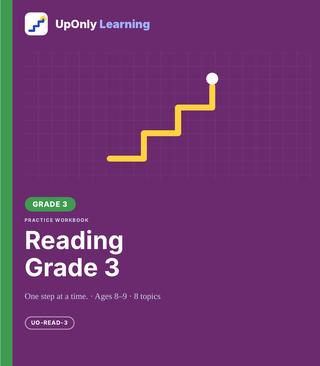
Printable reading workbook
960 questions on 222 printed pages for 3rd grade reading, with the answer key. Print as many copies as your household needs.
$19.99
See the workbookOne Step membership: every subject for 3rd grade
Reading, math, writing, science and more for your student's grade, step by step, with every flashcard set on screen and progress you can see. 1 student and 1 grade.
14 days free, then $9.99 a month. Cancel before day 15 and you pay nothing.
Try it: a 3rd grade reading comprehension passage
Your student reads this fact text alone, then answers the questions.
Sea Turtles Come Home
A loggerhead sea turtle hatches on a sandy beach, crawls into the ocean, and swims away. It may travel thousands of miles over many years. Then, when it is grown, a female often returns to lay her eggs on the same beach where she hatched.
How does she find her way? Scientists think sea turtles use Earth's magnetic field, an invisible force that surrounds our planet. Every part of the coast has its own magnetic "signature," a little like an address. Young turtles may remember the signature of their home beach.
Turtles face many dangers along the way, such as fishing nets and plastic in the water. People help by keeping beaches dark at night, so the hatchlings crawl toward the bright ocean instead of the lights of houses and roads.
- What is the main idea of the second paragraph?
Show the answer
Scientists think sea turtles use Earth's magnetic field to find their way back to their home beach.
Skill: Main idea
- Which words in the text show that sea turtles travel a long way?
Show the answer
"It may travel thousands of miles over many years."
Skill: Answering by referring to the text
- The author says a magnetic signature is "a little like an address." What does that mean?
Show the answer
Each place on the coast has its own pattern, so a turtle can tell where it is, the way an address tells you which house is which.
Skill: Literal and nonliteral language
- Why do people keep beaches dark at night?
Show the answer
So the hatchlings crawl toward the ocean instead of toward the lights of houses and roads.
Skill: Key details (why)
Questions to ask before, during and after reading
Before
- Look at the headings and bold words. What will you learn?
- What do you already know about this topic?
During
- Where does it say that? Put your finger on it.
- What does this phrase really mean? Is it literal?
- Why did the character do that? What does it tell you about them?
After
- What is the main idea? Which details support it?
- What is the central message of this fable? Which part shows it?
- Describe the main character with three words, and prove each one.
How to build 3rd grade reading comprehension at home
- Make "show me" a habitAfter every answer, ask: where does it say that? Students who point to the text answer more accurately.
- Main idea in one sentenceAfter a fact text, ask for the main idea in one sentence, then two details that support it.
- Character trait detectiveName a trait, such as brave or selfish, and find an action that proves it. Traits come from what characters do and say.
- Collect figurative phrasesWhen you meet phrases like "it's raining cats and dogs," talk about what they really mean. 3rd graders love these.
- Read across subjectsFact books on animals, space, history and how things work build the background knowledge that 3rd grade texts assume.
Signs a student may need more support
- Cannot find the sentence that answers a question, even with the text in front of them
- Main idea answers are a single detail instead of the big point
- Takes figurative phrases literally and gets confused
- Avoids reading longer chapter books or fact texts
Every student grows at a different pace. If you see several of these over a few weeks, try our free reading check and talk with the teacher. If you have concerns about learning or attention, a pediatrician or a school evaluation can help.
Free 3rd grade reading comprehension worksheets
The 3rd grade reading curriculum: all 8 topics →
One Step membership: every subject for 3rd grade
Reading, math, writing, science and more for your student's grade, step by step, with every flashcard set on screen and progress you can see. 1 student and 1 grade.
14 days free, then $9.99 a month. Cancel before day 15 and you pay nothing.
Questions parents ask
What reading comprehension skills should a 3rd grader have?
By the end of 3rd grade, students ask and answer questions by referring to the text, retell fables and explain the central message, describe characters' traits and motivations, tell literal from nonliteral language, find the main idea and supporting details, and use text features and search tools.
How can I improve my 3rd grader's reading comprehension?
Ask them to show you where in the text an answer is, practice main idea in one sentence, talk about character traits with proof, and read widely in science and history to build background knowledge.
Why is 3rd grade reading comprehension so important?
In 3rd grade, students begin to read to learn in every subject. Texts get longer and harder, so understanding what they read affects science, social studies and math word problems.
What is the difference between main idea and topic?
The topic is what the text is about, in a word or two, such as sea turtles. The main idea is the point the author makes about the topic, in a sentence.
Are your 3rd grade reading comprehension worksheets free?
There is a free printable sample topic with an answer key and free practice questions online. The full 3rd grade reading workbook is $19.99 as a PDF.
Reading comprehension in every grade
- Reading comprehension, K to 5: the full guide
- See kindergarten reading comprehension
- See 1st grade reading comprehension
- See 2nd grade reading comprehension
- See 4th grade reading comprehension
- See 5th grade reading comprehension
Related
Sources
- Shanahan, T., et al. (2010). Improving Reading Comprehension in Kindergarten Through 3rd Grade. What Works Clearinghouse, Institute of Education Sciences, U.S. Department of Education. https://ies.ed.gov/ncee/wwc/PracticeGuide/14
UpOnly Learning is a private educational publisher, not a school. These pages are general information for families and do not diagnose reading difficulties.