
8 reading topics · 4 comprehension topics
Kindergarten reading comprehension: skills, story questions and free worksheets
In kindergarten, comprehension grows mostly through listening. Students are still learning to read words, so they practice understanding with stories and fact books read aloud, then answer questions, name the characters and retell what happened.
By Dr. Evan J. Hasson, Founder, UpOnly Learning · Last checked:

In short
- With prompting and support, a kindergarten student answers who, what, where and why questions about a story read aloud.
- They name the characters, the setting and the main events, and tell what a simple fact book is mostly about.
- Comprehension at this age is built through read-alouds and talk, while phonics and sight words are taught at the same time.
The 4 reading comprehension skills in kindergarten
These are the comprehension topics in our kindergarten reading workbook, in teaching order. Each names the standard it addresses.
At this age, "with prompting and support" matters. A kindergarten student is not expected to answer on their own every time. You ask, you point to the picture, you reread the page, and the student learns how to find the answer.
- Asking and answering questions about a storyWith prompting, ask and answer who, what, where and why questions about key details
Reading: Literature (RL.K.1)· See the lesson → - Characters, setting and eventsWith prompting, name the characters, setting and major events in a story
Reading: Literature (RL.K.3)· See the lesson → - Main topic of a fact textWith prompting, tell what a nonfiction text is mostly about and retell key details
Reading: Informational Text (RI.K.2)· See the lesson → - Asking and answering questions about a true textWith prompting and support, ask and answer questions about key details in an informational text
Reading: Informational Text (RI.K.1)· See the lesson →
Comprehension starts with reading the words
Our kindergarten reading workbook also teaches the foundational skills that make comprehension possible:
- Concepts of print: Read left to right and top to bottom; words are separated by spaces; name upper- and lowercase letters
- Rhymes, syllables and sounds: Hear rhymes, clap syllables, and blend and say the sounds in short words
- Letter sounds and first sight words: Match letters to their most common sounds and read common high-frequency words
- Reading a simple story: Read an emergent-reader text with purpose and understanding
Build kindergarten reading comprehension, step by step
The same skills as this page, ready to use at home: online lessons that teach and check, flashcards that read aloud, and a printable workbook.
Online reading lessons
All 8 kindergarten reading topics as step-by-step lessons: a quick check, the lesson with worked examples, practice together, practice alone and a final check. Every answer is explained.
Try the free lesson
Reading Words flashcards
54 kindergarten reading words with pictures and audio, plus every grade from kindergarten to 8th. Missed cards come back until they stick.
$14.99 one-time (printable included) or $4.99 printable
Try the flashcards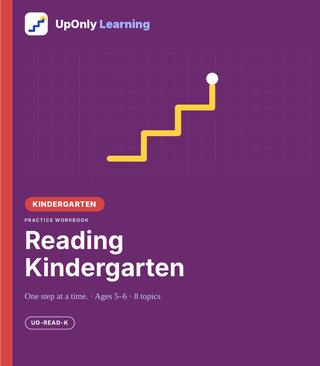
Printable reading workbook
904 questions on 180 printed pages for kindergarten reading, with the answer key. Print as many copies as your household needs.
$19.99
See the workbookOne Step membership: every subject for kindergarten
Reading, math, writing, science and more for your student's grade, step by step, with every flashcard set on screen and progress you can see. 1 student and 1 grade.
14 days free, then $9.99 a month. Cancel before day 15 and you pay nothing.
Try it: a kindergarten reading comprehension passage
Read this story aloud. Your student can follow along with a finger under the words.
Mia's Red Hat
Mia has a red hat. The wind blows. The hat flies up, up, up.
It lands in a tree. Dad gets a long stick. He gets the hat down.
Mia puts on her hat. She holds it with her hand.
- Who has a red hat?
Show the answer
Mia has a red hat.
Skill: Key detail (who)
- What made the hat fly away?
Show the answer
The wind blew it.
Skill: Key detail (what)
- Where did the hat land?
Show the answer
In a tree.
Skill: Setting and events (where)
- Why does Mia hold her hat with her hand at the end?
Show the answer
So the wind does not blow it away again. The story does not say this; your student figures it out from what happened.
Skill: Thinking beyond the text (why)
Questions to ask before, during and after reading
Before
- Look at the cover. Who do you think the story is about?
- What do you think will happen?
During
- Who is this? Where are they?
- What happened just now?
- How do you think she feels? Look at her face.
After
- Tell me the story. What happened first, next and last?
- What was your favorite part? Why?
- What was this book mostly about?
How to build kindergarten reading comprehension at home
- Read aloud every dayA short daily read-aloud, about 15 to 20 minutes, builds vocabulary and listening comprehension that students will later use when they read alone. Choose some books above their reading level, too.
- Stop and talk, but not too oftenTwo or three questions during a book are enough. Too many stops break the story.
- Retell with fingersFirst, next, then, last: one finger for each. Retelling in order is one of the best early checks of understanding.
- Mix stories and fact booksKindergarten students learn both: characters and events in stories, and the main topic in fact books about animals, weather or the community.
- Point to the picture and the wordsWhen your student answers, ask: how do you know? Point to the picture or the words together.
Signs a student may need more support
- Cannot retell a short story in order even after hearing it twice
- Answers questions with guesses that are not in the story
- Has trouble naming characters or the place where a story happens
- Struggles to follow two-step directions in everyday life
Every student grows at a different pace. If you see several of these over a few weeks, try our free reading check and talk with the teacher. If you have concerns about learning or attention, a pediatrician or a school evaluation can help.
Free kindergarten reading comprehension worksheets
The kindergarten reading curriculum: all 8 topics →
One Step membership: every subject for kindergarten
Reading, math, writing, science and more for your student's grade, step by step, with every flashcard set on screen and progress you can see. 1 student and 1 grade.
14 days free, then $9.99 a month. Cancel before day 15 and you pay nothing.
Questions parents ask
What reading comprehension skills should a kindergarten student have?
With prompting and support, they answer who, what, where and why questions about a story, name characters, setting and major events, retell familiar stories, and tell what a fact text is mostly about.
Can a kindergarten student work on comprehension before reading alone?
Yes. Kindergarten comprehension is mostly listening comprehension. Read aloud, ask questions and have your student retell. The same thinking skills transfer to reading alone later.
How long should we read each day in kindergarten?
A short daily session works well, about 15 to 20 minutes of reading aloud and talking, plus phonics practice. Consistency matters more than length.
What if my kindergarten student gives wrong answers?
That is normal at this age. Reread the page, point to the picture and ask again. The goal is to show how to find the answer in the story.
Are your kindergarten reading worksheets free?
There is a free printable sample topic with the lesson, practice and answer key, plus free practice questions online. The full kindergarten reading workbook is $19.99 as a PDF.
Reading comprehension in every grade
- Reading comprehension, K to 5: the full guide
- See 1st grade reading comprehension
- See 2nd grade reading comprehension
- See 3rd grade reading comprehension
- See 4th grade reading comprehension
- See 5th grade reading comprehension
Related
Sources
- Shanahan, T., et al. (2010). Improving Reading Comprehension in Kindergarten Through 3rd Grade. What Works Clearinghouse, Institute of Education Sciences, U.S. Department of Education. https://ies.ed.gov/ncee/wwc/PracticeGuide/14
UpOnly Learning is a private educational publisher, not a school. These pages are general information for families and do not diagnose reading difficulties.