
UpOnly Learning workbook · Learn Spanish
Learn Spanish workbook, level 5 (grades 9–10)
Printable PDF with an answer key
A printable Spanish workbook for English-speaking students in grades 9–10 (ages 14–16), and for adults at the same level. 12 topics, from “Spanish indirect and double object pronouns: le, les, se lo” to “Spanish reading comprehension: articles and formal letters”, with 1,440 practice questions and an answer key that explains every answer. Lessons and instructions are in English; every Spanish word has a simple pronunciation guide.
- 12topics
- 1,440practice questions
- 321printable pages
- 188pictures and diagrams
- 158read-aloud listening questions
Buy once, print as often as you need for your household. Free updates: your book stays in your account, so you always download the newest version.
Look inside
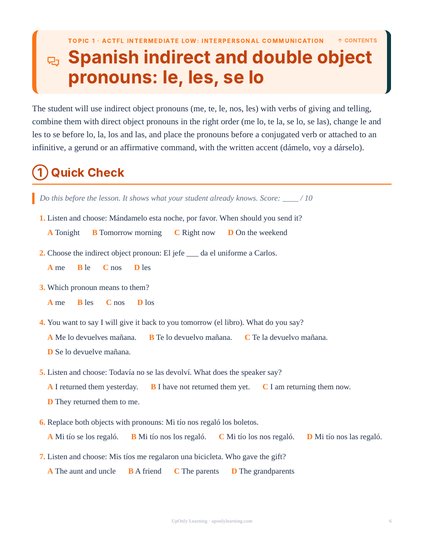
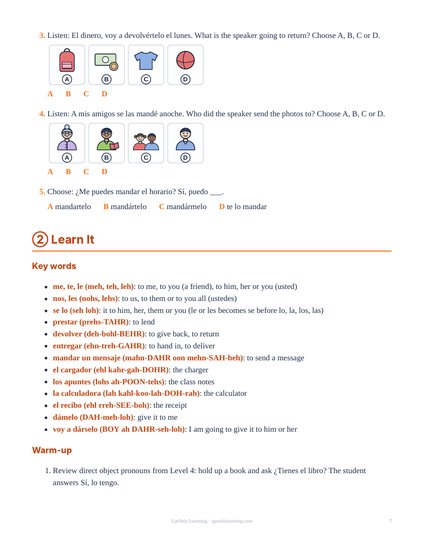
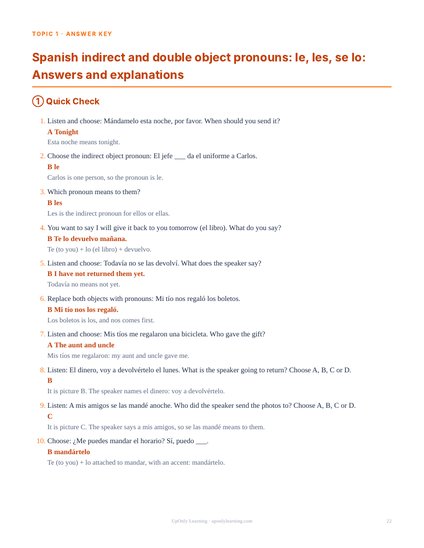
Real pages from topic 1, “Spanish indirect and double object pronouns: le, les, se lo”. Every topic in the book follows the same steps.
What your student will learn in level 5
Each topic builds on the one before it.
- Spanish indirect and double object pronouns: le, les, se loUse me, te, le, nos and les with verbs of giving and telling, combine them with lo, la, los and las (me lo, te la, se lo), change le and les to se, and attach pronouns to infinitives, gerunds and commands with the written accent: dámelo, voy a dárselo.
- Spanish present perfect: he comido, has visto, ¿alguna vez has...?Form the present perfect with haber and a past participle, including hecho, dicho, visto, escrito, puesto, vuelto, abierto and roto, talk about life experiences with ¿Alguna vez has...?, ya, todavía no and nunca, and use the preterite when a finished time is named.
- Spanish subjunctive for beginners: quiero que, espero que, ojaláForm the present subjunctive from the yo form (hablo, hable; tengo, tenga), with -car, -gar and -zar spelling changes, stem changes and the irregulars sea, esté, vaya, haya, sepa and dé, and use it after quiero que, espero que, te pido que and ojalá when the subject changes.
- Spanish subjunctive with feelings, advice and doubt: es importante que, dudo queUse the present subjunctive after emotion (me alegra que, me preocupa que), advice and impersonal expressions (es importante que, te recomiendo que) and doubt or denial (dudo que, no creo que), and the indicative after certainty (creo que, es verdad que), with health and well-being advice for teens.
- Spanish formal commands: at the doctor, at work and on signsUnderstand and give usted and ustedes commands (tome, venga, no coma, siéntese, abran), place pronouns correctly (dígame, no se preocupe), describe symptoms, follow a doctor, a pharmacist or a supervisor, read public signs and make polite requests with ¿Podría...?
- Spanish conditional tense: me gustaría, podría, ¿qué harías?Form the conditional (infinitive + -ía) and its irregular stems tendría, haría, diría, podría, saldría, vendría, pondría, sabría, querría and habría, and use it for polite requests (me gustaría, ¿podría...?), advice (deberías, yo en tu lugar...) and imagining (¿Qué harías con mil dólares?).
- Por vs para in Spanish: travel, gifts, time and reasonsChoose para for destination, recipient, deadline, purpose and opinion, and por for cause, exchange and price, duration, movement through a place, means and per, and use fixed expressions such as por favor, por eso, por fin, por ejemplo, por supuesto and para siempre.
- Preterite vs imperfect in stories: narrating the past in SpanishNarrate a connected past story with the imperfect for background (time, weather, feelings, ongoing actions), estaba + -ando or -iendo for an action in progress, the preterite for the events that move the story forward, and connectors such as mientras, de repente, entonces and al final.
- Spanish for part-time jobs: job interviews, se busca and formal emailsRead job ads with impersonal and passive se (se busca, se necesita, se habla español, se venden), answer interview questions with usted, use saber for skills and conocer for people and places, and write a short formal email with Estimado señor, Le escribo para and Atentamente.
- Giving opinions in Spanish: creo que, no creo que and debate phrasesGive and support opinions on teen topics (uniforms, phones in class, homework, social media), agree and disagree politely, use creo que + indicative and no creo que + subjunctive, and link ideas with además, sin embargo, por eso, por un lado... por otro lado and en conclusión.
- Spanish future plans: cuando + subjunctive, the environment and volunteeringTalk about plans after high school and community projects with the future and ir a + infinitive, use cuando, en cuanto, antes de que and para que + subjunctive for events that have not happened yet, contrast cuando + indicative for habits, and use environment and volunteering words.
- Spanish reading comprehension: articles and formal lettersRead original short articles, notices and a formal letter about life in Spanish-speaking countries today, find the main idea and details, infer word meaning from context, use the relative words que, quien, donde and lo que, and write a formal letter with greeting, purpose, details and closing.
How every topic works
- Quick Check: 10 questions to see what your student already knows
- Learn It: key words with pronunciation, step-by-step teaching you can read aloud, worked examples and common mistakes
- We Do It Together: 10 questions to work side by side
- You Try: up to 85 questions your student does alone, including listening questions
- Show What You Know: 15 new questions to see the progress
- Answer key: every answer, with a short explanation
What is in the free sample
- The cover, how to use the workbook and the table of contents
- One full topic, with its answers
Free with a free account. No card.
Who this Spanish workbook for kids is for
- Homeschool families who want a full Spanish course for grades 9–10 in one printable book
- Students who want daily practice at home, after school or over the summer
- Teachers and tutors who need ready-to-print practice with answers
- Adults who want to keep going at the right level
Questions parents ask
What level is this Spanish workbook for kids?
Level 5 is for grades 9–10, about ages 14–16. It works for adults too. The free Language check online shows which level fits your student.
Does it have pictures?
Yes. The book has 188 pictures and diagrams, used to teach new words and to ask questions like which picture shows a word.
How much time does each topic take?
About one week per topic: a lesson of about 40 minutes, then a page or two of practice a day.
Is there an answer key?
Yes. Every question has its answer and a short explanation, so a parent or teacher can check work and show why the answer is right.
Can I try it before I buy?
Yes. The free sample has the cover, how to use the workbook, the table of contents and one full topic with its answers.
Is it a PDF I can print?
Yes. It is a printable PDF of 321 pages. Buy it once and print it as often as you need for your household. It stays in your account, so you always download the newest version.
Keep exploring
- Learn Spanish level 5 curriculum (free lessons)
- Esta página en español
- Esta página em português
- Learn Spanish workbook, level 1 (grades K–1)
- Learn Spanish workbook, level 2 (grades 2–3)
- Learn Spanish workbook, level 3 (grades 4–5)
- Learn Spanish workbook, level 4 (grades 6–8)
- Learn Spanish workbook, level 6 (grades 11–12)
- Learn Spanish workbook, level 7 (adults)
- Free Learn Spanish level 5 worksheets
- Language flashcards
- The full curriculum