
High school math and science at home: 5 courses, 3 languages
Some families want extra practice next to a school class. Others teach high school at home. Both groups ask me the same thing: where can my student learn high school math and science at home, step by step, without a tutor at the table every night?
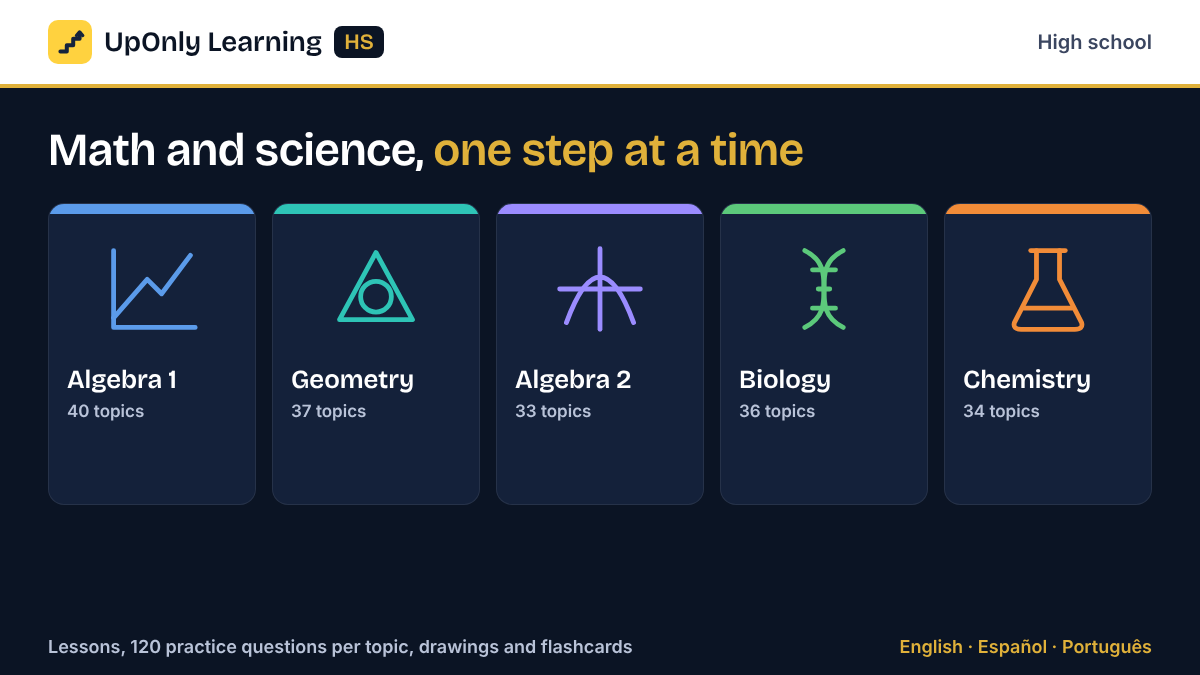
That is why UpOnly Learning now has five high school courses: Algebra 1, Geometry, Algebra 2, Biology and Chemistry. They sit in the member library next to Pre-K to 8th grade, in English, Spanish and Portuguese. Here is what is inside, how a lesson works, and how to pick a starting point.
The five courses at a glance
Together the courses have 180 topics. Each topic has a full lesson and 120 practice questions. Each course also has its own digital flashcard set with the key terms from its lessons, read aloud.
| Course | Often taken | Topics | Flashcards |
|---|---|---|---|
| Algebra 1 | Usually grade 8 or 9 | 40 | 238 |
| Geometry | Usually grade 9 or 10 | 37 | 238 |
| Algebra 2 | Usually grade 10 or 11 | 33 | 225 |
| Biology | Usually grade 9 or 10 | 36 | 283 |
| Chemistry | Usually grade 10 or 11 | 34 | 260 |
The grade levels are a guide, not a rule. A strong 8th grader may be ready for Algebra 1. A 10th grader may want to review it before Algebra 2. Algebra 1 runs from real numbers and linear equations to quadratics and data. Geometry covers proofs, transformations, trigonometry, circles and volume. Algebra 2 goes into polynomials, logarithms, the unit circle and statistics. Biology covers cells, genetics, evolution and ecosystems. Chemistry covers atoms, bonding, the mole, reactions, equilibrium and acids and bases.
What one topic looks like
Every high school topic follows the same six steps, so your student always knows what comes next.
- Quick Check. A few short questions on the skills the topic needs. If they go poorly, the lesson says to review the earlier skill first.
- Learn. The lesson itself, with worked examples and a list of common mistakes and what to do instead.
- Try it. Guided problems with hints and answers to check.
- Practice. Questions from the 120 in that topic, each with the answer.
- Show What You Know. 10 questions. 8 right is a pass. Your student answers without help and without notes.
- Come back another day. A few days later, a 5-question review opens. The topic counts as mastered only when that review is passed too.
Geometry, graphs, cells and molecules are hard to explain with words alone, so the lessons use clear drawings for their figures. Each lesson also lists its sources.
Written for the student, with notes for you
Each lesson speaks to the student. It starts with a goal in plain words, such as "By the end, you will be able to sort any real number into its number family." A teenager can read it, work the examples and practice alone.
You still have a role. Each lesson has a short box called For parents and teachers, with a tip on how to help when your student gets stuck. You do not need to remember chemistry from your own school days. You need to know what to ask, and the box tells you.

Supplementing school or teaching at home
If your student takes the class at school
Find the topic the class is on this week and use it as a second explanation. A second explanation, in different words, can help a hard idea make sense. The practice questions and the 5-question review help the skill last until the test.
If you teach high school at home
Go through a course in order, one topic at a time. The steps give you a clear record: Quick Check, lesson, practice, a pass on Show What You Know and a review a few days later. You set the pace.
Where to start
Algebra 1 rests on middle school skills: fractions, negative numbers and simple equations. If those feel shaky, start with the free placement test. It covers math, reading and English from kindergarten to 8th grade and shows the first gaps to fill. Then open the first Algebra 1 topic in the library. The Quick Check at the top of each topic is also a good early signal.
How these courses connect to college
Colleges look at high school math and science. Here are three examples from official sources. They are examples, not rules for every college.
- The University of California asks first-year applicants for three years of college-preparatory math covering elementary and advanced algebra and two- and three-dimensional geometry, and two years of science in two of biology, chemistry or physics.
- The AAMC says high school students who want to become doctors should take as many math and science classes as they can.
- One engineering college, at the University of Nebraska-Lincoln, asks for 4 units of high school math, including Algebra I, Algebra II and geometry, and 3 units of science that include physics and chemistry.
Physics and precalculus are not part of the library yet, so plan for them separately. Our pre-health guide and engineering majors page list the college courses on each path. Under each one, "Get ready with these topics" links straight to the matching high school lesson and flashcard set. The full College Prep section covers majors, test prep and paying for college.
What it costs
The five courses come with an Every Step membership: $29.99 a month, $249 a year, or $1,199 once for Lifetime. Every Step covers up to 10 students in your home, and members can use all five high school flashcard decks on screen.
If you only want the flashcards, each high school set is $14.99 one-time for the digital version. The All Flashcards pass is $49.99 and opens all 17 sets, including new ones. Every deck has 10 free cards to try first.
A simple next step
Start free. Take the placement test if you are not sure about the basics, and try the free cards in the high school flashcards. When you are ready for the full lessons, choose a membership. One topic at a time is enough.
Common questions
Can a student learn Algebra 1 at home?
Yes. Each Algebra 1 topic in UpOnly Learning has a lesson written to the student, guided problems, 120 practice questions and a short test, so a motivated student can work through it alone with a parent checking in.
What order should high school math be taken in?
A common order is Algebra 1, then Geometry, then Algebra 2. Algebra 1 is often taken in grade 8 or 9, Geometry in grade 9 or 10 and Algebra 2 in grade 10 or 11.
Are the high school courses in Spanish and Portuguese?
Yes. All five courses and their flashcard sets are in English, Spanish and Portuguese.
Is there online algebra 1 practice with answers?
Each of the 40 Algebra 1 topics has 120 practice questions with answers, plus a 10-question Show What You Know and a 5-question review a few days later.
Are the high school flashcards included with membership?
Yes. Every Step members can use all five high school decks on screen. Without a membership, each set is $14.99, or $49.99 for the All Flashcards pass.