
UpOnly Learning presents
Math drill books: printable worksheets from addition to equations
Foundational Math Practice Drills: 9 books, one step a page, with the answers after every page
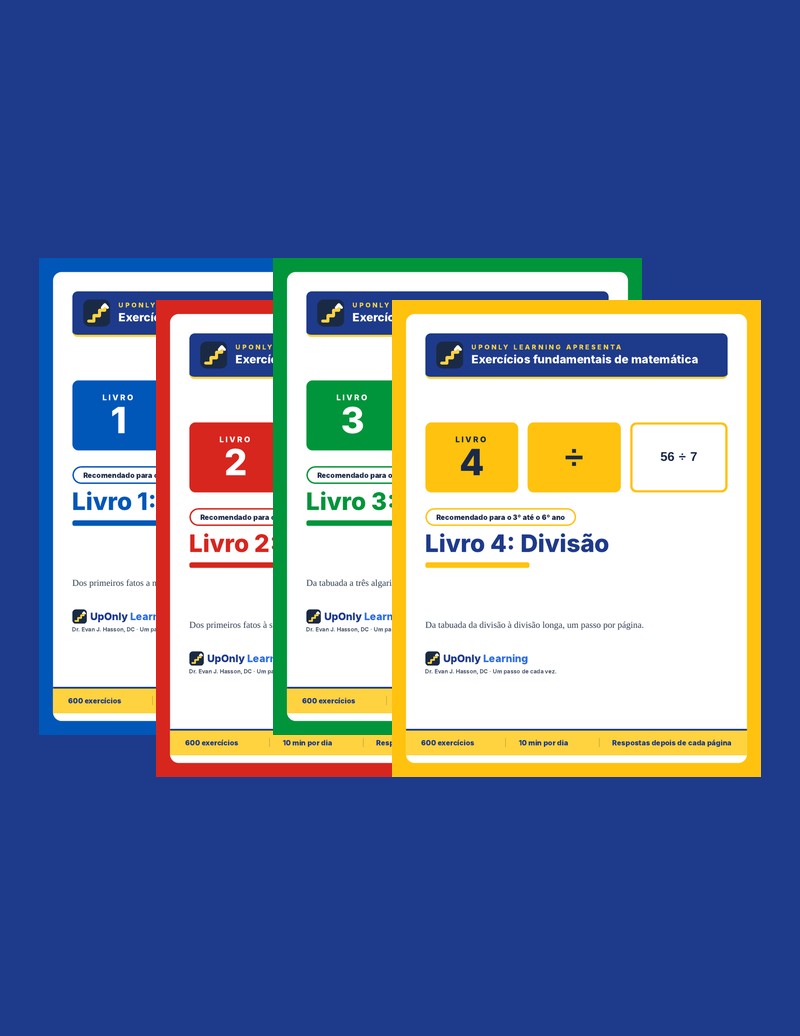
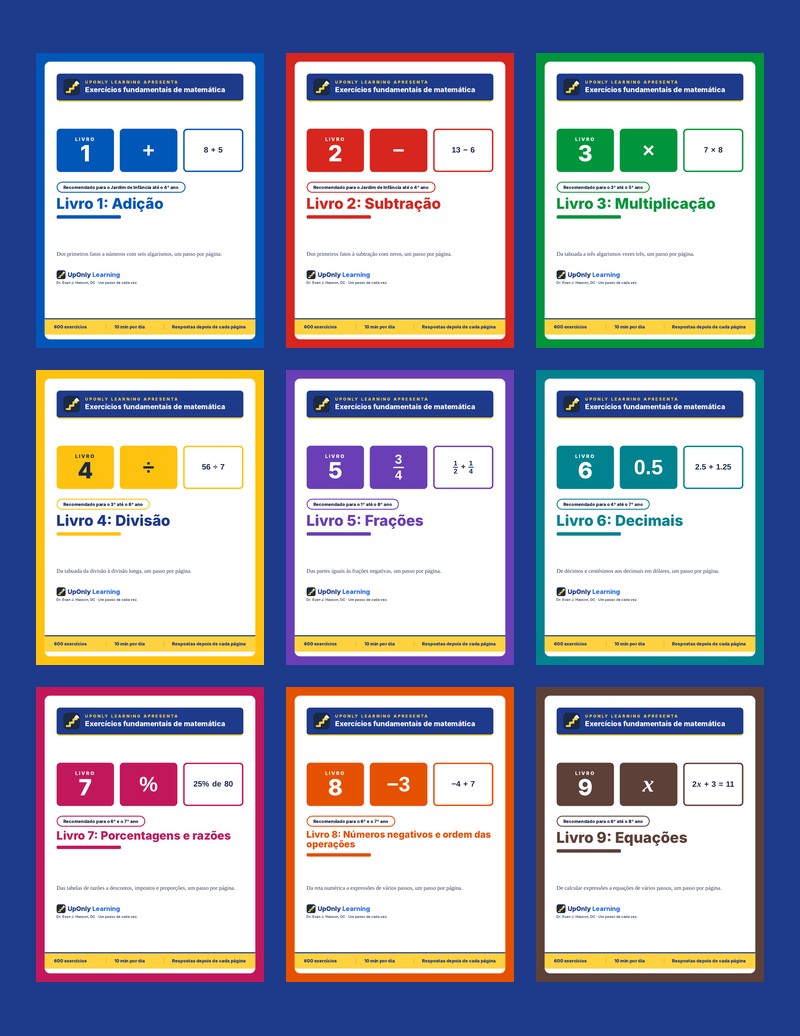
Foundational Math Practice Drills is a series of nine printable math drill books by UpOnly Learning. Each book has 600 questions on 30 practice pages, and every practice page is followed by its answer page. The books go in order, from first addition facts in kindergarten to solving equations in grade 8, so a student can start where they are and keep going. Each book is $9.99, in English, Spanish or Portuguese, with a free sample to try first.
- 9 books
- 5,400 questions
- 773 pages
- Grades K–8
- English, Spanish, Portuguese
What a math drill book is, and why drill matters
A drill book is short, focused practice. It does not replace lessons. It gives students the steady practice that turns a skill they have learned into a skill they own.
When facts and steps become automatic, students can put their attention on thinking and solving problems instead of on the arithmetic. That is the idea behind the series: one small step per page, about 10 minutes a day, with the answers right there to check.
An IES practice guide for students who struggle in math recommends that interventions at all grade levels spend about 10 minutes in each session building fluent recall of arithmetic facts (moderate evidence)[1]. The same guide recommends in-depth work on whole numbers in kindergarten through grade 5 and on rational numbers, such as fractions and decimals, in grades 4 through 8 (minimal evidence)[1]. The series follows that shape: Books 1 to 4 work with whole numbers, and Books 5 to 9 move on to fractions, decimals, percents, negative numbers and equations.
We do not claim that any book changes test scores. The research shaped how the books are built: short daily practice, one step at a time, with a check after every page.
How every book works
- Each book has 30 practice pages of 20 questions: 600 questions in all.
- Every practice page is followed by its answer page. Printed double-sided, the answers are on the back.
- A starting check shows which page to begin on.
- Before each new step, a "How to do it" page shows the rule with worked examples.
- Write the score in the Correct: ___ / 20 box and color the page on the progress chart. 18 or more correct: go on to the next page.
- Each section names the grade it practices, so a student can start at their own level.
- One practice page a day takes about 10 minutes.
The order: how the 9 books build on each other
The books are numbered in the order most students meet these topics, and each one uses skills from the books before it. The grade bands overlap, so a student can work in two books at once, for example finishing Book 2 while starting the times tables in Book 3.
- Book 1: AdditionGrades K–4Starts with adding 0, 1 or 2 and ends with six-digit numbers. It comes first because every other book uses addition.
- Book 2: SubtractionGrades K–4Comes after addition because one of its strategies is "think addition": 13 − 6 asks 6 + ? = 13. Regrouping a ten mirrors carrying the 1 in Book 1.
- Book 3: MultiplicationGrades 3–5Multiplication is repeated addition, and multiplying by two or more digits ends by adding the rows, so it follows the addition and subtraction books. The times tables 0 to 12 learned here are the base of Book 4.
- Book 4: DivisionGrades 3–6The book starts with "think multiplication": 56 ÷ 7 asks 7 × ? = 56. Long division then multiplies and subtracts at every step, so it comes after Books 2 and 3.
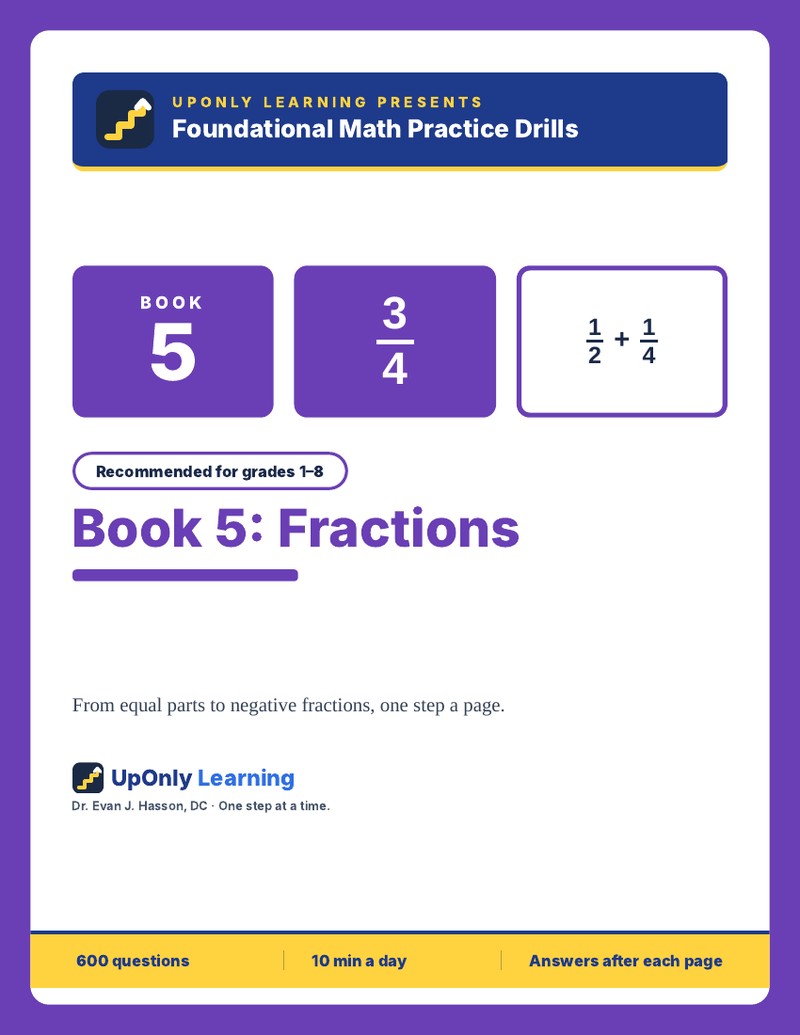
- Book 5: FractionsGrades 1–8Fractions need multiplication and division: equivalent fractions and simplest form multiply or divide the top and bottom by the same number. This book has the widest range: its first section, equal parts, is for grades 1 and 2, and its last pages reach negative fractions and order of operations for grades 6 to 8. A student can do the early sections alongside Books 1 to 4 and come back for the rest.
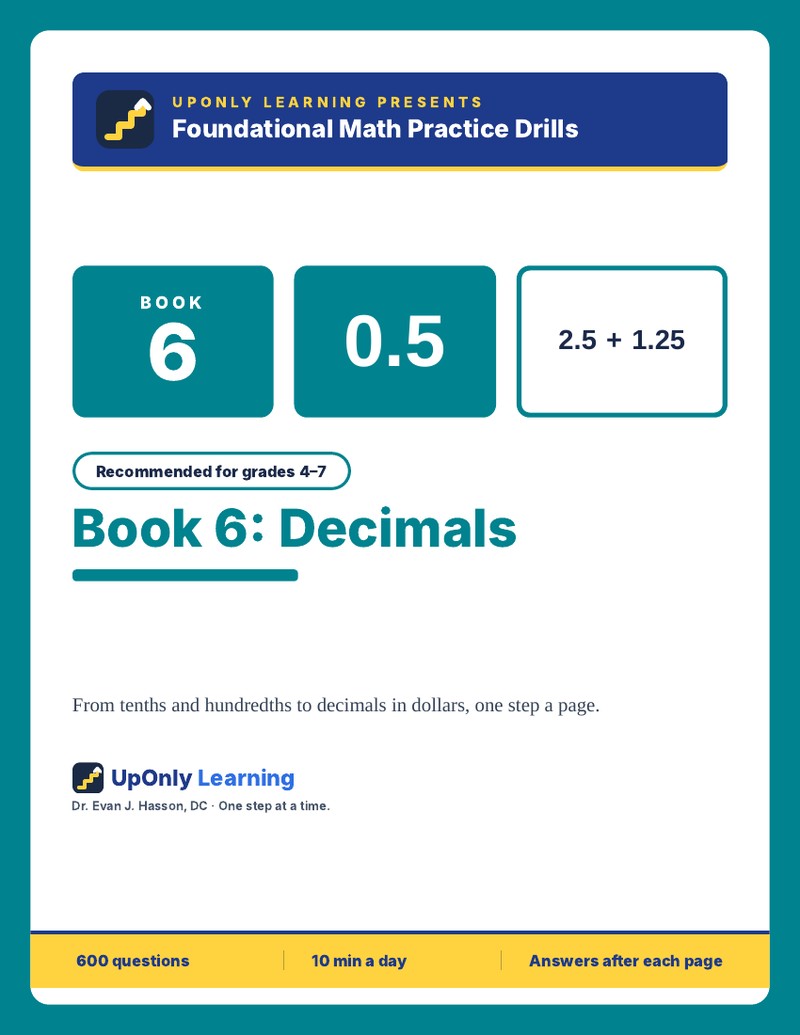
- Book 6: DecimalsGrades 4–7Decimals are fractions written in tenths, hundredths and thousandths, so Book 5 comes first. Dividing decimals uses the long division of Book 4, and the last sections turn fractions into decimals and percents.
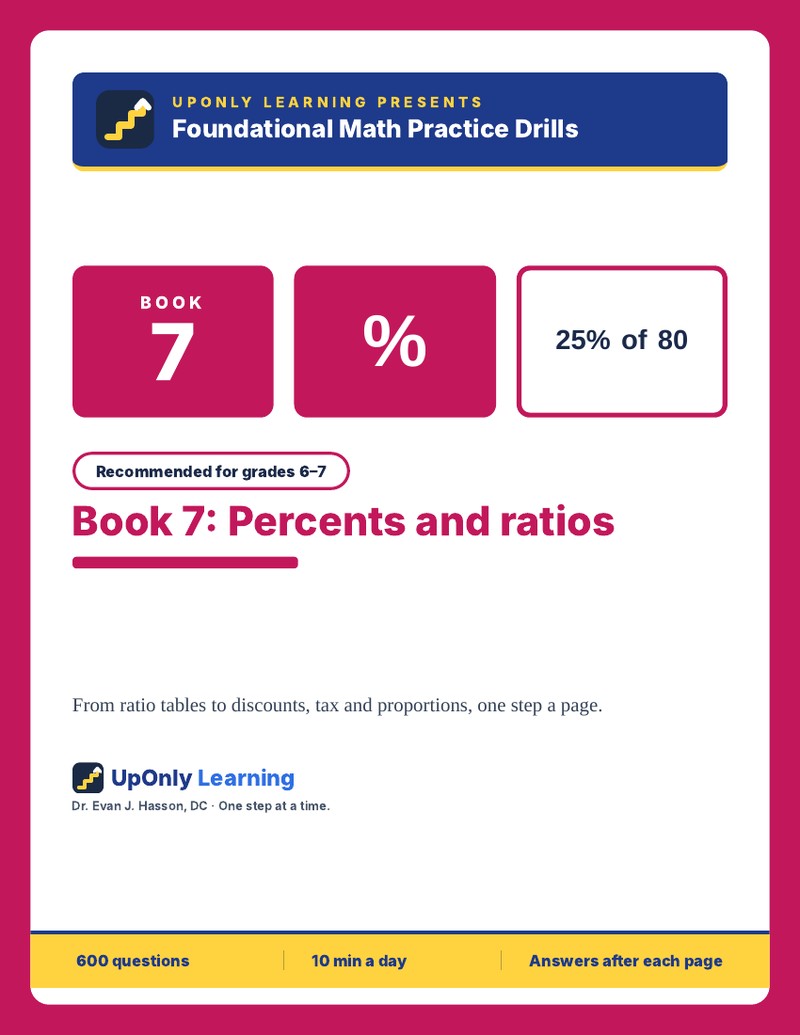
- Book 7: Percents and ratiosGrades 6–7A percent is a number of hundredths, so this book builds on fractions and decimals: unit prices to the nearest cent, percents as fractions and decimals, discounts, tax, tips and simple interest. It ends with proportions, the first equation most students use.
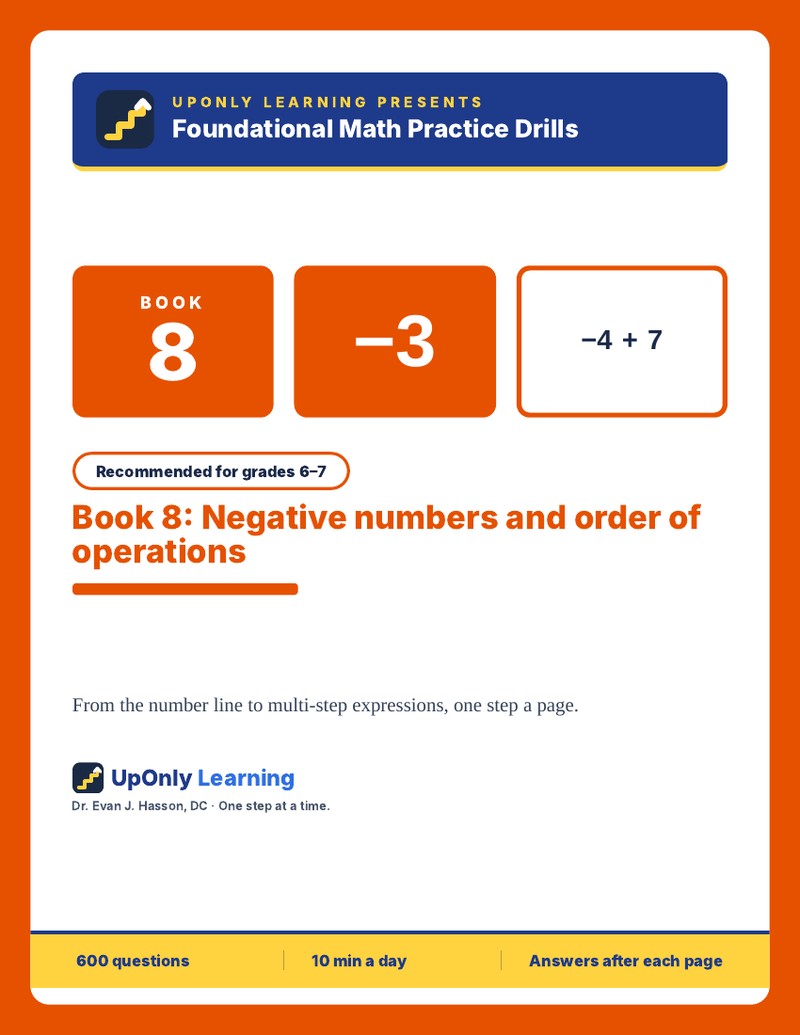
- Book 8: Negative numbers and order of operationsGrades 6–7This book takes every operation below zero, including negative fractions and decimals, and then sets the order of operations for expressions with several steps. Equations need both.
- Book 9: EquationsGrades 6–8The last book puts it all together: evaluating expressions uses the order of operations, solving uses inverse operations with negative numbers, fractions and decimals, and the final pages are inequalities and word problems.
- Grades K–4
- 85 pages
Addition worksheets printable book
Book 1: Addition
From first facts to six-digit numbers, one step a page.
What it is
Foundational Math Practice Drills · Book 1: Addition is a printable book of 600 addition questions, one step a page: from first facts to six-digit numbers. The steps: single digits, then two digits, then three digits, then four to six digits.
Why it matters
Addition is the base of everything that follows: subtraction, multiplication and every problem with several digits use it. When the addition facts and carrying become automatic, students can put their attention on thinking and solving problems. A few minutes of practice each day adds up, one step at a time.
Who it is for
Recommended for grades K–4. Each section names the grade it practices, so a student can start at their own level.
Topics and subtopics, in order
- Single digitsKindergarten to grade 210 practice pages
- How to do it: count on
- Page 1: add 0, 1 or 2
- Page 2: add 0, 1 or 2 to bigger numbers
- How to do it: doubles
- Page 3: doubles to 5 + 5
- Page 4: doubles to 9 + 9
- How to do it: make ten
- Page 5: make ten
- Page 6: make ten to add 8 and 9
- How to do it: near doubles
- Page 7: near doubles
- Page 8: near doubles, one or two apart
- Page 9: sums from 11 to 18
- Page 10: all facts mixed
- Two digitsGrade 27 practice pages
- How to do it: add in columns
- Page 11: two-digit plus one-digit, no regrouping
- Page 12: two-digit plus two-digit, no regrouping
- How to do it: carry the 1
- Page 13: two-digit plus one-digit, regroup ones
- Page 14: two-digit plus two-digit, regroup ones
- Page 15: two-digit, with and without regrouping
- Page 16: sums over 100
- Page 17: two-digit review
- Three digitsGrade 36 practice pages
- How to do it: three-digit numbers
- Page 18: three-digit, no regrouping
- Page 19: three-digit, regroup ones
- Page 20: three-digit, regroup tens
- Page 21: three-digit, regroup in two places
- Page 22: three-digit, sums near 1,000
- Page 23: three-digit review
- Four to six digitsGrade 47 practice pages
- How to do it: big numbers
- Page 24: four-digit, no regrouping
- Page 25: four-digit, regroup once
- Page 26: four-digit, regroup two or three times
- Page 27: four-digit, sums over 10,000
- Page 28: five-digit numbers
- Page 29: six-digit numbers, up to 1,000,000
- Page 30: four- to six-digit review
What is included
- 85 pages
- 600 questions on 30 practice pages, 20 per page
- An answer page after every practice page
- 8 "How to do it" pages with worked examples
- A starting check and a progress chart
- Free updates: your book stays in your account, so you always download the newest version
One-time purchase, no subscription. Book 1: Addition, full details
- Grades K–4
- 85 pages
Subtraction worksheets printable book
Book 2: Subtraction
From first facts to subtracting across zeros, one step a page.
What it is
Foundational Math Practice Drills · Book 2: Subtraction is a printable book of 600 subtraction questions, one step a page: from first facts to subtracting across zeros. The steps: single digits, then two digits, then three digits, then four to six digits.
Why it matters
Subtraction is the other half of addition, and students use it every time they find a difference, make change or check an answer. Regrouping and subtracting across zeros each get their own pages, with a "How to do it" page before them. When those steps become automatic, students can put their attention on thinking and solving problems. A few minutes of practice each day adds up, one step at a time.
Who it is for
Recommended for grades K–4. Each section names the grade it practices, so a student can start at their own level.
Topics and subtopics, in order
- Single digitsKindergarten to grade 210 practice pages
- How to do it: take away
- Page 1: within 5
- Page 2: take away 0, 1 or 2
- Page 3: within 10
- How to do it: think addition
- Page 4: take away from 10
- Page 5: within 10, mixed
- Page 6: from the teens, answers of 10 or more
- How to do it: back through ten
- Page 7: from 11 to 13, back through ten
- Page 8: from 14 to 16, back through ten
- Page 9: from the teens, mixed
- Page 10: all facts mixed
- Two digitsGrade 27 practice pages
- How to do it: subtract in columns
- Page 11: two-digit minus one-digit, no regrouping
- Page 12: two-digit minus two-digit, no regrouping
- How to do it: regroup a ten
- Page 13: two-digit minus one-digit, regroup a ten
- Page 14: two-digit minus two-digit, regroup a ten
- Page 15: take away from a ten (60 − 27)
- Page 16: two-digit review
- Page 17: from numbers up to 198
- Three digitsGrade 36 practice pages
- How to do it: three-digit numbers
- Page 18: three-digit, no regrouping
- Page 19: three-digit, regroup a ten
- Page 20: three-digit, regroup a hundred
- Page 21: three-digit, regroup in two places
- How to do it: across zeros
- Page 22: three-digit, across zeros (400 − 178)
- Page 23: three-digit review
- Four to six digitsGrade 47 practice pages
- How to do it: big numbers
- Page 24: four-digit, no regrouping
- Page 25: four-digit, regroup once
- Page 26: four-digit, regroup two or three times
- Page 27: four-digit, across zeros (5,000 − 2,368)
- Page 28: five-digit numbers
- Page 29: six-digit numbers, across zeros
- Page 30: four- to six-digit review
What is included
- 85 pages
- 600 questions on 30 practice pages, 20 per page
- An answer page after every practice page
- 8 "How to do it" pages with worked examples
- A starting check and a progress chart
- Free updates: your book stays in your account, so you always download the newest version
One-time purchase, no subscription. Book 2: Subtraction, full details
- Grades 3–5
- 93 pages
Multiplication drills printable book
Book 3: Multiplication
From times tables to three-digit by three-digit numbers, one step a page.
What it is
Foundational Math Practice Drills · Book 3: Multiplication is a printable book of 600 multiplication questions, one step a page: from times tables to three-digit by three-digit numbers. The steps: times tables 0 to 12, then one-digit multipliers, then two-digit multipliers, then larger numbers.
Why it matters
The times tables come back in division, fractions, area and almost every topic after them. When the facts to 12 × 12 and the steps of multiplying by several digits become automatic, students can put their attention on thinking and solving problems. A few minutes of practice each day adds up, one step at a time.
Who it is for
Recommended for grades 3–5. Each section names the grade it practices, so a student can start at their own level.
Topics and subtopics, in order
- Times tables 0 to 12Grade 311 practice pages
- How to do it: times 0, 1, 2 and 10
- Page 1: times 0 and times 1
- Page 2: times 2 and times 10
- How to do it: times 5
- Page 3: times 5
- Page 4: times 0, 1, 2, 5 and 10 mixed
- How to do it: times 3 and times 4
- Page 5: times 3
- Page 6: times 4
- How to do it: times 6 and times 7
- Page 7: times 6
- Page 8: times 7
- How to do it: times 8 and times 9
- Page 9: times 8 and times 9
- How to do it: missing factors, 11 and 12
- Page 10: all facts, with missing factors
- Page 11: times 11 and times 12
- One-digit multipliersGrades 3–47 practice pages
- How to do it: times tens, hundreds and thousands
- Page 12: one digit times tens (3 × 40)
- Page 13: one digit times hundreds and thousands
- How to do it: multiply in columns
- Page 14: two-digit times one-digit, no regrouping
- How to do it: carrying in multiplication
- Page 15: two-digit times one-digit, regrouping
- Page 16: three-digit times one-digit
- Page 17: three-digit times one-digit, regrouping
- Page 18: four-digit times one-digit
- Two-digit multipliersGrade 43 practice pages
- How to do it: two-digit multipliers
- Page 19: two-digit times tens (24 × 30)
- Page 20: two-digit times two-digit, up to 25
- Page 21: two-digit times two-digit
- Larger numbersGrade 59 practice pages
- How to do it: three- and four-digit numbers times two digits
- Page 22: three-digit times 11 to 29
- Page 23: three-digit times two-digit
- Page 24: three-digit with a zero times two-digit (306 × 47)
- Page 25: four-digit times 11 to 29
- Page 26: four-digit times two-digit
- How to do it: three-digit multipliers
- Page 27: three-digit times 101 to 199
- Page 28: three-digit times three-digit
- Page 29: review: three- and four-digit times two-digit
- Page 30: review: the longest problems
What is included
- 93 pages
- 600 questions on 30 practice pages, 20 per page
- An answer page after every practice page
- 12 "How to do it" pages with worked examples
- A starting check and a progress chart
- Free updates: your book stays in your account, so you always download the newest version
One-time purchase, no subscription. Book 3: Multiplication, full details
- Grades 3–6
- 85 pages
Long division worksheets printable book
Book 4: Division
From division facts to long division, one step a page.
What it is
Foundational Math Practice Drills · Book 4: Division is a printable book of 600 division questions, one step a page: from division facts to long division. The steps: division tables, then one-digit divisors, then two-digit divisors, then long division.
Why it matters
Division is multiplication run backwards, and long division brings together skills from Books 1 to 3: multiplying, subtracting and bringing down the next digit. It is also the step before fractions: simplifying a fraction and writing it as a decimal both use division. When those steps become automatic, students can put their attention on thinking and solving problems. A few minutes of practice each day adds up, one step at a time.
Who it is for
Recommended for grades 3–6. Each section names the grade it practices, so a student can start at their own level.
Topics and subtopics, in order
- Division tablesGrade 310 practice pages
- How to do it: think multiplication
- Page 1: divide by 1 and 2
- Page 2: divide by 5 and 10
- Page 3: divide by 1, 2, 5 and 10 mixed
- How to do it: dividing by 3 to 9
- Page 4: divide by 3
- Page 5: divide by 4
- Page 6: divide by 6
- Page 7: divide by 7
- Page 8: divide by 8 and 9
- Page 9: all facts, with missing numbers
- Page 10: answers of 11 and 12
- One-digit divisorsGrade 48 practice pages
- How to do it: long division
- Page 11: two-digit by one-digit, no remainder (68 ÷ 2)
- Page 12: two-digit by one-digit, regrouping (72 ÷ 4)
- How to do it: remainders
- Page 13: remainders, one-digit answers (47 ÷ 6)
- Page 14: remainders, two-digit answers
- How to do it: three- and four-digit numbers
- Page 15: three-digit by one-digit
- Page 16: three-digit by one-digit, remainders
- Page 17: four-digit by one-digit
- Page 18: four-digit by one-digit, remainders
- Two-digit divisorsGrade 58 practice pages
- How to do it: two-digit divisors
- Page 19: divide by tens (240 ÷ 30)
- Page 20: two-digit divisors, one-digit answers
- Page 21: three-digit by two-digit
- Page 22: four-digit by two-digit
- How to do it: zeros in the quotient
- Page 23: zeros in the answer, one-digit divisors
- Page 24: zeros in the answer, two-digit divisors
- Page 25: three-digit by two-digit, remainders
- Page 26: four-digit by two-digit, remainders
- Long divisionGrade 64 practice pages
- How to do it: long division with large numbers
- Page 27: five-digit by two-digit
- Page 28: five-digit by two-digit, remainders
- Page 29: five- and six-digit by three-digit
- Page 30: long division review
What is included
- 85 pages
- 600 questions on 30 practice pages, 20 per page
- An answer page after every practice page
- 8 "How to do it" pages with worked examples
- A starting check and a progress chart
- Free updates: your book stays in your account, so you always download the newest version
One-time purchase, no subscription. Book 4: Division, full details
- Grades 1–8
- 85 pages
Fraction worksheets printable book
Book 5: Fractions
From equal parts to negative fractions, one step a page.
What it is
Foundational Math Practice Drills · Book 5: Fractions is a printable book of 600 fraction questions, one step a page: from equal parts to negative fractions. The steps: equal parts and number lines, then equivalent fractions and mixed numbers, then adding, subtracting, multiplying and dividing, then decimals and negative fractions.
Why it matters
Fractions are where many students first get stuck in math, and almost everything after them depends on them: decimals, percents, ratios, measurement and algebra. When naming, comparing and working with fractions becomes automatic, students can put their attention on thinking and solving problems. A few minutes of practice each day adds up, one step at a time.
Who it is for
Recommended for grades 1–8. Each section names the grade it practices, so a student can start at their own level.
Topics and subtopics, in order
- Equal partsGrades 1–23 practice pages
- How to do it: equal parts
- Page 1: name the equal parts
- Page 2: write the shaded fraction
- Page 3: unit fractions
- Fractions on a number lineGrade 34 practice pages
- How to do it: number lines, groups and comparing
- Page 4: fractions on a number line
- Page 5: fractions of a group
- Page 6: compare: same denominator
- Page 7: compare: same numerator
- Equivalent fractionsGrades 3–44 practice pages
- How to do it: equivalent fractions and simplest form
- Page 8: equivalent fractions with pictures
- Page 9: equivalent fractions: multiply
- Page 10: equivalent fractions: divide
- Page 11: simplest form
- Mixed numbersGrade 43 practice pages
- How to do it: mixed numbers and improper fractions
- Page 12: improper fractions to mixed numbers
- Page 13: mixed numbers to improper fractions
- Page 14: compare: different denominators
- Adding and subtractingGrades 4–55 practice pages
- How to do it: adding and subtracting fractions
- Page 15: add: same denominator
- Page 16: subtract: same denominator
- Page 17: add: different denominators
- Page 18: subtract: different denominators
- Page 19: mixed numbers: add and subtract
- MultiplyingGrades 4–54 practice pages
- How to do it: multiplying fractions
- Page 20: fraction times a whole number
- Page 21: fraction times a fraction
- Page 22: multiply mixed numbers
- Page 23: fraction of an amount
- DividingGrades 5–63 practice pages
- How to do it: dividing fractions
- Page 24: divide with whole numbers
- Page 25: fraction divided by a fraction
- Page 26: divide mixed numbers
- Fractions, decimals and negativesGrades 6–84 practice pages
- How to do it: decimals, negatives and order of operations
- Page 27: fractions and decimals
- Page 28: negative fractions: add and subtract
- Page 29: negative fractions: multiply and divide
- Page 30: order of operations
What is included
- 85 pages
- 600 questions on 30 practice pages, 20 per page
- An answer page after every practice page
- 8 "How to do it" pages with worked examples
- A starting check and a progress chart
- Free updates: your book stays in your account, so you always download the newest version
One-time purchase, no subscription. Book 5: Fractions, full details
- Grades 4–7
- 85 pages
Decimal worksheets printable book
Book 6: Decimals
From tenths and hundredths to decimals in dollars, one step a page.
What it is
Foundational Math Practice Drills · Book 6: Decimals is a printable book of 600 decimal questions, one step a page: from tenths and hundredths to real-world decimals in dollars. The steps: tenths and hundredths with grids and money, then place value, comparing, ordering and rounding, then adding, subtracting, multiplying and dividing decimals, then decimals, fractions and percents and real-world decimals in dollars.
Why it matters
Decimals are the numbers of everyday life: prices, change, measurements, sports scores and grades are all written with a decimal point. They also link fractions to percents, which students need for science, money and algebra. When place value, rounding and the four operations with decimals become automatic, students can put their attention on thinking and solving problems. A few minutes of practice each day adds up, one step at a time.
Who it is for
Recommended for grades 4–7. Each section names the grade it practices, so a student can start at their own level.
Topics and subtopics, in order
- Tenths and hundredthsGrade 43 practice pages
- How to do it: tenths and hundredths
- Page 1: tenths and hundredths grids
- Page 2: tenths and hundredths as decimals
- Page 3: money as decimals
- Place value, compare and orderGrades 4–54 practice pages
- How to do it: place value, comparing and ordering
- Page 4: place value to thousandths
- Page 5: compare decimals
- Page 6: order decimals
- Page 7: decimals on a number line
- Rounding and estimatingGrade 53 practice pages
- How to do it: rounding and estimating
- Page 8: round to the nearest whole number and tenth
- Page 9: round to the nearest hundredth, dollar and cent
- Page 10: estimate
- Adding and subtractingGrades 5–64 practice pages
- How to do it: adding and subtracting decimals
- Page 11: add decimals
- Page 12: subtract decimals
- Page 13: add and subtract longer decimals
- Page 14: add and subtract money
- MultiplyingGrades 5–64 practice pages
- How to do it: multiplying decimals
- Page 15: multiply by 10, 100 and 1,000
- Page 16: decimal times a whole number
- Page 17: decimal times a decimal
- Page 18: multiply money and longer decimals
- DividingGrades 5–64 practice pages
- How to do it: dividing decimals
- Page 19: divide by 10, 100 and 1,000
- Page 20: decimal divided by a whole number
- Page 21: divide by a decimal
- Page 22: divide money and longer decimals
- Decimals, fractions and percentsGrades 6–74 practice pages
- How to do it: decimals, fractions and percents
- Page 23: fractions to decimals
- Page 24: decimals to fractions
- Page 25: decimals and percents
- Page 26: fractions and percents
- Real-world decimalsGrades 6–74 practice pages
- How to do it: decimals in everyday life
- Page 27: total cost and change
- Page 28: unit prices
- Page 29: measurement with decimals
- Page 30: mixed operations
What is included
- 85 pages
- 600 questions on 30 practice pages, 20 per page
- An answer page after every practice page
- 8 "How to do it" pages with worked examples
- A starting check and a progress chart
- Free updates: your book stays in your account, so you always download the newest version
One-time purchase, no subscription. Book 6: Decimals, full details
- Grades 6–7
- 85 pages
Percent and ratio worksheets printable book
Book 7: Percents and ratios
From ratio tables to discounts, tax and proportions, one step a page.
What it is
Foundational Math Practice Drills · Book 7: Percents and ratios is a printable book of 600 percent and ratio questions, one step a page: from ratio tables to percent change, discounts and proportions. The steps: ratio language and ratio tables, then equivalent ratios and unit rates, then percents, fractions and decimals, then percent of a number and finding the whole, then percent change, discounts, tax, tips and simple interest, then proportions and scale.
Why it matters
Ratios and percents are the math of everyday life: prices, sales, tax, tips, speed, recipes, maps and interest. They also open the door to algebra, because a proportional relationship is the first equation most students use. When finding a unit rate or a percent becomes automatic, students can put their attention on thinking and solving problems. A few minutes of practice each day adds up, one step at a time.
Who it is for
Recommended for grades 6–7. Each section names the grade it practices, so a student can start at their own level.
Topics and subtopics, in order
- Ratio language and ratio tablesGrade 64 practice pages
- How to do it: ratios and ratio tables
- Page 1: ratios from pictures: part to part
- Page 2: ratios from pictures: part to whole
- Page 3: ratios in simplest form
- Page 4: ratio tables
- Equivalent ratiosGrade 63 practice pages
- How to do it: equivalent ratios
- Page 5: equivalent ratios: multiply
- Page 6: equivalent ratios: divide
- Page 7: equivalent ratios: simplify first
- Unit rates and unit pricesGrades 6–74 practice pages
- How to do it: unit rates and unit prices
- Page 8: unit rates
- Page 9: unit rates with decimals and fractions
- Page 10: unit prices
- Page 11: unit prices to the nearest cent
- Percents, fractions and decimalsGrade 64 practice pages
- How to do it: percents, fractions and decimals
- Page 12: percent means per 100
- Page 13: percents to fractions
- Page 14: percents and decimals
- Page 15: fractions to percents
- Percent of a numberGrade 63 practice pages
- How to do it: percent of a number
- Page 16: percent of a number: 1%, 10%, 25%, 50%
- Page 17: percent of a number
- Page 18: percent of money, decimal percents, over 100%
- Finding the whole and the percentGrades 6–73 practice pages
- How to do it: finding the whole and the percent
- Page 19: find the percent
- Page 20: find the whole
- Page 21: percent problems with money
- Percent change and moneyGrade 75 practice pages
- How to do it: percent change, discounts, tax, tips and interest
- Page 22: percent increase and decrease
- Page 23: discounts and sale prices
- Page 24: sales tax
- Page 25: tips and total cost
- Page 26: simple interest
- Proportional relationshipsGrade 74 practice pages
- How to do it: proportions, constant of proportionality and scale
- Page 27: solving proportions
- Page 28: constant of proportionality
- Page 29: proportional or not
- Page 30: scale drawings and maps
What is included
- 85 pages
- 600 questions on 30 practice pages, 20 per page
- An answer page after every practice page
- 8 "How to do it" pages with worked examples
- A starting check and a progress chart
- Free updates: your book stays in your account, so you always download the newest version
One-time purchase, no subscription. Book 7: Percents and ratios, full details
- Grades 6–7
- 85 pages
Integer worksheets printable book
Book 8: Negative numbers and order of operations
From the number line to multi-step expressions, one step a page.
What it is
Foundational Math Practice Drills · Book 8: Negative numbers and order of operations is a printable book of 600 integer and order of operations questions, one step a page: from the number line to multi-step expressions. The steps: the number line, opposites and absolute value, then comparing and ordering, then adding, subtracting, multiplying and dividing integers, then negative fractions and decimals, then exponents, the order of operations and multi-step expressions.
Why it matters
Negative numbers and the order of operations are the doorway to algebra. Solving equations, graphing, working with formulas and science all depend on handling signs correctly and doing the steps of an expression in the right order. When the sign rules and the order of operations become automatic, students can put their attention on thinking and solving problems. A few minutes of practice each day adds up, one step at a time.
Who it is for
Recommended for grades 6–7. Each section names the grade it practices, so a student can start at their own level.
Topics and subtopics, in order
- Number line, opposites and absolute valueGrade 63 practice pages
- How to do it: the number line, opposites and absolute value
- Page 1: integers on the number line
- Page 2: opposites and absolute value
- Page 3: absolute value expressions
- Comparing and ordering integersGrade 63 practice pages
- How to do it: comparing and ordering integers
- Page 4: compare integers
- Page 5: compare: absolute value and opposites
- Page 6: order integers
- Adding integersGrade 74 practice pages
- How to do it: adding integers
- Page 7: add: same signs
- Page 8: add: different signs
- Page 9: add: larger numbers
- Page 10: add three integers
- Subtracting integersGrade 74 practice pages
- How to do it: subtracting integers
- Page 11: subtract: answers below zero
- Page 12: subtract a negative
- Page 13: subtract: larger numbers
- Page 14: add and subtract
- Multiplying and dividing integersGrade 74 practice pages
- How to do it: multiplying and dividing integers
- Page 15: multiply integers
- Page 16: divide integers
- Page 17: multiply and divide: larger numbers
- Page 18: three numbers: multiply and divide
- Rational numbersGrade 74 practice pages
- How to do it: negative fractions and decimals
- Page 19: negative decimals: add and subtract
- Page 20: negative fractions: add and subtract
- Page 21: rational numbers: multiply and divide
- Page 22: rational numbers and integers
- Exponents and order of operationsGrades 6–74 practice pages
- How to do it: exponents and order of operations
- Page 23: exponents and negative bases
- Page 24: order of operations: × and ÷ first
- Page 25: order of operations: parentheses
- Page 26: order of operations: powers
- Multi-step expressionsGrade 74 practice pages
- How to do it: multi-step expressions
- Page 27: brackets and parentheses
- Page 28: absolute value and powers
- Page 29: fractions and decimals, multi-step
- Page 30: mixed multi-step review
What is included
- 85 pages
- 600 questions on 30 practice pages, 20 per page
- An answer page after every practice page
- 8 "How to do it" pages with worked examples
- A starting check and a progress chart
- Free updates: your book stays in your account, so you always download the newest version
One-time purchase, no subscription. Book 8: Negative numbers and order of operations, full details
- Grades 6–8
- 85 pages
Solving equations worksheets printable book
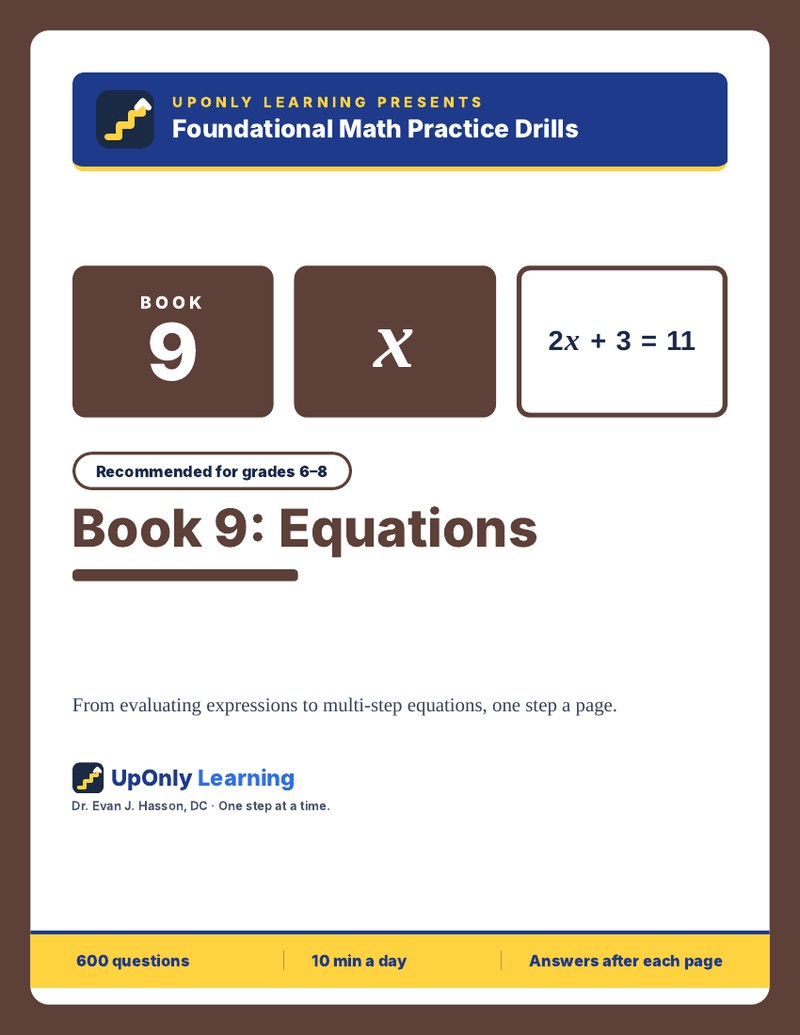
Book 9: Equations
From evaluating expressions to multi-step equations, one step a page.
What it is
Foundational Math Practice Drills · Book 9: Equations is a printable book of 600 equation questions, one step a page: from evaluating expressions to multi-step equations and inequalities. The steps: writing and evaluating expressions, then combining like terms and the distributive property, then one-step and two-step equations, then multi-step equations and variables on both sides, then inequalities and word problems.
Why it matters
Equations are the language of algebra, and algebra opens the door to the rest of math and science. Students who can simplify an expression and solve an equation step by step, without guessing, walk into algebra class ready. When those steps become automatic, students can put their attention on the problem itself. A few minutes of practice each day adds up, one step at a time.
Who it is for
Recommended for grades 6–8. Each section names the grade it practices, so a student can start at their own level.
Topics and subtopics, in order
- Expressions and variablesGrade 64 practice pages
- How to do it: variables and expressions
- Page 1: write expressions from words
- Page 2: evaluate expressions
- Page 3: evaluate: powers and parentheses
- Page 4: evaluate: two variables and negatives
- Simplifying expressionsGrades 6–74 practice pages
- How to do it: like terms and the distributive property
- Page 5: combine like terms
- Page 6: like terms and numbers
- Page 7: the distributive property
- Page 8: distribute, then combine
- One-step: add and subtractGrade 63 practice pages
- How to do it: one-step equations: add and subtract
- Page 9: undo adding
- Page 10: undo subtracting
- Page 11: add and subtract: negatives and decimals
- One-step: multiply and divideGrades 6–74 practice pages
- How to do it: one-step equations: multiply and divide
- Page 12: undo multiplying and dividing
- Page 13: multiply and divide: negative numbers
- Page 14: multiply and divide: fractions
- Page 15: multiply and divide: decimals
- Two-step equationsGrade 74 practice pages
- How to do it: two-step equations
- Page 16: two-step equations
- Page 17: two-step: subtraction and negatives
- Page 18: two-step: with division
- Page 19: two-step: fractions and decimals
- Multi-step equationsGrades 7–83 practice pages
- How to do it: multi-step equations
- Page 20: combine like terms first
- Page 21: distribute first
- Page 22: distribute and combine
- Variables on both sidesGrade 84 practice pages
- How to do it: variables on both sides
- Page 23: variables on both sides
- Page 24: both sides: negative numbers
- Page 25: both sides: distribute first
- Page 26: one solution, no solution or infinitely many
- Inequalities and word problemsGrades 6–74 practice pages
- How to do it: inequalities and word problems
- Page 27: one-step inequalities
- Page 28: inequalities: multiply or divide by a negative
- Page 29: two-step inequalities
- Page 30: word problems
What is included
- 85 pages
- 600 questions on 30 practice pages, 20 per page
- An answer page after every practice page
- 8 "How to do it" pages with worked examples
- A starting check and a progress chart
- Free updates: your book stays in your account, so you always download the newest version
One-time purchase, no subscription. Book 9: Equations, full details
Sets and 3-language packs: what you save
Each book is $9.99. The sets and packs below are the same books for less. Every saving is worked out against buying the same books one at a time.
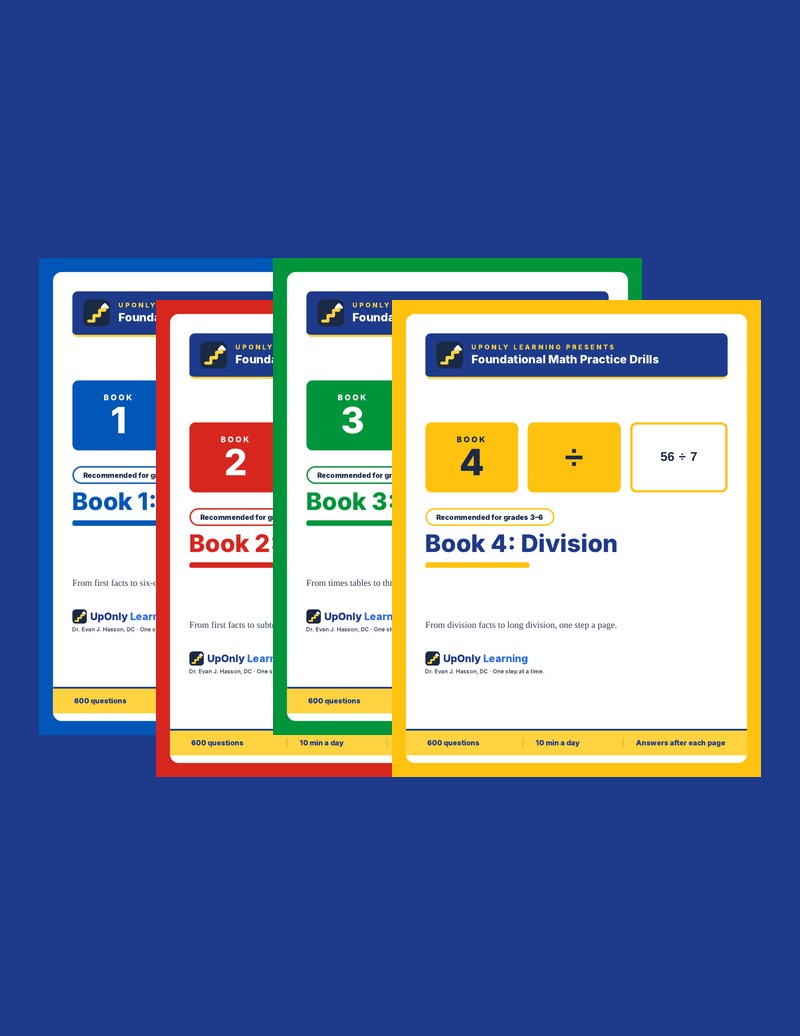
Books 1 to 4 set
$29.99Addition, Subtraction, Multiplication and Division. Choose English, Spanish or Portuguese.
Bought one at a time: 4 × $9.99 = $39.96. You save $9.97 (25%).
See it in the store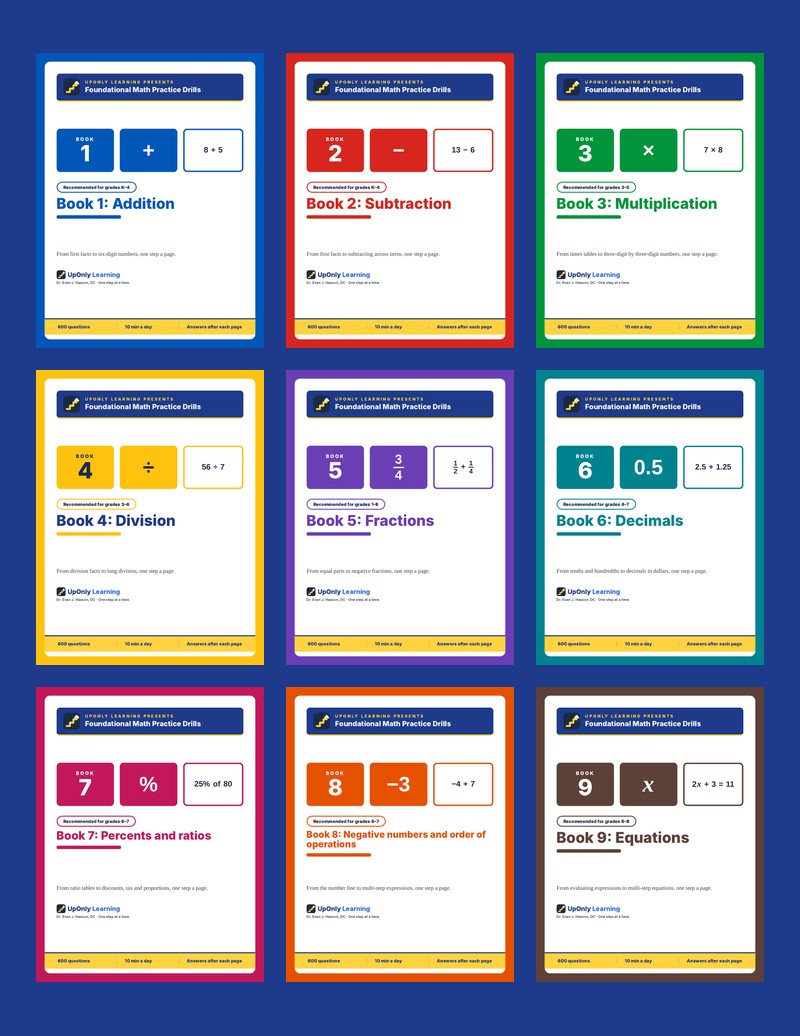
All 9 books set
$64.99The whole series, Book 1: Addition to Book 9: Equations. Choose English, Spanish or Portuguese.
Bought one at a time: 9 × $9.99 = $89.91. You save $24.92 (28%).
See it in the store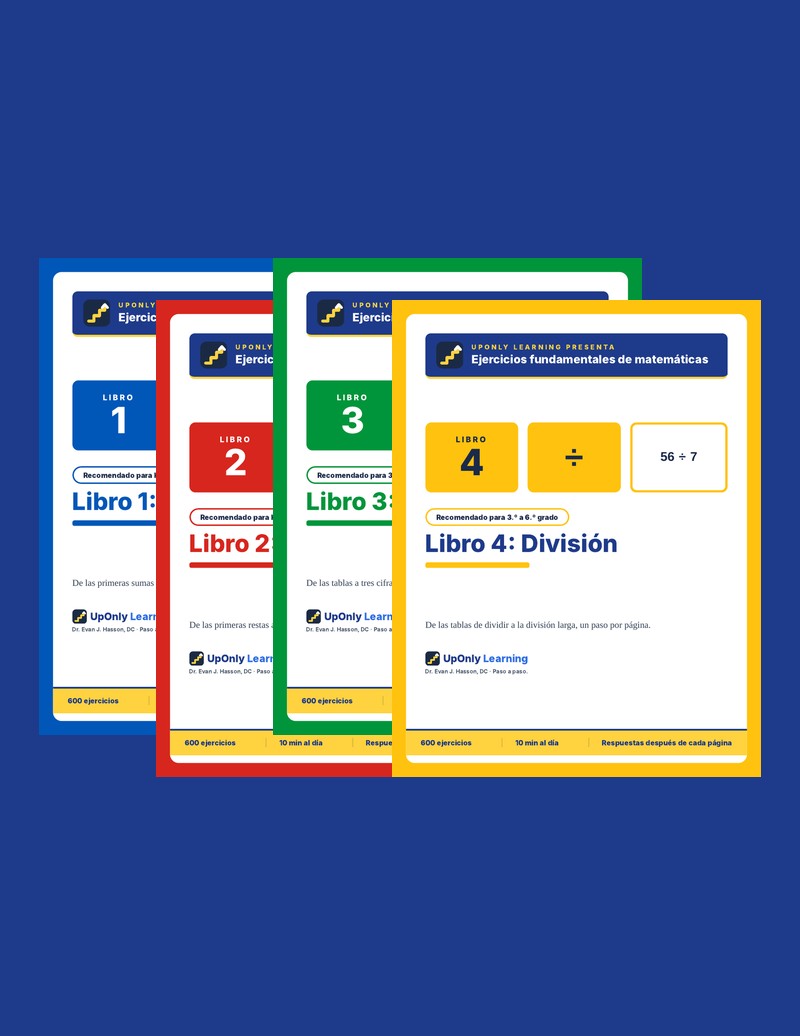
Books 1 to 4, all 3 languages
$59.98Books 1 to 4 in English, Spanish and Portuguese: 3 languages for the price of 2 sets.
Bought one at a time: 12 × $9.99 = $119.88. You save $59.90 (50%).
Compared with three Books 1 to 4 sets ($89.97), you save $29.99.
See it in the store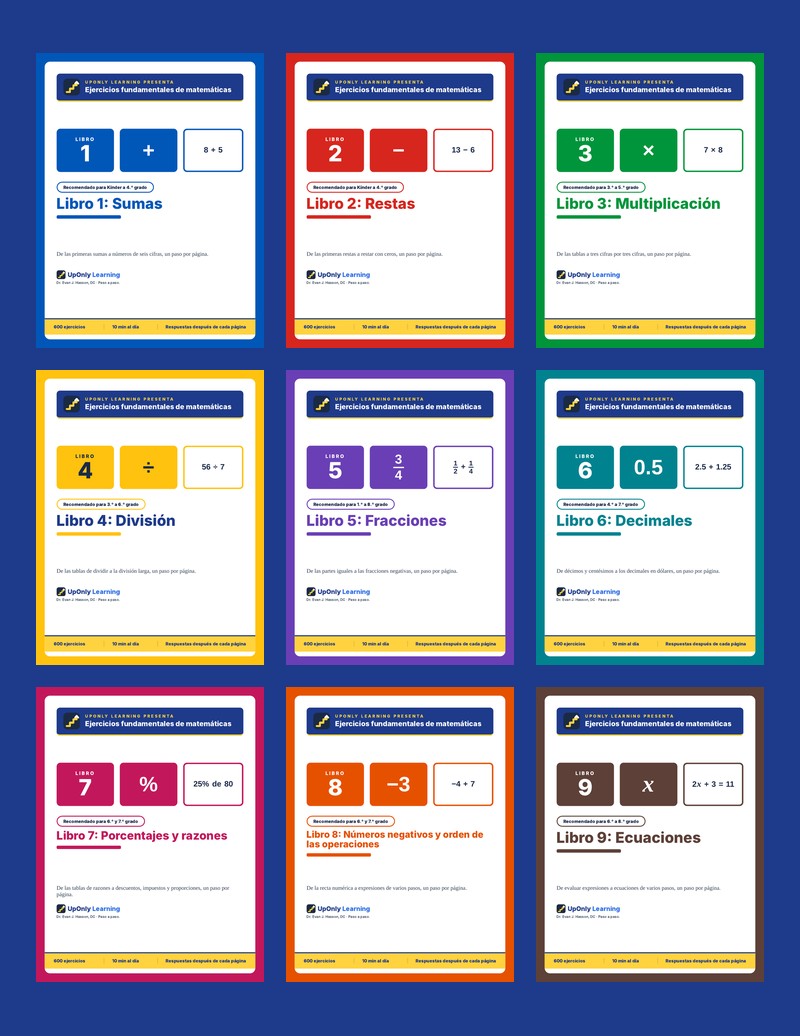
All 9 books, all 3 languages
$99.00All 9 books in English, Spanish and Portuguese.
Bought one at a time: 27 × $9.99 = $269.73. You save $170.73 (63%).
Compared with three 9-book sets ($194.97), you save $95.97.
See it in the store
Which one to choose
- One topic: the book for that topic, $9.99.
- Whole-number practice for grades K–6: the Books 1 to 4 set, $29.99.
- Grades K–8, or students of different ages at home: the 9-book set, $64.99.
- Families who use more than one language at home: a 3-language pack, $59.98 for Books 1 to 4 or $99.00 for all 9 books.
Every free sample, side by side: free math drill samples on the workbooks page.
All 9 math drill books
- Foundational Math Practice Drills · Book 1: AdditionGrades K–4 · $9.99
- Foundational Math Practice Drills · Book 2: SubtractionGrades K–4 · $9.99
- Foundational Math Practice Drills · Book 3: MultiplicationGrades 3–5 · $9.99
- Foundational Math Practice Drills · Book 4: DivisionGrades 3–6 · $9.99
- Foundational Math Practice Drills · Book 5: FractionsGrades 1–8 · $9.99
- Foundational Math Practice Drills · Book 6: DecimalsGrades 4–7 · $9.99
- Foundational Math Practice Drills · Book 7: Percents and ratiosGrades 6–7 · $9.99
- Foundational Math Practice Drills · Book 8: Negative numbers and order of operationsGrades 6–7 · $9.99
- Foundational Math Practice Drills · Book 9: EquationsGrades 6–8 · $9.99
- StoreAll 9 books set · $64.99
Questions
In what order should the math drill books be used?
What grade is each math drill book for?
Are answer keys included?
Are the math drill books printable?
Are there Spanish and Portuguese editions?
Is there a free sample?
Which set should I buy?
Do the books match Common Core?
Written by the UpOnly Learning team. Sources checked 2 Nov 2026; page updated 2 Nov 2026.
References
- Institute of Education Sciences, What Works Clearinghouse. Assisting Students Struggling with Mathematics: Response to Intervention (RtI) for Elementary and Middle Schools (Gersten et al., 2009), IES Practice Guide, Recommendations 2 and 6. Checked 2 Nov 2026.
UpOnly Learning is a private educational publisher, not a school. We award no grades, credits or diplomas, we are not accredited, and nothing we publish satisfies a legal requirement on its own.
Each topic names the standard it addresses. That alignment is UpOnly Learning's own reading of the published standards; the people who own those standards do not review or endorse what we publish, and standards change.