
UpOnly Learning presents: Foundational Math Practice Drills · Book 8
Integer worksheets printable book: 600 negative number drills with answers
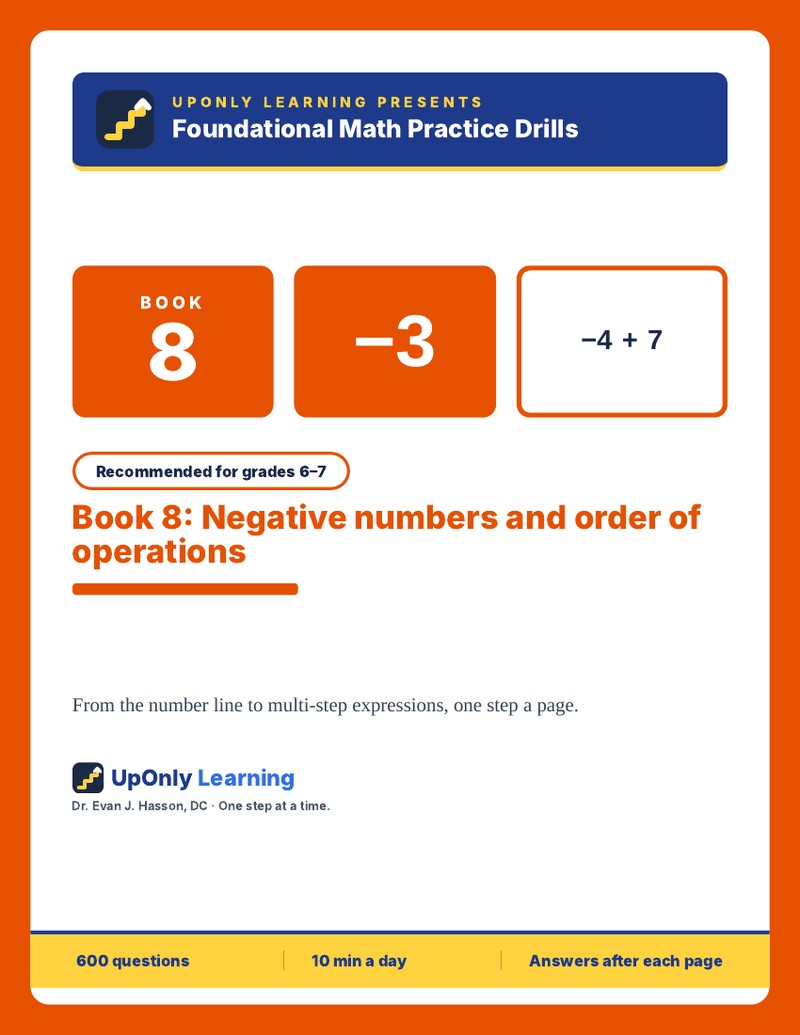
Foundational Math Practice Drills · Book 8: Negative numbers and order of operations is a printable book of 600 integer and order of operations questions, one step a page: from the number line to multi-step expressions. Every practice page has 20 questions and is followed by its answer page, and each section opens with a "How to do it" page that shows the rule with worked examples. Recommended for grades 6–7. 600 questions, organized step by step: the number line, opposites and absolute value, then comparing and ordering, then adding, subtracting, multiplying and dividing integers, then negative fractions and decimals, then exponents, the order of operations and multi-step expressions.
One-time purchase, no subscription. Buy it once and print it at home as often as you need for your household.
Free updates included. We keep improving our books with ideas from parents, teachers and educators. Your book stays in your account, so you always download the newest version.
See it in the store Free sample (PDF): the first practice page and its answers
All four first books together: the set of Books 1 to 4 for $29.99, in English, Spanish or Portuguese. All nine books together: the set of Books 1 to 9 for $64.99.
What is inside: the table of contents
Negative numbers worksheets with answers for every step: integers on the number line, opposites and absolute value, comparing and ordering integers, adding and subtracting integers, multiplying and dividing integers, negative fractions and decimals, exponents with negative bases, order of operations worksheets with parentheses and brackets, and multi-step expressions.
- Number line, opposites and absolute value · Grade 6
- How to do it: the number line, opposites and absolute value
- Page 1: integers on the number line
- Page 2: opposites and absolute value
- Page 3: absolute value expressions
- Comparing and ordering integers · Grade 6
- How to do it: comparing and ordering integers
- Page 4: compare integers
- Page 5: compare: absolute value and opposites
- Page 6: order integers
- Adding integers · Grade 7
- How to do it: adding integers
- Page 7: add: same signs
- Page 8: add: different signs
- Page 9: add: larger numbers
- Page 10: add three integers
- Subtracting integers · Grade 7
- How to do it: subtracting integers
- Page 11: subtract: answers below zero
- Page 12: subtract a negative
- Page 13: subtract: larger numbers
- Page 14: add and subtract
- Multiplying and dividing integers · Grade 7
- How to do it: multiplying and dividing integers
- Page 15: multiply integers
- Page 16: divide integers
- Page 17: multiply and divide: larger numbers
- Page 18: three numbers: multiply and divide
- Rational numbers · Grade 7
- How to do it: negative fractions and decimals
- Page 19: negative decimals: add and subtract
- Page 20: negative fractions: add and subtract
- Page 21: rational numbers: multiply and divide
- Page 22: rational numbers and integers
- Exponents and order of operations · Grades 6–7
- How to do it: exponents and order of operations
- Page 23: exponents and negative bases
- Page 24: order of operations: × and ÷ first
- Page 25: order of operations: parentheses
- Page 26: order of operations: powers
- Multi-step expressions · Grade 7
- How to do it: multi-step expressions
- Page 27: brackets and parentheses
- Page 28: absolute value and powers
- Page 29: fractions and decimals, multi-step
- Page 30: mixed multi-step review
How to use it
- One practice page a day, about 10 minutes. The answer page comes right after it; printed double-sided, the answers are on the back.
- Start with the starting check: it shows which page to begin on.
- Write the score in the Correct: ___ / 20 box and color the page on the progress chart. 18 or more correct: go on to the next page.
- Each section opens with a "How to do it" page that shows the rule and worked examples, step by step.
Matches these Common Core standards: 6.NS.C.5, 6.NS.C.6, 6.NS.C.7, 6.EE.A.1, 6.EE.A.2c, 7.NS.A.1, 7.NS.A.2, 7.NS.A.3. Each section names the grade it practices, so a student can start at their own level.
Also from UpOnly Learning
- All 9 math drill books explained: the order, grades and topics
- Foundational Math Practice Drills · Book 1: Addition
- Foundational Math Practice Drills · Book 2: Subtraction
- Foundational Math Practice Drills · Book 3: Multiplication
- Foundational Math Practice Drills · Book 4: Division
- Foundational Math Practice Drills · Book 5: Fractions
- Foundational Math Practice Drills · Book 6: Decimals
- Foundational Math Practice Drills · Book 7: Percents and ratios
- Foundational Math Practice Drills · Book 9: Equations
- Foundational Math Practice Drills · all 4 books · $29.99
- Foundational Math Practice Drills · all 9 books · $64.99
- Practice workbooks
Questions parents ask
Recommended for grades 6–7. Each section names the grade it practices, so a student can start at their own level; the starting check shows the right first page.
Yes. Every practice page is followed by its answer page, so a parent or the student can check the work in a minute.
Yes. The free sample has the first practice page and its answer page, with the book's cover.
No. It is a one-time purchase, no subscription. Buy it once and print it at home as often as you need for your household.
Yes. We update our books as we improve them, often from suggestions by parents, teachers and educators. Your purchase stays in your UpOnly Learning account, and every download gives you the newest version at no extra cost.
Yes. Section 7 has a page on exponents with negative bases and three order of operations pages (× and ÷ first, parentheses, powers), and section 8 has four pages of multi-step expressions with brackets, absolute value, fractions and decimals.
Whole-number answers are written as integers with the minus sign in front when they are negative. Fractions are in simplest form, written as mixed numbers when they are greater than 1 or less than −1, and questions with decimals have decimal answers.