
UpOnly Learning workbook · English for Portuguese Speakers
English for Portuguese Speakers workbook, level 5 (grades 9–10)
Printable PDF with an answer key
A printable English workbook for Portuguese-speaking students in grades 9–10 (ages 14–16), and for adults at the same level. 12 topics, from “Present perfect continuous: How long have you been...?” to “Reading the news: articles, fact vs opinion and media words”, with 1,440 practice questions and an answer key that explains every answer. Instructions are in Brazilian Portuguese, so a Portuguese-speaking parent can teach it; every English word has a pronunciation guide written for Portuguese speakers.
- 12topics
- 1,440practice questions
- 336printable pages
- 214pictures and diagrams
- 156read-aloud listening questions
Buy once, print as often as you need for your household. Free updates: your book stays in your account, so you always download the newest version.
Look inside
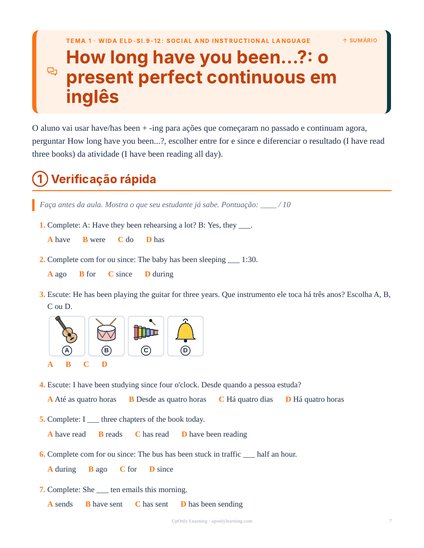
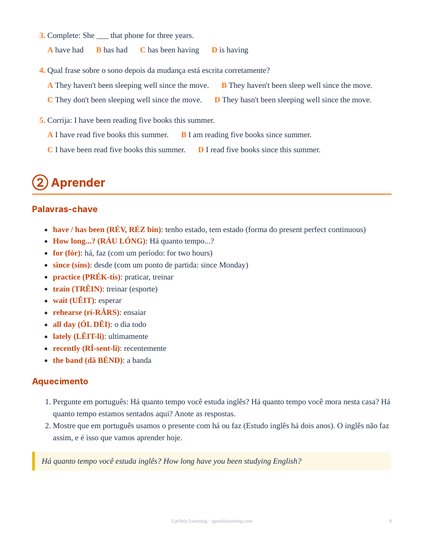
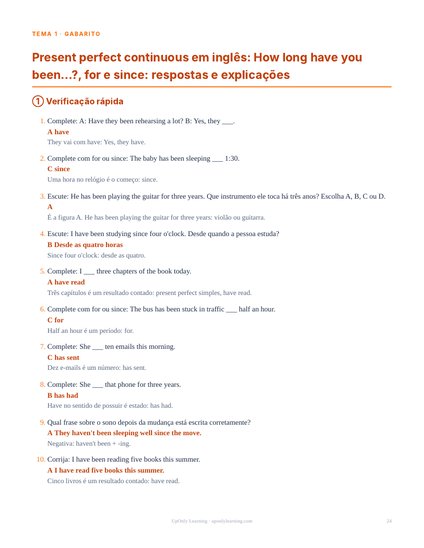
Real pages from topic 1, “Present perfect continuous: How long have you been...?”. Every topic in the book follows the same steps.
What your student will learn in level 5
Each topic builds on the one before it.
- Present perfect continuous: How long have you been...?Use have/has been + -ing for actions that started in the past and are still going on, ask How long have you been...?, choose for or since, and tell the result (I have read three books) from the activity (I have been reading all day)
- Past perfect and used to: what happened beforeUse the past perfect (had + past participle) to show what happened first, with before, after, by the time and already, and use used to and didn't use to for past habits and states that have changed
- Future plans: will, going to and the present continuousChoose will (decisions made now, predictions, promises, offers), going to (plans and predictions with evidence) and the present continuous (fixed arrangements), and use when, as soon as, before, after and until + present to talk about the future
- Second conditional: If I had..., I would...Use the second conditional for imaginary situations (If I had more time, I would learn the guitar), give advice with If I were you, express wishes with I wish + past, and tell it apart from the first conditional
- Passive voice: It was built in 1932Form the passive in the present and past (is made, are grown, was built, were discovered) and with modals (can be recycled, must be returned), use by when it matters who did it, and choose active or passive in news, science and labels
- Reported speech: She said that...Report what someone said, asked or requested with said, told and asked (She said that she was tired; He asked if I could help; The coach told us to arrive early), changing tenses, pronouns and time words, and choose between say and tell
- Relative clauses: who, which, that, where, whoseJoin ideas with who, which, that, where and whose, tell clauses with and without commas apart (defining and non-defining), and leave out that or who when it is the object (the book I read)
- Gerunds and infinitives: enjoy doing, decide to doUse -ing after enjoy, finish, avoid, mind, suggest and keep and after prepositions (interested in, good at, before leaving), use to + verb after want, decide, hope, plan, need, learn and agree, and use the gerund as a subject (Swimming is fun)
- Health and advice: should, had better, must be, might beTalk about symptoms and healthy habits, give advice with should, ought to, had better and Why don't you...?, make deductions with must, might, could and can't (She must be tired), and recognize should have + past participle for regrets
- English for part-time jobs: interviews and formal emailsRead job ads, answer interview questions (Tell me about yourself; What are your strengths?; When can you start?), ask polite indirect questions (Could you tell me when the shift starts?) and write a formal email or cover letter safely
- Opinions and debate: although, however, whereasGive and defend an opinion (In my opinion, I strongly believe), agree or disagree politely (I see your point, but...), link ideas with although, however, even though, whereas, because of, so and therefore, and organize an opinion paragraph
- Reading the news: articles, fact vs opinion and media wordsRead short original news stories, notices and posts, find the main idea and details, tell facts from opinions, guess words from context and recognize media words (headline, source, reporter, according to, survey), and check the source before sharing
How every topic works
- Quick Check: 10 questions to see what your student already knows
- Learn It: key words with pronunciation, step-by-step teaching you can read aloud, worked examples and common mistakes
- We Do It Together: 10 questions to work side by side
- You Try: up to 85 questions your student does alone, including listening questions
- Show What You Know: 15 new questions to see the progress
- Answer key: every answer, with a short explanation
What is in the free sample
- The cover, how to use the workbook and the table of contents
- One full topic, with its answers
Free with a free account. No card.
Who this English workbook for Portuguese speakers is for
- Portuguese-speaking families who want their teen to learn English at home
- Students who want daily practice at home, after school or over the summer
- ESL and ELL teachers who work with newcomers
- Teachers and tutors who need ready-to-print practice with answers
- Adults who want to keep going at the right level
Questions parents ask
What level is this English workbook for Portuguese speakers?
Level 5 is for grades 9–10, about ages 14–16. It works for adults too. The free Language check online shows which level fits your student.
Does it have pictures?
Yes. The book has 214 pictures and diagrams, used to teach new words and to ask questions like which picture shows a word.
How much time does each topic take?
About one week per topic: a lesson of about 40 minutes, then a page or two of practice a day.
Is there an answer key?
Yes. Every question has its answer and a short explanation, so a parent or teacher can check work and show why the answer is right.
Can I try it before I buy?
Yes. The free sample has the cover, how to use the workbook, the table of contents and one full topic with its answers.
Is it a PDF I can print?
Yes. It is a printable PDF of 336 pages. Buy it once and print it as often as you need for your household. It stays in your account, so you always download the newest version.
Keep exploring
- English for Portuguese Speakers level 5 curriculum (free lessons)
- Esta página en español
- Esta página em português
- English for Portuguese Speakers workbook, level 1 (grades K–1)
- English for Portuguese Speakers workbook, level 2 (grades 2–3)
- English for Portuguese Speakers workbook, level 3 (grades 4–5)
- English for Portuguese Speakers workbook, level 4 (grades 6–8)
- English for Portuguese Speakers workbook, level 6 (grades 11–12)
- English for Portuguese Speakers workbook, level 7 (adults)
- Free English for Portuguese Speakers level 5 worksheets
- Language flashcards
- The full curriculum