
UpOnly Learning workbook · English for Portuguese Speakers
English for Portuguese Speakers workbook, level 6 (grades 11–12)
Printable PDF with an answer key
A printable English workbook for Portuguese-speaking students in grades 11–12 (ages 16–18), and for adults at the same level. 12 topics, from “Narrative tenses: had been waiting, would tell and personal stories” to “Formal and informal English: emails to professors and university life”, with 1,440 practice questions and an answer key that explains every answer. Instructions are in Brazilian Portuguese, so a Portuguese-speaking parent can teach it; every English word has a pronunciation guide written for Portuguese speakers.
- 12topics
- 1,440practice questions
- 356printable pages
- 192pictures and diagrams
- 156read-aloud listening questions
Buy once, print as often as you need for your household. Free updates: your book stays in your account, so you always download the newest version.
Look inside
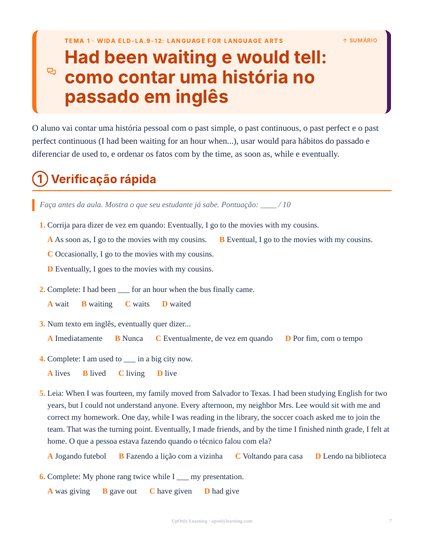
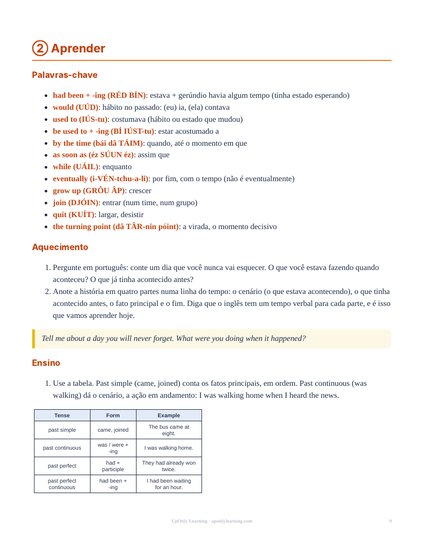
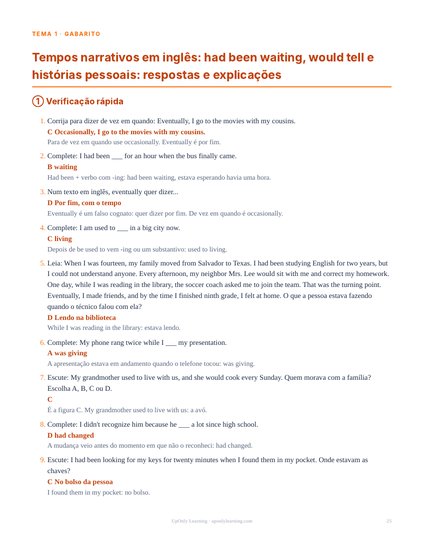
Real pages from topic 1, “Narrative tenses: had been waiting, would tell and personal stories”. Every topic in the book follows the same steps.
What your student will learn in level 6
Each topic builds on the one before it.
- Narrative tenses: had been waiting, would tell and personal storiesTell a personal story with the past simple, past continuous, past perfect and past perfect continuous (I had been waiting for an hour when...), use would for past habits and tell it apart from used to, and order events with by the time, as soon as, while and eventually
- Third and mixed conditionals: If I had known, I would have...Talk about past situations that did not happen with the third conditional (If I had studied, I would have passed), use mixed conditionals (If I had taken that job, I would be in Chicago now), express regret with I wish, If only and should have, and choose between the first, second and third conditionals
- Deductions about the past: must have, can't have, might haveMake deductions about the past with must have, can't have, couldn't have, might have and could have + participle (The window is broken; someone must have kicked a ball), tell could have apart from should have, and use probability expressions (It's likely that, There's a good chance that, probably, apparently) to explain mysteries in science and history
- Passive reporting: It is said that..., is thought to have and have something doneUse formal passive structures to report (It is said that...; The painting is thought to have been lost; The results are expected to be published), use have or get something done for services (I'm having my bike repaired), and use the passive with modals and perfect tenses (has been tested, should have been checked) when reading science and technology news
- Future perfect and future continuous: will have finished, will be studyingUse the future continuous for actions in progress at a future time (This time next year, I will be studying in college), the future perfect for what will be finished before a time (By 2035, they will have built...), and the future in the past (was going to, would) for plans that changed (I was going to call you, but...), when talking about careers, goals and technology
- Participle clauses: Having finished..., Founded in 1890...Shorten sentences with participles (Having finished the essay, she...; Founded in 1890, the library...; Not knowing the answer, he...), reduce relative clauses (the students living near the school, the books written by...), use the -ing form after prepositions (after finishing, before leaving) and avoid participles without a clear subject
- Academic vocabulary: word families, collocations and false friendsBuild word families with prefixes and suffixes (develop, development, developer; possible, impossible, possibility), use frequent collocations (make a decision, do research, take notes, raise a question), choose the noun, verb, adjective or adverb for each sentence, and recognize common false friends in academic texts
- Argumentative essays: thesis, counterargument and concessionWrite an argumentative essay with a thesis, topic sentences, evidence, a counterargument and a rebuttal, use concession and contrast connectors (despite, in spite of, whereas, nevertheless, on the contrary), soften claims (may, tend to, it could be argued that) and cite sources (according to, the data suggests), on global issues such as water, energy and digital access
- College applications: personal statements, résumés and interviewsWrite a short personal statement that shows an experience and what you learned, describe activities with action verbs (led, organized, designed, volunteered), write a formal email to ask for information or an interview, and answer interview questions (Why do you want to study...? Tell me about a challenge you faced). Safety: an adult checks every application before it is sent
- Presentations: signposting, cleft sentences and Not only... but alsoOrganize an oral presentation with signposting (First, I'll look at...; Let me move on to...; To sum up...), add emphasis with cleft sentences (What I want to show is...; It was the data that...) and inversion after negative expressions (Not only did we..., but we also...; Never have I seen...), present a chart and answer audience questions politely
- Reading academic texts and data: purpose, tone, inference and graphsRead short original academic texts, opinion articles and graphs, identify the main idea, the purpose and the tone, make inferences, find what a pronoun refers to and describe data (rose sharply, fell slightly, one in five, the majority of), as in college entrance exams
- Formal and informal English: emails to professors and university lifeSwitch register, choose formal verbs instead of phrasal verbs (find out, discover; ask for, request; put off, postpone), write polite emails to professors and offices (I was wondering if...; Would it be possible to...?; Please let me know...), understand university instructions and notices, and take notes from a short lecture
How every topic works
- Quick Check: 10 questions to see what your student already knows
- Learn It: key words with pronunciation, step-by-step teaching you can read aloud, worked examples and common mistakes
- We Do It Together: 10 questions to work side by side
- You Try: up to 85 questions your student does alone, including listening questions
- Show What You Know: 15 new questions to see the progress
- Answer key: every answer, with a short explanation
What is in the free sample
- The cover, how to use the workbook and the table of contents
- One full topic, with its answers
Free with a free account. No card.
Who this English workbook for Portuguese speakers is for
- Portuguese-speaking families who want their teen to learn English at home
- Students who want daily practice at home, after school or over the summer
- ESL and ELL teachers who work with newcomers
- Teachers and tutors who need ready-to-print practice with answers
- Adults who want to keep going at the right level
Questions parents ask
What level is this English workbook for Portuguese speakers?
Level 6 is for grades 11–12, about ages 16–18. It works for adults too. The free Language check online shows which level fits your student.
Does it have pictures?
Yes. The book has 192 pictures and diagrams, used to teach new words and to ask questions like which picture shows a word.
How much time does each topic take?
About one week per topic: a lesson of about 40 minutes, then a page or two of practice a day.
Is there an answer key?
Yes. Every question has its answer and a short explanation, so a parent or teacher can check work and show why the answer is right.
Can I try it before I buy?
Yes. The free sample has the cover, how to use the workbook, the table of contents and one full topic with its answers.
Is it a PDF I can print?
Yes. It is a printable PDF of 356 pages. Buy it once and print it as often as you need for your household. It stays in your account, so you always download the newest version.
Keep exploring
- English for Portuguese Speakers level 6 curriculum (free lessons)
- Esta página en español
- Esta página em português
- English for Portuguese Speakers workbook, level 1 (grades K–1)
- English for Portuguese Speakers workbook, level 2 (grades 2–3)
- English for Portuguese Speakers workbook, level 3 (grades 4–5)
- English for Portuguese Speakers workbook, level 4 (grades 6–8)
- English for Portuguese Speakers workbook, level 5 (grades 9–10)
- English for Portuguese Speakers workbook, level 7 (adults)
- Free English for Portuguese Speakers level 6 worksheets
- Language flashcards
- The full curriculum