
UpOnly Learning workbook · Learn Portuguese
Learn Portuguese workbook, level 4 (grades 6–8)
Printable PDF with an answer key
A printable Portuguese workbook for English-speaking students in grades 6–8 (ages 11–14). 12 topics, from “Portuguese irregular verbs in the present: faço, posso, digo, trago” to “Portuguese reading practice: a Brazilian-style legend and the Portuguese-speaking world”, with 1,440 practice questions and an answer key that explains every answer. Lessons and instructions are in English; every Portuguese word has a simple pronunciation guide. Brazilian Portuguese.
- 12topics
- 1,440practice questions
- 327printable pages
- 225pictures and diagrams
- 168read-aloud listening questions
Buy once, print as often as you need for your household. Free updates: your book stays in your account, so you always download the newest version.
Look inside
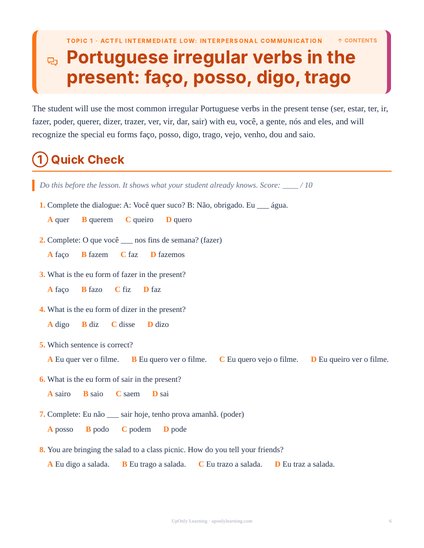
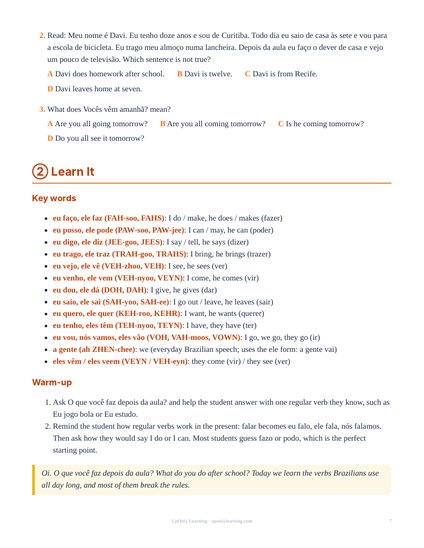
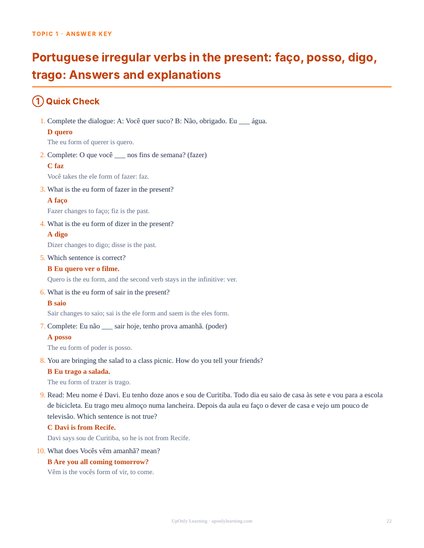
Real pages from topic 1, “Portuguese irregular verbs in the present: faço, posso, digo, trago”. Every topic in the book follows the same steps.
What your student will learn in level 4
Each topic builds on the one before it.
- Portuguese irregular verbs in the present: faço, posso, digo, tragoUse the most common irregular verbs in the present tense (ser, estar, ter, ir, fazer, poder, querer, dizer, trazer, ver, vir, dar, sair) with eu, você, a gente, nós and eles, and learn the special eu forms: eu faço, eu posso, eu digo, eu trago, eu vejo
- Ser vs estar in Portuguese: traits, feelings, time and where things areChoose ser for traits, origin, jobs, relationships, materials, the time and where events take place, and estar for feelings, conditions and where people and things are now; contrast está cansado with é cansativo, and use ficar for buildings and cities: O museu fica no centro
- Gostar de in Portuguese: how to say what you like, love, prefer and what hurtsSay what you like with gostar de plus a noun or an infinitive and the contractions do, da, dos, das; use adorar, preferir, odiar, interessar-se por and gostaria de; and say what hurts with doer and estar com dor: minha cabeça dói, estou com dor de cabeça
- Portuguese reflexive verbs and daily routine: eu me levanto, eu tomo banhoDescribe a daily routine with acordar, levantar-se, tomar banho, escovar os dentes, vestir-se and deitar-se; place me, se and nos before the verb the Brazilian way (eu me levanto, eu não me deito tarde, vou me deitar), and notice that Brazilians often drop the pronoun in speech: eu levanto às sete
- Portuguese past tense: regular and irregular preterite (fui, fiz, tive)Tell finished past events with the pretérito perfeito in every person: regular -ar, -er and -ir verbs (falei, comi, abri), the irregular fui, fiz, tive, estive, pude, disse, trouxe, vi, vim and dei, and time words like anteontem and no ano passado
- Portuguese imperfect tense: quando eu era criança (imperfeito vs perfeito)Describe how things used to be and what was happening with the pretérito imperfeito (falava, comia, era, tinha, ia), and choose between imperfeito and perfeito: Eu estava lendo quando o telefone tocou
- Portuguese future tense: vou viajar and falarei (ir + infinitive)Talk about plans with the everyday Brazilian future, ir + infinitive (vou viajar, vamos estudar), recognize and write the simple future for formal texts (falarei, farei, direi, trarei), and use time words like amanhã, semana que vem and um dia
- Portuguese commands: the Brazilian imperative for directions and recipesGive and understand commands with você the Brazilian way: the spoken form (fala, vem, faz) and the written form (fale, venha, faça), negative commands (não fala, não fale), street directions (vira à direita, segue reto) and recipe steps (mistura, coloca, espera), with kitchen and street safety lines
- Portuguese object pronouns: Eu o vi or Eu vi ele?Replace a noun with an object pronoun in Brazilian Portuguese: o, a, os, as in writing (Eu o vi), ele, ela, eles, elas in everyday speech (Eu vi ele), plus me, te, nos and the formal lhe
- Travel Portuguese: airport, hotel and restaurant phrasesGet through a trip in Brazilian Portuguese: the airport (passaporte, cartão de embarque, portão), hotel check-in, asking for directions, ordering at a restaurant or lanchonete, asking for a conta, polite requests with por favor, você poderia...? and eu gostaria de..., and travel safety phrases
- Portuguese comparatives and superlatives: mais... do que, melhor, o maiorCompare people, places and things in Brazilian Portuguese: mais/menos ... (do) que, tão ... quanto, tanto/tanta/tantos/tantas ... quanto, the special forms melhor, pior, maior, menor, the superlative o/a mais ... de, and -íssimo (lindíssimo)
- Portuguese reading practice: a Brazilian-style legend and the Portuguese-speaking worldRead an original legend in the style of a traditional Brazilian tale and short texts about Portuguese-speaking countries (Brazil, Portugal, Angola, Mozambique, Cape Verde); answer comprehension questions, spot the two past tenses in context (era, morava; subiu, cantou) and learn new vocabulary
How every topic works
- Quick Check: 10 questions to see what your student already knows
- Learn It: key words with pronunciation, step-by-step teaching you can read aloud, worked examples and common mistakes
- We Do It Together: 10 questions to work side by side
- You Try: up to 85 questions your student does alone, including listening questions
- Show What You Know: 15 new questions to see the progress
- Answer key: every answer, with a short explanation
What is in the free sample
- The cover, how to use the workbook and the table of contents
- One full topic, with its answers
Free with a free account. No card.
Who this Portuguese workbook for kids is for
- Homeschool families who want a full Portuguese program for grades 6–8 in one printable book
- Parents who want daily practice at home, after school or over the summer
- Teachers and tutors who need ready-to-print practice with answers
- Older beginners who want to start at the right level
Questions parents ask
What level is this Portuguese workbook for kids?
Level 4 is for grades 6–8, about ages 11–14. It works for older beginners too. The free Language check online shows which level fits your student.
Does it have pictures?
Yes. The book has 225 pictures and diagrams, used to teach new words and to ask questions like which picture shows a word.
How much time does each topic take?
About one week per topic: a lesson of about 40 minutes, then a page or two of practice a day.
Is there an answer key?
Yes. Every question has its answer and a short explanation, so a parent or teacher can check work and show why the answer is right.
Can I try it before I buy?
Yes. The free sample has the cover, how to use the workbook, the table of contents and one full topic with its answers.
Is it a PDF I can print?
Yes. It is a printable PDF of 327 pages. Buy it once and print it as often as you need for your household. It stays in your account, so you always download the newest version.
Keep exploring
- Learn Portuguese level 4 curriculum (free lessons)
- Esta página en español
- Esta página em português
- Learn Portuguese workbook, level 1 (grades K–1)
- Learn Portuguese workbook, level 2 (grades 2–3)
- Learn Portuguese workbook, level 3 (grades 4–5)
- Learn Portuguese workbook, level 5 (grades 9–10)
- Learn Portuguese workbook, level 6 (grades 11–12)
- Learn Portuguese workbook, level 7 (adults)
- Free Learn Portuguese level 4 worksheets
- Language flashcards
- The full K–8 curriculum