
UpOnly Learning workbook · Learn Portuguese
Learn Portuguese workbook, level 6 (grades 11–12)
Printable PDF with an answer key
A printable Portuguese workbook for English-speaking students in grades 11–12 (ages 16–18), and for adults at the same level. 12 topics, from “Portuguese imperfect subjunctive: queria que, era importante que, como se” to “Cultural comparisons in Portuguese: presentations, the Lusophone world and identity”, with 1,440 practice questions and an answer key that explains every answer. Lessons and instructions are in English; every Portuguese word has a simple pronunciation guide. Brazilian Portuguese.
- 12topics
- 1,440practice questions
- 345printable pages
- 195pictures and diagrams
- 168read-aloud listening questions
Buy once, print as often as you need for your household. Free updates: your book stays in your account, so you always download the newest version.
Look inside
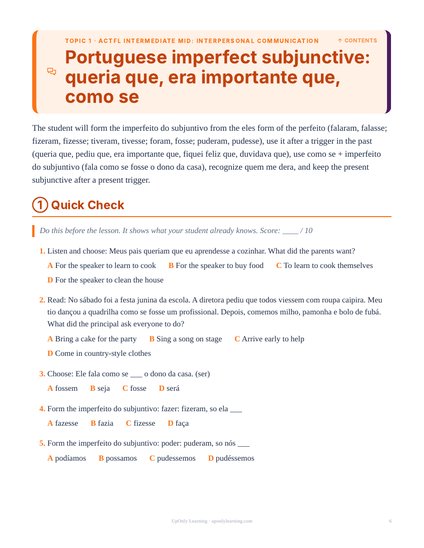
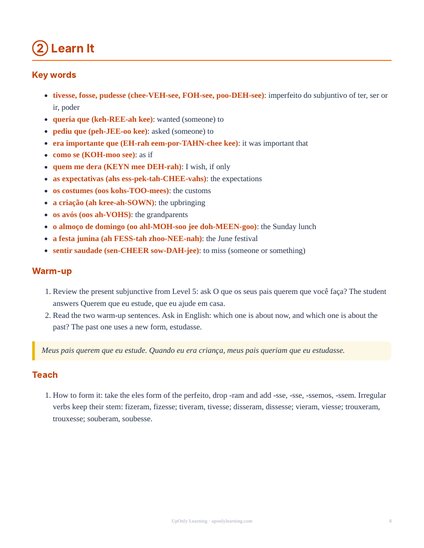
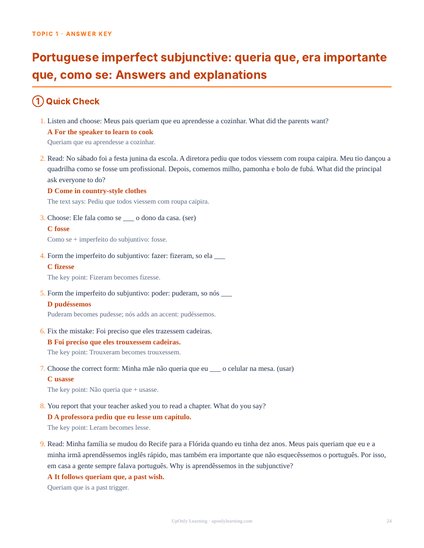
Real pages from topic 1, “Portuguese imperfect subjunctive: queria que, era importante que, como se”. Every topic in the book follows the same steps.
What your student will learn in level 6
Each topic builds on the one before it.
- Portuguese imperfect subjunctive: queria que, era importante que, como seForm the imperfeito do subjuntivo from the eles form of the perfeito (falaram, falasse; fizeram, fizesse; tiveram, tivesse; foram, fosse), use it after a trigger in the past (queria que, pediu que, era importante que), use como se + imperfeito do subjuntivo, recognize quem me dera, and keep the present subjunctive after a present trigger.
- Portuguese se clauses: se eu tivesse, eu faria and se eu tiverBuild hypothetical sentences with se + imperfeito do subjuntivo + futuro do pretérito (Se eu tivesse uma bolsa, estudaria em Portugal) and the spoken ia + infinitive, contrast them with likely conditions using se + futuro do subjuntivo (Se chover, a gente não vai), give advice with Se eu fosse você..., recognize se eu tivesse estudado, teria passado, and talk about choices after high school.
- Portuguese subjunctive in descriptions: procuro algo que tenha, espero que tenha gostadoUse the subjunctive after something unknown or that does not exist (Procuro um estágio que tenha horário flexível; Não conheço ninguém que fale japonês) and the indicative after something known (Tenho um amigo que mora perto), form the pretérito perfeito do subjuntivo (Espero que você tenha gostado), and read listings for summer programs, rooms and volunteer posts.
- Portuguese conjunctions with the subjunctive: para que, caso, emboraUse the present subjunctive after para que, antes que, sem que, a não ser que, contanto que, caso and embora, use the futuro do subjuntivo after quando, se and assim que, use the infinitive when the subject does not change (para economizar, antes de sair), and write a short plan for a community or environmental project (um mutirão).
- Guessing and the future in Portuguese: deve ter saído, será que, terá mudadoGuess about the present and the past the Brazilian way, with dever + infinitive (deve estar na aula) and dever ter + participle (ela deve ter saído), ask open guesses with Será que...?, recognize the futuro composto (Até 2040, muita coisa terá mudado) and its spoken form vai ter mudado, and talk about inventions and the future of work with talvez and é provável que + subjunctive.
- Portuguese passive voice: foi construída, vendem-se and everyday accidentsForm the passive with ser + a participle that agrees with the subject (A ponte foi construída; As vacinas foram testadas), recognize the passive with se in signs and formal writing (Vendem-se bicicletas; Aluga-se apartamento), use estar + participle for a result (A loja está fechada), say unplanned events the Brazilian way (O copo caiu; Esqueci o trabalho em casa), and read short science and health articles.
- Reported speech in Portuguese: disse que ia, pediu que eu revisasseReport what someone said, asked or asked for, changing the tense (disse que estava, disse que tinha chegado, disse que ia abrir or abriria), use pediu que + imperfeito do subjuntivo for requests and perguntou se or perguntou onde for questions, change pronouns and time words, use reporting verbs (afirmar, explicar, acrescentar, negar, contar), and check a news source before sharing it.
- Portuguese pluperfect: tinha terminado and life storiesForm the mais-que-perfeito composto (tinha + participle) to show what happened before another past event (Quando cheguei, o filme já tinha começado), recognize the simple form in books (fizera, chegara), use já, ainda não and nunca with it, combine it with the perfeito and the imperfeito, use depois de, antes de and ao + infinitive, and write a short biography of a person who made a difference in a community.
- Talking about art in Portuguese: o que, o qual, cujo and describing a workDescribe and interpret a painting, a woodcut (xilogravura), a mural, a song, a building or a film (Em primeiro plano há...; As cores transmitem...), use o que for a whole idea (O que eu mais gosto é...), use o qual, a qual and que after prepositions (a música da qual te falei) and cujo, cuja, cujos and cujas (o artista cujas obras vimos), and give a reasoned opinion about a work.
- Portuguese for college and careers: personal statement, CV and interviewWrite a short personal statement (Tenho interesse em... porque...; Minha experiência em... me ensinou...), list skills and experience for a CV, answer interview questions with o senhor, a senhora or a polite você, use formal openings and closings (Prezados senhores, Atenciosamente) and the Brazilian email phrases Segue em anexo and Fico à disposição. An adult checks every application before it is sent.
- Argumentative writing in Portuguese: global issues, sources and connectorsRead two short texts and a chart with different points of view, state a thesis, support it with evidence from the sources (segundo, de acordo com, o gráfico mostra que), concede and refute (embora, apesar de, no entanto, porém), conclude with a proposal (portanto, dessa forma, é preciso que + subjunctive), and follow the Brazilian essay pattern of introduction, two arguments and a conclusion with a proposal.
- Cultural comparisons in Portuguese: presentations, the Lusophone world and identityPrepare and give a short presentation that compares a community you know with one in the Portuguese-speaking world, use comparisons (tão... quanto, tanto quanto, mais do que, enquanto, ao contrário de, assim como), signal the structure (Em primeiro lugar, Por outro lado, Para concluir), answer follow-up questions, and recognize common European Portuguese words and forms (pequeno-almoço, autocarro, estou a fazer) in listening.
How every topic works
- Quick Check: 10 questions to see what your student already knows
- Learn It: key words with pronunciation, step-by-step teaching you can read aloud, worked examples and common mistakes
- We Do It Together: 10 questions to work side by side
- You Try: up to 85 questions your student does alone, including listening questions
- Show What You Know: 15 new questions to see the progress
- Answer key: every answer, with a short explanation
What is in the free sample
- The cover, how to use the workbook and the table of contents
- One full topic, with its answers
Free with a free account. No card.
Who this Portuguese workbook for kids is for
- Homeschool families who want a full Portuguese course for grades 11–12 in one printable book
- Students who want daily practice at home, after school or over the summer
- Teachers and tutors who need ready-to-print practice with answers
- Adults who want to keep going at the right level
Questions parents ask
What level is this Portuguese workbook for kids?
Level 6 is for grades 11–12, about ages 16–18. It works for adults too. The free Language check online shows which level fits your student.
Does it have pictures?
Yes. The book has 195 pictures and diagrams, used to teach new words and to ask questions like which picture shows a word.
How much time does each topic take?
About one week per topic: a lesson of about 40 minutes, then a page or two of practice a day.
Is there an answer key?
Yes. Every question has its answer and a short explanation, so a parent or teacher can check work and show why the answer is right.
Can I try it before I buy?
Yes. The free sample has the cover, how to use the workbook, the table of contents and one full topic with its answers.
Is it a PDF I can print?
Yes. It is a printable PDF of 345 pages. Buy it once and print it as often as you need for your household. It stays in your account, so you always download the newest version.
Keep exploring
- Learn Portuguese level 6 curriculum (free lessons)
- Esta página en español
- Esta página em português
- Learn Portuguese workbook, level 1 (grades K–1)
- Learn Portuguese workbook, level 2 (grades 2–3)
- Learn Portuguese workbook, level 3 (grades 4–5)
- Learn Portuguese workbook, level 4 (grades 6–8)
- Learn Portuguese workbook, level 5 (grades 9–10)
- Learn Portuguese workbook, level 7 (adults)
- Free Learn Portuguese level 6 worksheets
- Language flashcards
- The full curriculum