
Geography & Culture · free reference
Antarctica: the continent of ice, science and penguins
Antarctica has no countries and no permanent population. It is a continent set aside for peace and science.
Free printable world maps
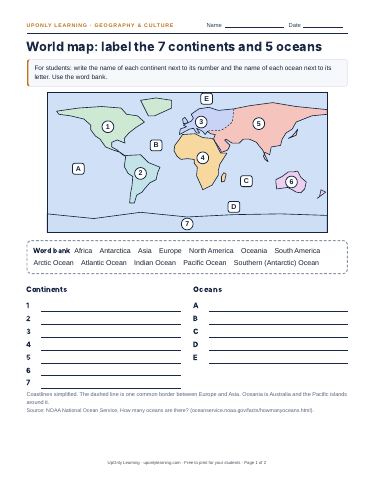
Print a map and go country by country with your students.
Printables with a black and white button also come in a low-ink version, good for coloring and filling in.
The continent
- Antarctica's land area is about 14.2 million square kilometers (5.5 million square miles).[1]
- It is almost wholly covered by an ice sheet that averages about 2,000 meters (6,500 feet) thick and holds about 90% of the world's glacial ice.[1]
- It is by far the coldest continent. The world's lowest recorded temperature, −89.2 °C (−128.6 °F), was measured there in 1983.[1]
- There are no permanent human inhabitants.[1]
- Roald Amundsen reached the South Pole in December 1911, and Robert Falcon Scott reached it in January 1912.[1]
Research stations
- During the International Geophysical Year of 1957–58, 12 countries set up more than 50 stations on the continent to study it together.[1]
- Today, COMNAP shares information on the Antarctic facilities run by its 34 member national Antarctic programs. Some facilities are open all year; others are seasonal.[2]
The Antarctic Treaty
- The Antarctic Treaty was signed in Washington on 1 December 1959 by the 12 countries whose scientists had been active in Antarctica during the International Geophysical Year. It entered into force in 1961.[3]
- Article I: “Antarctica shall be used for peaceful purposes only.” Article II keeps freedom of scientific investigation and cooperation.[3]
- The Treaty now has 58 Parties.[3]
Wildlife
The Southern Ocean
- The Southern Ocean is the newest named ocean. The U.S. Board on Geographic Names recognizes it as the water from the coast of Antarctica to the line of latitude at 60 degrees South. Not all countries agree on these boundaries.[5]
Sources
- Encyclopaedia Britannica (summary): Antarctica · www.britannica.com/summary/Antarctica (accessed 2026-10-26)
- COMNAP (Council of Managers of National Antarctic Programs): Antarctic Facilities Information · www.comnap.aq/antarctic-facilities-information (accessed 2026-10-26)
- Secretariat of the Antarctic Treaty: The Antarctic Treaty · www.ats.aq/e/antarctictreaty.html (accessed 2026-10-26)
- Australian Antarctic Program: Penguins · www.antarctica.gov.au/about-antarctica/animals/penguins/ (accessed 2026-10-26)
- NOAA National Ocean Service: How many oceans are there? · oceanservice.noaa.gov/facts/howmanyoceans.html (accessed 2026-10-26)
See something we should correct about Antarctica? Tell us.