
HSMathematics · Usually grade 8 or 9
Algebra 1
Equations, functions, systems, exponents and quadratics, built one clear step at a time.
- 40lessons
- 4,800practice questions
- 98drawings
- 238flashcards
- EN · ES · PTEnglish, Spanish, Portuguese
Start with One Step: one high school course for $9.99 a month. Switch courses once every 30 days.
Start One StepAll 7 courses for up to 10 students: Every Step, $29.99 a month.
What this course covers
Algebra 1 is the course where math stops being only about numbers and starts being about relationships. Students learn to write an equation from a situation, solve it, and read what the answer means. Every later math and science course, from Geometry to Chemistry to college statistics, assumes these skills.
Our course follows the Common Core high school standards in 40 lessons. It starts with real numbers and expressions, moves through linear equations, inequalities and functions, then systems, exponential growth, polynomials and quadratics, and ends with data. Each lesson checks the skills it builds on first, so a student who missed something in middle school finds out on day one, not on the test.
Standards: Common Core State Standards for Mathematics, high school (Algebra I course). Every lesson lists its standard code.
By the end of the course, the student can
- Solve linear equations and inequalities, including ones with variables on both sides and absolute value
- Graph lines from slope, intercepts and two points, and write the equation of any line
- Solve systems of equations by graphing, substitution and elimination, and use them to model real problems
- Factor quadratics and solve them by factoring, completing the square and the quadratic formula
Before you start: Grade 8 math: integers, fractions, one-step and two-step equations, and the coordinate plane.
What comes next: Geometry
Inside every lesson
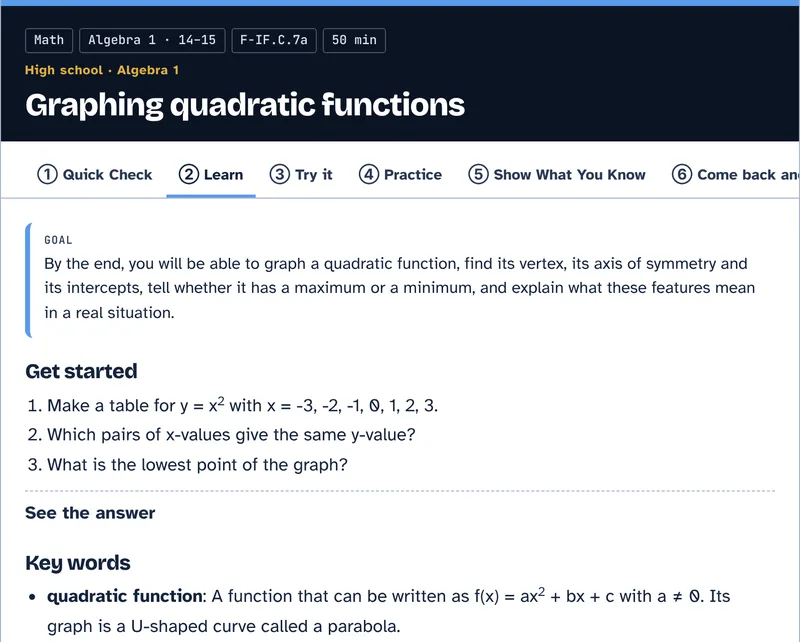
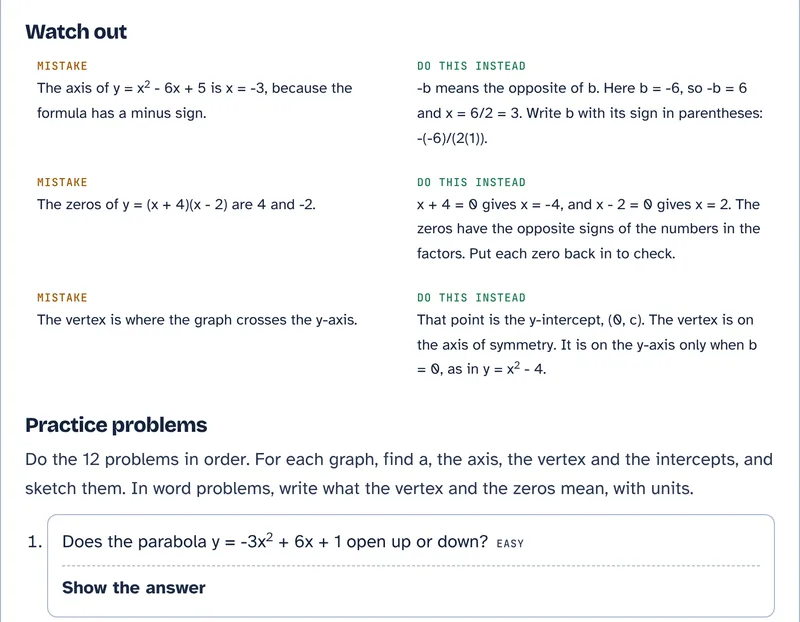
Each lesson runs the same six steps, so the student always knows what comes next. These are real screens from the Algebra 1 course.
- Quick CheckThree questions on the skills this lesson needs. Miss two or more and the lesson points to what to review first.
- LearnThe idea in plain words, key vocabulary and worked examples, with a drawing whenever it helps.
- Try itGuided problems with the first steps shown, then fewer hints each time.
- PracticeThe common mistakes with the fix, then a full set of practice problems.
- Show What You KnowA scored check from a bank of 120 questions per lesson, with an explanation for every answer.
- Come back another dayA short spaced review a few days later, so the skill stays.
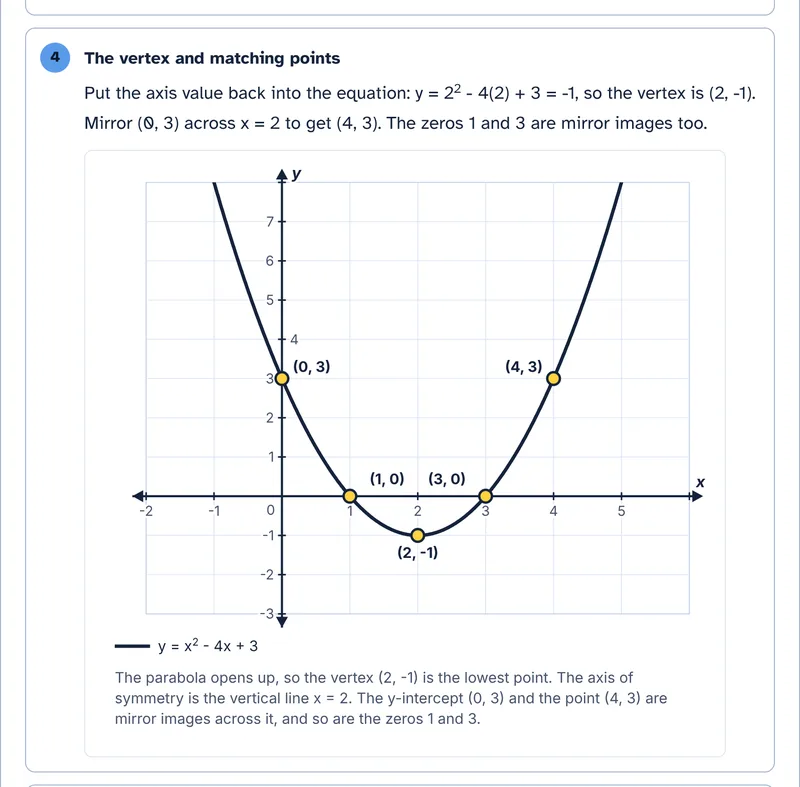
Drawings from the course
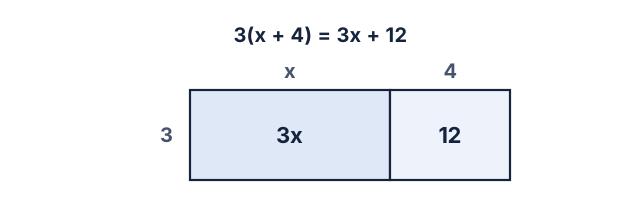
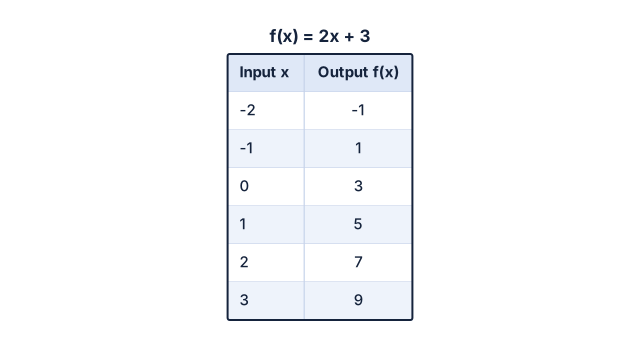
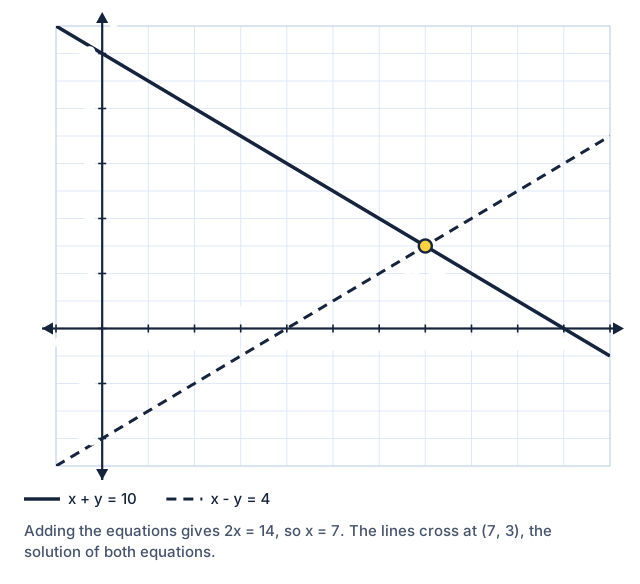
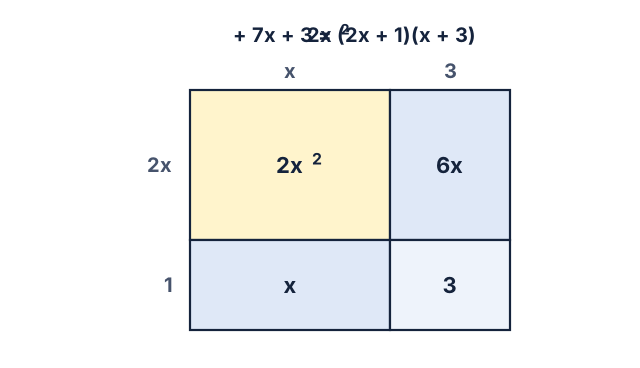
Every drawing is our own and is labeled for screen readers. A few of the 98 in this course:
Full course outline
40 lessons in 7 units, in the order we teach them. Each lesson lists its standard. Members open any lesson from here. High school lessons are part of membership. There is no free trial lesson.
Unit 1Numbers, expressions and equations
- 1Real numbers: rational and irrational
N-RN.B.3 - 2Order of operations and evaluating expressions
A-SSE.A.1a - 3Simplifying expressions: like terms and the distributive property
A-SSE.A.2 - 4Writing expressions and equations from words
A-CED.A.1 - 5Solving multi-step linear equations
A-REI.B.3 - 6Equations with variables on both sides
A-REI.B.3 - 7Literal equations and formulas
A-CED.A.4 - 8Quantities, units and rates
N-Q.A.1
Unit 2Inequalities and absolute value
Unit 3Functions and linear graphs
- 12Relations and functions: domain and range
F-IF.A.1 - 13Function notation
F-IF.A.2 - 14Key features of graphs
F-IF.B.4 - 15Rate of change
F-IF.B.6 - 16Arithmetic sequences as linear functions
F-IF.A.3 - 17Slope and slope-intercept form
F-IF.C.7a - 18Point-slope and standard form
A-CED.A.2 - 19Transformations of functions: linear and absolute value
F-BF.B.3 - 20Scatter plots, correlation and lines of fit
S-ID.B.6
Unit 4Systems of equations and inequalities
Unit 5Exponents and exponential models
Unit 6Polynomials and quadratics
- 30Adding and subtracting polynomials
A-APR.A.1 - 31Multiplying polynomials
A-APR.A.1 - 32Factoring: greatest common factor and x2 + bx + c
A-SSE.A.2 - 33Factoring ax2 + bx + c and special products
A-SSE.A.2 - 34Graphing quadratic functions
F-IF.C.7a - 35Solving quadratics by factoring and square roots
A-REI.B.4b - 36Completing the square and vertex form
A-REI.B.4a - 37The quadratic formula and the discriminant
A-REI.B.4b - 38Quadratic models and comparing functions
A-CED.A.1
Unit 7Data and statistics
Try three practice questions
These come straight from the lesson banks, from three different lessons, from warm-up to stretch. Pick an answer, then open the explanation.
From lesson 5: Solving multi-step linear equations
Solve the equation x + 14 = 30.
Show the answer
Answer: x = 16. Subtract 14 from both sides: x = 30 - 14 = 16.
From lesson 19: Transformations of functions: linear and absolute value
How is the graph of y = |x| shifted to get the graph of g(x) = |x - 3| - 2?
Show the answer
Answer: right 3 and down 2. Inside, |x - 3| is 0 at x = 3, so the graph moves right 3. Outside, -2 moves it down 2. The vertex is (3, -2).
From lesson 32: Factoring: greatest common factor and x2 + bx + c
Ana factored x2 - 5x - 14 as (x - 7)(x - 2). What is the correct complete factorization?
Show the answer
Answer: (x - 7)(x + 2). (x - 7)(x - 2) is not the complete correct factorization: her product is +14, not -14. The correct one is (x - 7)(x + 2), which multiplies back to x2 - 5x - 14 and cannot be factored further.
Algebra 1 flashcards
238 cards with the vocabulary of every lesson, each with a definition. Flip, sort the ones you know, and review the rest. Included with membership to use on screen, or $14.99 for the set. Digital only, with no printable version.
- perfect squareA number that is an integer times itself, like 1, 4, 9, 16 and 25.
- dimensional analysisWriting units in every step and canceling them like factors to reach the units you want.
- maximum, minimumThe greatest and least output values of a function. They are y-values, read at the highest and lowest points of the graph.
- point of intersectionThe point where two graphs cross. For two lines, it is the solution of the system.
- exponential functionA function y = a·bx, where a is not 0, b > 0 and b is not 1. The input x is in the exponent.
- parabolaThe graph of a quadratic function. It opens up when a > 0 and opens down when a < 0.
Studying more than one course? Save with a pass
Best for high school
High School Flashcards pass
$59.99one-time payment
All 7 high school courses, 1,812 cards, new courses added free
Save $44.94 compared with buying the 7 sets one at a time
Get the High School passEverything
All Flashcards pass
$79.99one-time payment
Every set on UpOnly Learning, 19 sets: high school, K to 8 and languages
Get everything for $79.99Membership includes every flashcard deck to use on screen. Printing is not included. See membership
Workbook coming soonWorkbook coming soon
A printable Algebra 1 workbook is in the works. Until then, every lesson, practice set and flashcard deck is ready online, and each lesson prints cleanly from the browser.
Where Algebra 1 leads
Algebra 1 is part of the high school preparation for these college programs and majors. Each page lists the requirements with sources.
Health professions
How to start today
- Become a memberStart with One Step: one high school course for $9.99 a month. Switch courses once every 30 days. For all 7 courses: Every Step is $29.99 a month or $249 a year. It opens all 7 high school courses, every K to 8 lesson and every flashcard deck for up to 10 students at home.
- Open lesson 1Start with Real numbers: rational and irrational. The Quick Check takes a few minutes.
- Follow the Quick CheckIf it shows a gap, review that one skill first. Then go lesson by lesson, at your own pace.
Questions families ask
Is Algebra 1 taken in 8th or 9th grade?
Both are common. Students who finished grade 8 math with confidence often take Algebra 1 in grade 8; most take it in grade 9. The Quick Check at the start of every lesson shows whether the earlier skills are in place, so you can start where the student actually is.
What is the hardest part of Algebra 1?
For most students it is quadratics: factoring, completing the square and the quadratic formula (lessons 32 to 37). The course gets there only after linear equations, functions and exponents are solid, and the Watch out section of each lesson names the exact mistakes students make.
Can a parent teach Algebra 1 without being a math person?
Yes. Every lesson has worked examples, the common mistakes with the fix, and an explanation on every practice question, so a parent can check the work without knowing the method ahead of time. Each lesson also includes a short tip for the parent.
 Geometry
 Algebra 2
 Biology
 Chemistry
 Physics
 Anatomy and Physiology
Written by Dr. Evan J. Hasson, Founder of UpOnly Learning.