
HSScience · Usually grade 10 or 11
Chemistry
Atoms, bonds, reactions and the mole, with the math worked out step by step.
- 34lessons
- 4,080practice questions
- 156drawings
- 260flashcards
- EN · ES · PTEnglish, Spanish, Portuguese
Start with One Step: one high school course for $9.99 a month. Switch courses once every 30 days.
Start One StepAll 7 courses for up to 10 students: Every Step, $29.99 a month.
What this course covers
Chemistry explains what matter is made of and why substances change. Students learn how the structure of an atom sets its place on the periodic table, why atoms bond, and how to count particles with the mole so they can predict how much product a reaction makes. It is required for every health profession and most engineering programs.
Our course follows the Next Generation Science Standards for high school physical science in 34 lessons, with 156 of our own drawings of atoms, molecules and reactions. It moves from measurement and atomic structure to bonding and molecular shape, gases, reactions and stoichiometry, energy and equilibrium, acids, bases and redox, and ends with nuclear and organic chemistry.
Standards: Next Generation Science Standards, high school physical sciences (HS-PS1 to HS-PS3). Every lesson lists its standard code.
By the end of the course, the student can
- Use the periodic table to predict electron arrangement, ion charge and bond type
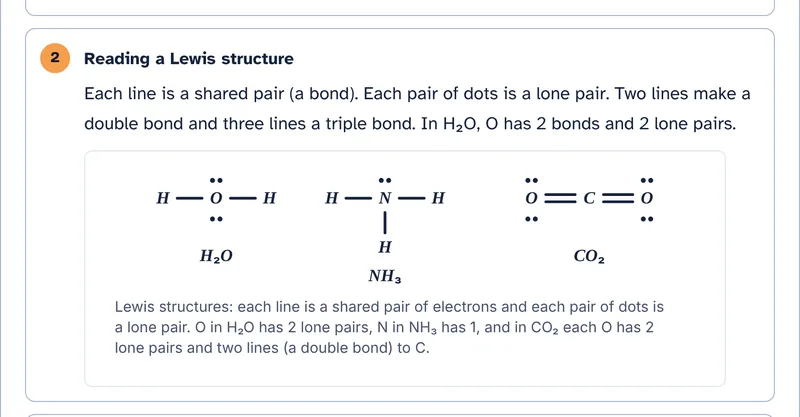
- Name compounds, draw Lewis structures and predict molecular shape
- Balance equations and use the mole to find masses, limiting reactant and percent yield
- Calculate concentration, pH, heat and gas behavior, and explain equilibrium shifts
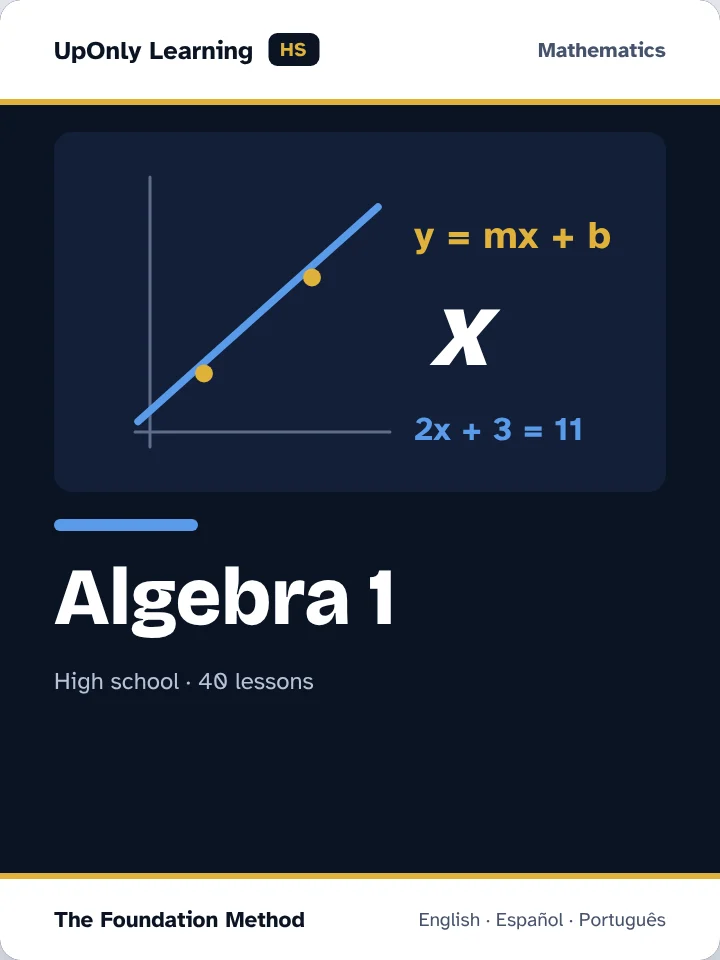
Before you start: Algebra 1, especially solving equations, ratios and scientific notation; Biology helps but is not required.
What comes next: Physics
Inside every lesson
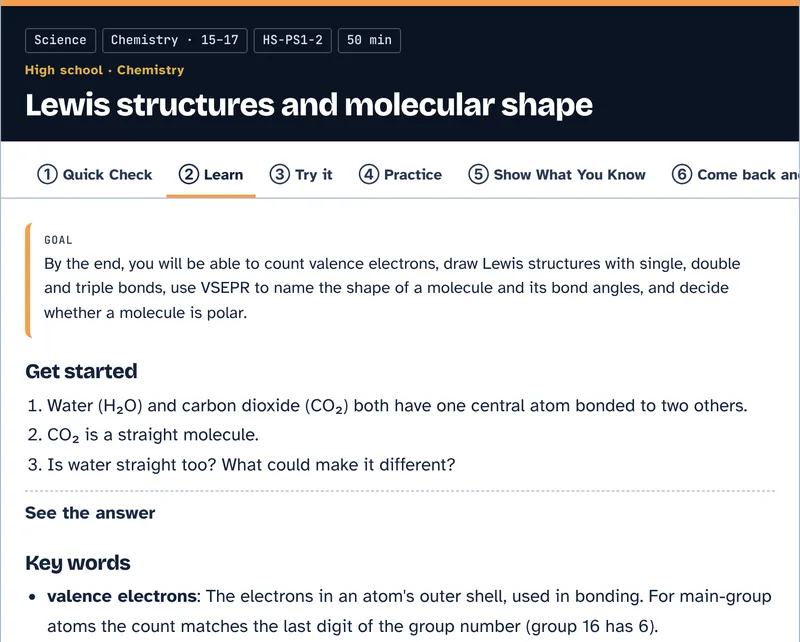
Each lesson runs the same six steps, so the student always knows what comes next. These are real screens from the Chemistry course.
- Quick CheckThree questions on the skills this lesson needs. Miss two or more and the lesson points to what to review first.
- LearnThe idea in plain words, key vocabulary and worked examples, with a drawing whenever it helps.
- Try itGuided problems with the first steps shown, then fewer hints each time.
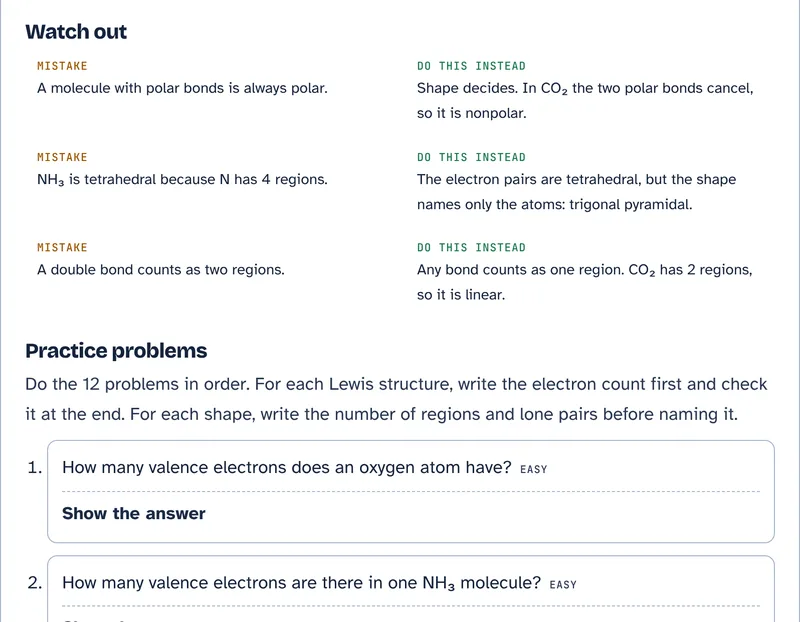
- PracticeThe common mistakes with the fix, then a full set of practice problems.
- Show What You KnowA scored check from a bank of 120 questions per lesson, with an explanation for every answer.
- Come back another dayA short spaced review a few days later, so the skill stays.
Drawings from the course
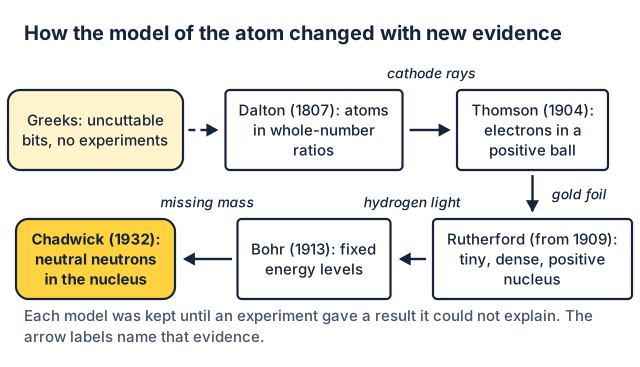
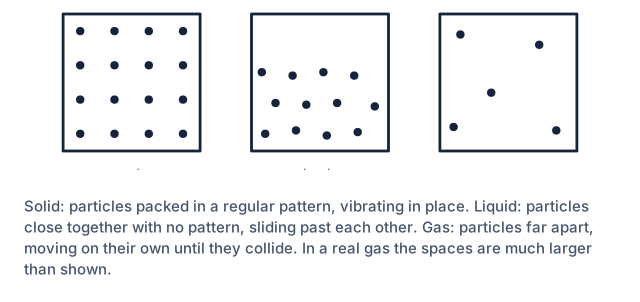
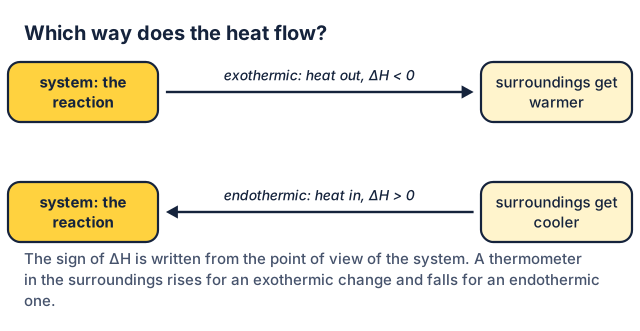
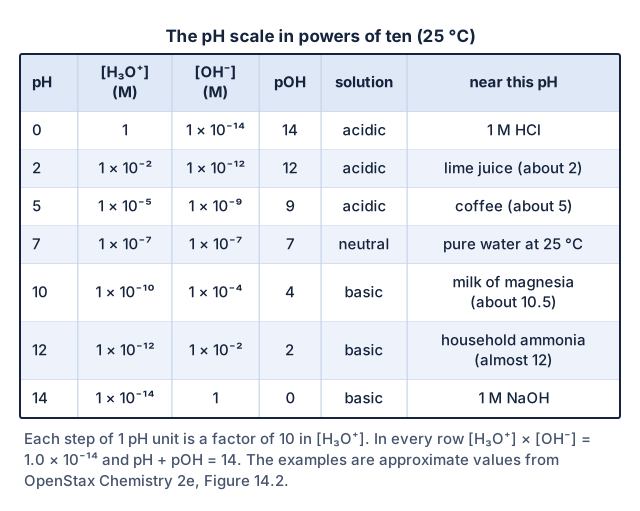
Every drawing is our own and is labeled for screen readers. A few of the 156 in this course:
Full course outline
34 lessons in 7 units, in the order we teach them. Each lesson lists its standard. Members open any lesson from here. High school lessons are part of membership. There is no free trial lesson.
Unit 1Matter, measurement and the atom
Unit 2Bonding and structure
Unit 3States of matter and gases
Unit 4Reactions and stoichiometry
Unit 5Energy, rates and equilibrium
Unit 6Solutions, acids, bases and redox
Unit 7Nuclear, organic and applied chemistry
Try three practice questions
These come straight from the lesson banks, from three different lessons, from warm-up to stretch. Pick an answer, then open the explanation.
From lesson 5: Periodic table patterns
Sulfur (S) is in period 3, group 16. How many valence electrons does it have?
Show the answer
Answer: 6 electrons. For main-group elements, groups 1 and 2 have 1 and 2 valence electrons and groups 13 to 18 have the group number minus 10. So S has 6. The period number (3) gives the shell, not the count.
From lesson 16: Percent composition and empirical formulas
What is the percent oxygen by mass in glucose (C₆H₁₂O₆)?
Show the answer
Answer: 53.3%. C₆H₁₂O₆ has 6 O atoms and a molar mass of 180.16 g/mol. Percent O = 6 × 16.00 ÷ 180.16 × 100 = 53.3%. Using one O atom when there are 6, or counting atoms instead of mass, gives a wrong percent.
From lesson 27: pH and neutralization
A 25.00 mL sample of H₂SO₄ needs 31.20 mL of 0.100 M NaOH to reach the end point. Use H₂SO₄ + 2NaOH → Na₂SO₄ + 2H₂O to find the molarity of the H₂SO₄.
Show the answer
Answer: 0.0624 M. mol NaOH = 0.100 M × 0.03120 L = 0.003120 mol. Ratio 1 mol H₂SO₄ / 2 mol NaOH: 0.001560 mol H₂SO₄. M = 0.001560 mol ÷ 0.02500 L = 0.0624 M. Skipping the ratio gives a value twice as large.
Chemistry flashcards
260 cards with the vocabulary of every lesson, each with a definition. Flip, sort the ones you know, and review the rest. Included with membership to use on screen, or $14.99 for the set. Digital only, with no printable version.
- compoundA pure substance made of two or more elements chemically combined. A chemical change can break it down.
- covalent bondA bond in which two atoms share a pair of electrons.
- phase changeA change from one state of matter to another (melting, freezing, vaporization, condensation, sublimation, deposition). The substance stays the same; only the arrangement of its particles changes.
- empirical formula massThe sum of the atomic masses in the empirical formula.
- equilibrium constant (K)The value of the ratio of product concentrations to reactant concentrations, each raised to its coefficient, when the system is at equilibrium. It is also written Kc.
- corrosionThe slow damage of a metal by a natural redox process, such as rust on iron.
Studying more than one course? Save with a pass
Best for high school
High School Flashcards pass
$59.99one-time payment
All 7 high school courses, 1,812 cards, new courses added free
Save $44.94 compared with buying the 7 sets one at a time
Get the High School passEverything
All Flashcards pass
$79.99one-time payment
Every set on UpOnly Learning, 19 sets: high school, K to 8 and languages
Get everything for $79.99Membership includes every flashcard deck to use on screen. Printing is not included. See membership
Workbook coming soonWorkbook coming soon
A printable Chemistry workbook is in the works. Until then, every lesson, practice set and flashcard deck is ready online, and each lesson prints cleanly from the browser.
Where Chemistry leads
Chemistry is part of the high school preparation for these college programs and majors. Each page lists the requirements with sources.
Health professions
College majors
- Aerospace Engineering
- Astronomy
- Biochemistry
- Biology
- Biomedical Engineering
- Chemical Engineering
- Chemistry
- Civil Engineering
- Earth and Environmental Science
- Engineering: the first-year core and how to choose a major
- Environmental Engineering
- Health Science
- Materials Engineering
- Mechanical Engineering
- Neuroscience
- Nutrition
- Physics
How to start today
- Become a memberStart with One Step: one high school course for $9.99 a month. Switch courses once every 30 days. For all 7 courses: Every Step is $29.99 a month or $249 a year. It opens all 7 high school courses, every K to 8 lesson and every flashcard deck for up to 10 students at home.
- Open lesson 1Start with Matter, measurement and significant figures. The Quick Check takes a few minutes.
- Follow the Quick CheckIf it shows a gap, review that one skill first. Then go lesson by lesson, at your own pace.
Questions families ask
How much math does high school chemistry need?
Algebra 1 is enough. The math in Chemistry is ratios, unit conversions, scientific notation and solving for one variable in a formula. Every calculation lesson (the mole, stoichiometry, gas laws, calorimetry, pH) shows the setup with units written out at each step.
What is stoichiometry and why is it hard?
Stoichiometry is using a balanced equation to find how much of one substance reacts with or makes another. It is hard because it chains several steps: grams to moles, moles to moles, moles back to grams. Lessons 15 to 18 build those steps one at a time before combining them.
Is Chemistry required for health careers?
Yes. Medicine, dentistry, pharmacy, nursing, physician assistant, physical therapy and veterinary programs all require college chemistry, and college chemistry assumes high school chemistry. The College prep pages below list each program's requirements with sources.
 Algebra 1
 Geometry
 Algebra 2
 Biology
 Physics
 Anatomy and Physiology
Written by Dr. Evan J. Hasson, Founder of UpOnly Learning.