
HSMathematics · Usually grade 10 or 11
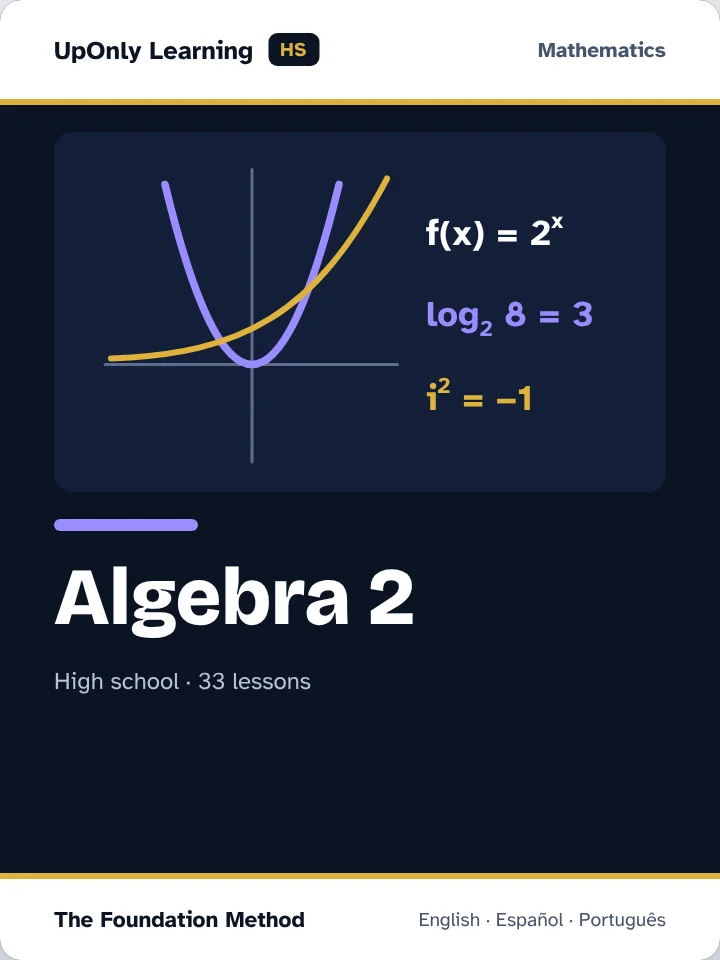
Algebra 2
Functions, polynomials, logarithms and the unit circle: the math that college courses build on.
- 33lessons
- 3,960practice questions
- 119drawings
- 225flashcards
- EN · ES · PTEnglish, Spanish, Portuguese
Start with One Step: one high school course for $9.99 a month. Switch courses once every 30 days.
Start One StepAll 7 courses for up to 10 students: Every Step, $29.99 a month.
What this course covers
Algebra 2 takes the tools from Algebra 1 and applies them to whole families of functions: polynomial, rational, radical, exponential, logarithmic and trigonometric. It is the course most colleges list as the minimum for admission, and it is the direct preparation for precalculus, calculus and statistics.
Our course follows the Common Core high school standards in 33 lessons. It opens with function families and transformations, adds complex numbers and polynomials, then rational and radical functions, inverses, exponentials and logarithms, the unit circle, and finishes with statistics and probability, the part of Algebra 2 students use most in everyday life.
Standards: Common Core State Standards for Mathematics, high school (Algebra II course). Every lesson lists its standard code.
By the end of the course, the student can
- Graph and transform polynomial, rational, radical, exponential and logarithmic functions
- Divide polynomials, use the remainder and factor theorems, and find all zeros, including complex ones
- Solve exponential and logarithmic equations and model growth, decay and interest
- Use radians, the unit circle and normal distributions to describe real data
Before you start: Algebra 1 (factoring and quadratics above all) and Geometry (right triangle trigonometry).
What comes next: Precalculus is coming next. Until then, the College prep pages show what each program expects.
Inside every lesson
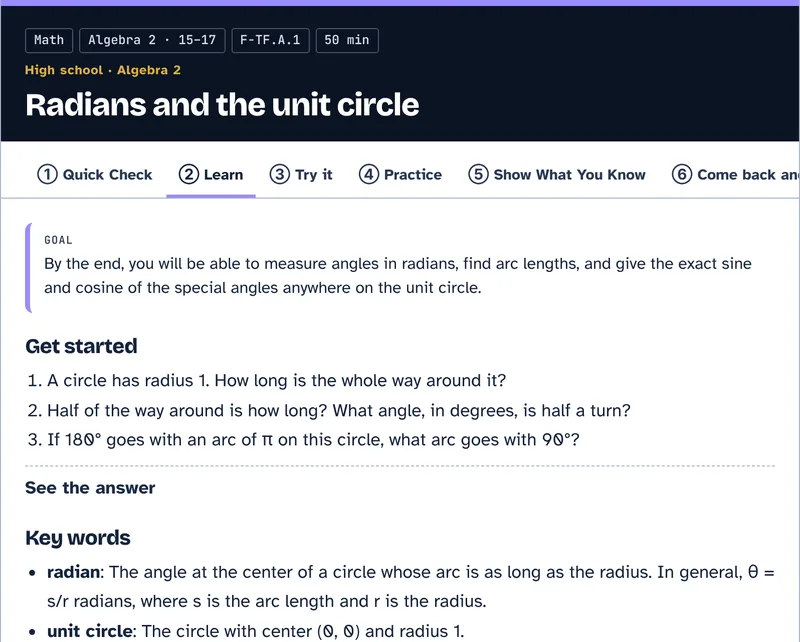
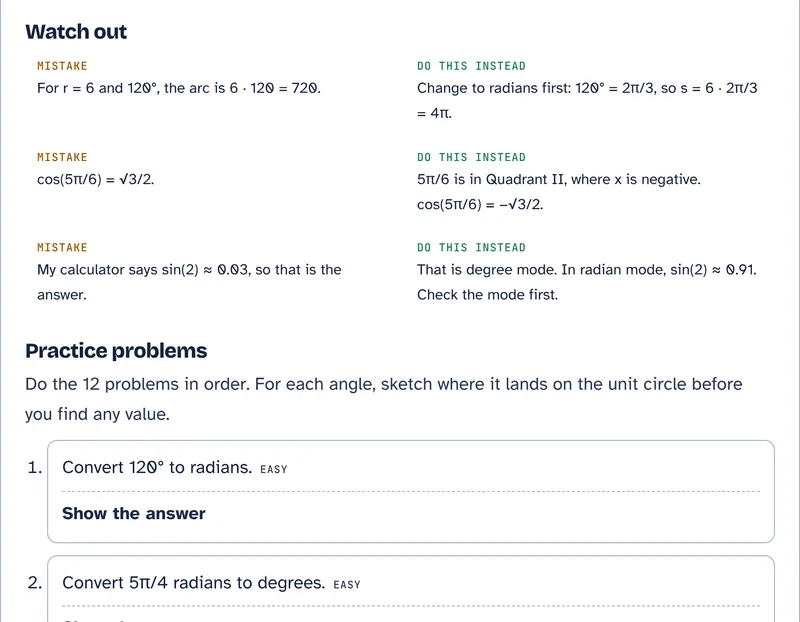
Each lesson runs the same six steps, so the student always knows what comes next. These are real screens from the Algebra 2 course.
- Quick CheckThree questions on the skills this lesson needs. Miss two or more and the lesson points to what to review first.
- LearnThe idea in plain words, key vocabulary and worked examples, with a drawing whenever it helps.
- Try itGuided problems with the first steps shown, then fewer hints each time.
- PracticeThe common mistakes with the fix, then a full set of practice problems.
- Show What You KnowA scored check from a bank of 120 questions per lesson, with an explanation for every answer.
- Come back another dayA short spaced review a few days later, so the skill stays.
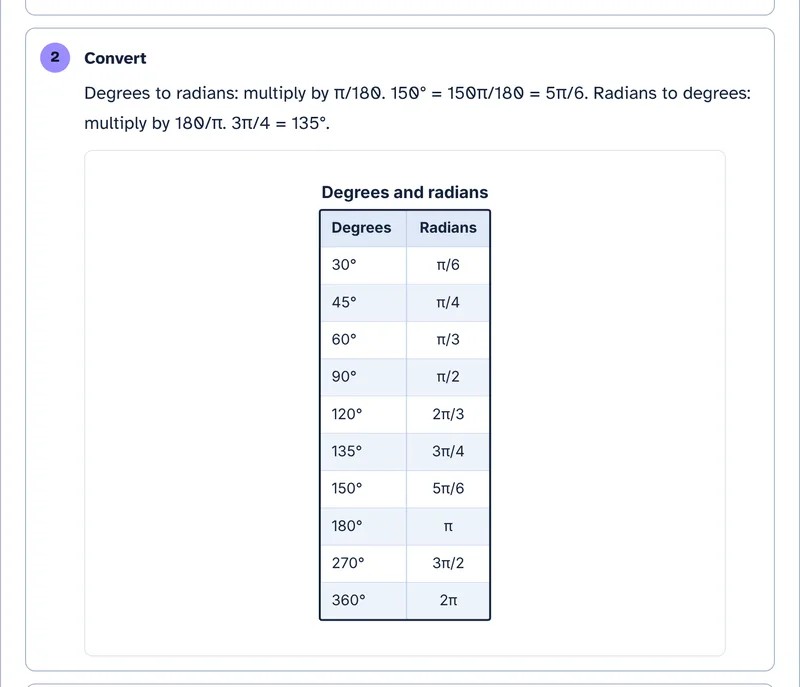
Drawings from the course
Every drawing is our own and is labeled for screen readers. A few of the 119 in this course:
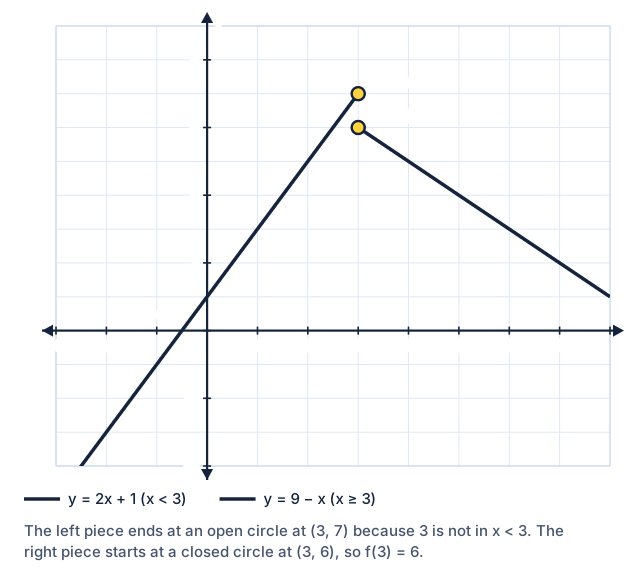
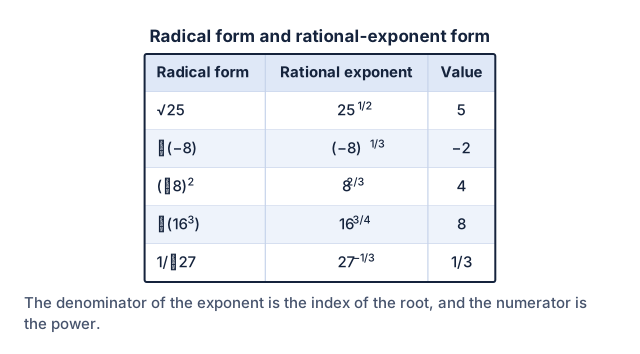
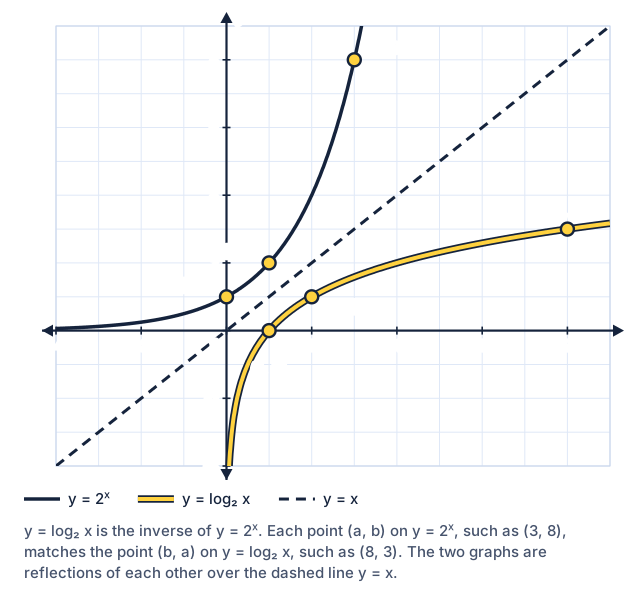
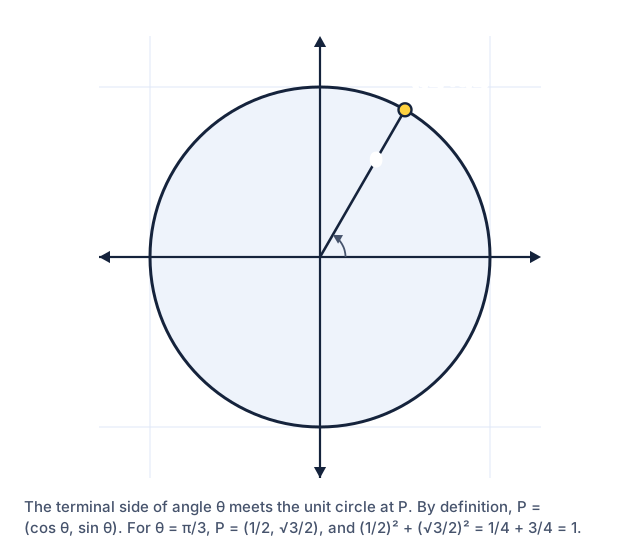
Full course outline
33 lessons in 7 units, in the order we teach them. Each lesson lists its standard. Members open any lesson from here. High school lessons are part of membership. There is no free trial lesson.
Unit 1Functions and systems
Unit 2Complex numbers
Unit 3Polynomials
Unit 4Radicals, rational functions and inverses
Unit 5Exponentials, logarithms and modeling
- 18Exponential functions and the number e
F-IF.C.8b - 19Logarithms as inverses
F-LE.A.4 - 20Properties of logarithms
F-LE.A.4 - 21Solving exponential and logarithmic equations
F-LE.A.4 - 22Geometric sequences and series
A-SSE.B.4 - 23Building functions to model situations
F-BF.A.1a - 24Fitting functions to data
S-ID.B.6a
Unit 6Trigonometric functions
Unit 7Statistics and probability
Try three practice questions
These come straight from the lesson banks, from three different lessons, from warm-up to stretch. Pick an answer, then open the explanation.
From lesson 4: Systems of three equations
Is (2, 3, 4) a solution of the system x + y + z = 9, x − y + z = 3 and 2x + y − z = 3?
Show the answer
Answer: yes, it makes all three equations true. Put x = 2, y = 3 and z = 4 into each equation. First: 2 + 3 + 4 = 9; second: 2 − 3 + 4 = 3; third: 2(2) + 3 − 4 = 3. It makes 3 of the 3 equations true, and a solution must make all three true.
From lesson 15: Rational equations
Multiply every term of 2/x + 1/3 = 1 by the LCD, 3x. Which equation do you get?
Show the answer
Answer: 6 + x = 3x. Every term on both sides is multiplied by 3x, and each denominator cancels: 2/x · 3x = 6, 1/3 · 3x = x and 1 · 3x = 3x. The result is 6 + x = 3x.
From lesson 26: Graphs of sine and cosine
A rider's height above the ground on a Ferris wheel is h(t) = −20cos((π/4)t) + 25 meters, where t is the time in minutes. Find the height when t = 3, to the nearest tenth of a meter.
Show the answer
Answer: 39.1 meters. Put t = 3 into the model with the calculator in radian mode. The input of cos is about 2.3562, and cos of it is about −0.7071. So h ≈ −20(−0.7071) + 25 ≈ 39.14, which rounds to 39.1. Degree mode would give 5.0.
Algebra 2 flashcards
225 cards with the vocabulary of every lesson, each with a definition. Flip, sort the ones you know, and review the rest. Included with membership to use on screen, or $14.99 for the set. Digital only, with no printable version.
- interceptsThe y-intercept is the point (0, f(0)). An x-intercept is a point (a, 0) where f(a) = 0. The number a is also called a zero of the function.
- non-real solutionA complex solution a + bi with b ≠ 0. A quadratic with real coefficients has two of them when b2 − 4ac < 0.
- rational exponentAn exponent that is a fraction. a1/n = ⁿ√a and am/n = (ⁿ√a)m = ⁿ√(am).
- horizontal line ruleIf any horizontal line meets the graph of f more than once, f is not one-to-one.
- parameterA fixed number in a model, such as the 15 and the 25 in C(m) = 15m + 25. Each one has a meaning in the situation.
- sample survey, observational study, experimentA sample survey asks a sample questions. An observational study records what happens without changing anything. An experiment assigns treatments to units and measures a response.
Studying more than one course? Save with a pass
Best for high school
High School Flashcards pass
$59.99one-time payment
All 7 high school courses, 1,812 cards, new courses added free
Save $44.94 compared with buying the 7 sets one at a time
Get the High School passEverything
All Flashcards pass
$79.99one-time payment
Every set on UpOnly Learning, 19 sets: high school, K to 8 and languages
Get everything for $79.99Membership includes every flashcard deck to use on screen. Printing is not included. See membership
Workbook coming soonWorkbook coming soon
A printable Algebra 2 workbook is in the works. Until then, every lesson, practice set and flashcard deck is ready online, and each lesson prints cleanly from the browser.
Where Algebra 2 leads
Algebra 2 is part of the high school preparation for these college programs and majors. Each page lists the requirements with sources.
Health professions
College majors
- Actuarial Science
- Applied Mathematics
- Astronomy
- Biology
- Chemistry
- Computer Engineering
- Computer Science
- Data Science
- Earth and Environmental Science
- Electrical Engineering
- Engineering: the first-year core and how to choose a major
- Environmental Engineering
- Health Science
- Industrial Engineering
- Information Technology
- Kinesiology and Exercise Science
- Mathematics
- Mechanical Engineering
- Neuroscience
- Nutrition
- Physics
- Psychology
- Statistics
How to start today
- Become a memberStart with One Step: one high school course for $9.99 a month. Switch courses once every 30 days. For all 7 courses: Every Step is $29.99 a month or $249 a year. It opens all 7 high school courses, every K to 8 lesson and every flashcard deck for up to 10 students at home.
- Open lesson 1Start with Functions and their families. The Quick Check takes a few minutes.
- Follow the Quick CheckIf it shows a gap, review that one skill first. Then go lesson by lesson, at your own pace.
Questions families ask
Do colleges require Algebra 2?
Most four-year colleges in the U.S. list Algebra 2 as part of the minimum math they expect, and many selective colleges expect more after it. Our College prep pages list the requirements by program, with each fact cited to its source.
Is Algebra 2 harder than Algebra 1?
It moves faster and assumes Algebra 1 is solid, especially factoring and quadratics. That is why every lesson starts with a Quick Check of the earlier skills: if a student misses two or more, the lesson points back to the Algebra 1 topic to review first.
Does Algebra 2 include trigonometry and statistics?
Yes. Lessons 25 to 27 cover radians, the unit circle, the graphs of sine and cosine and the Pythagorean identity. Lessons 28 to 33 cover sampling, the normal distribution, margin of error and probability.
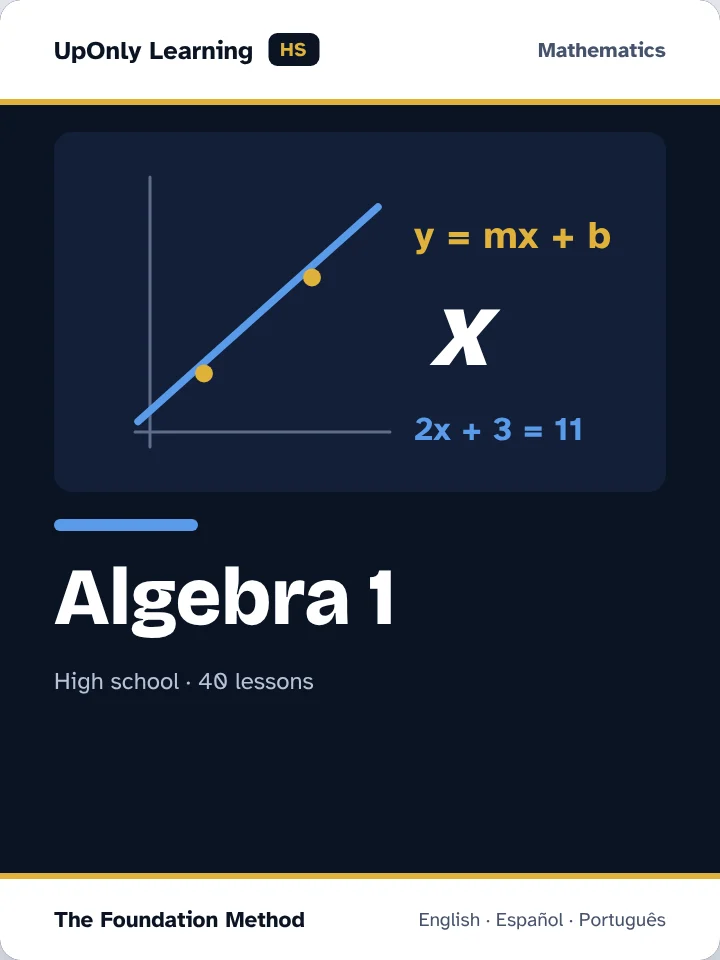 Algebra 1
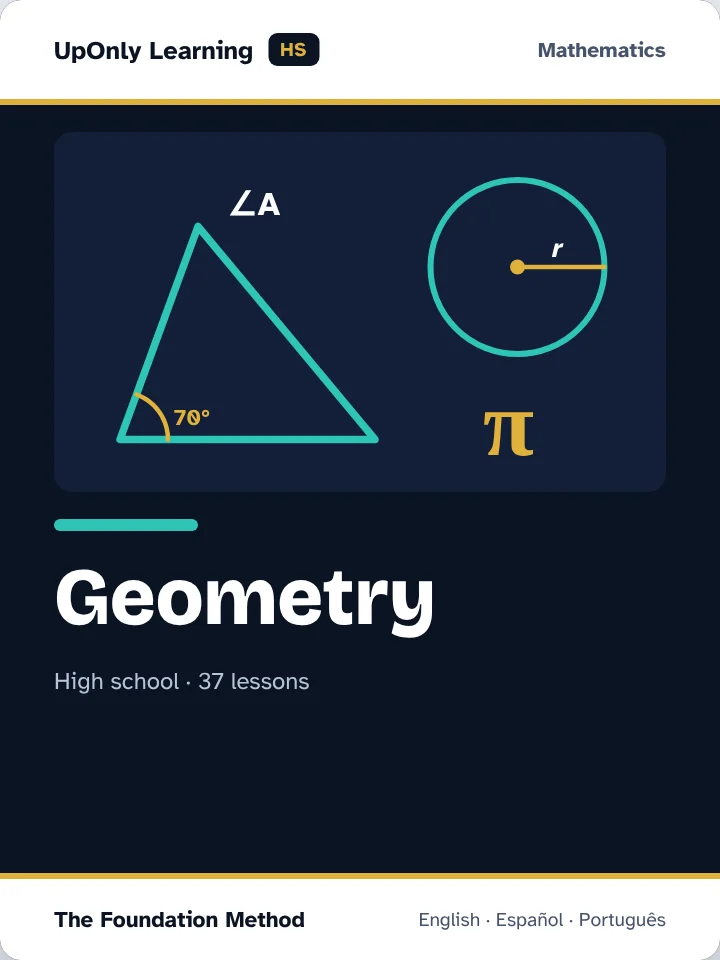 Geometry
 Biology
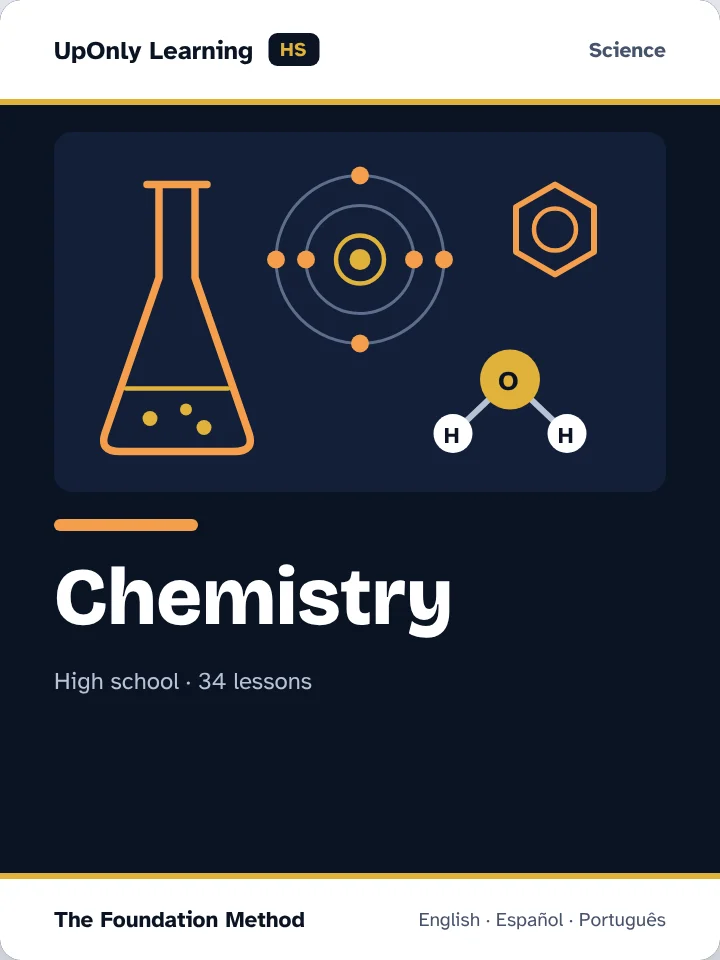 Chemistry
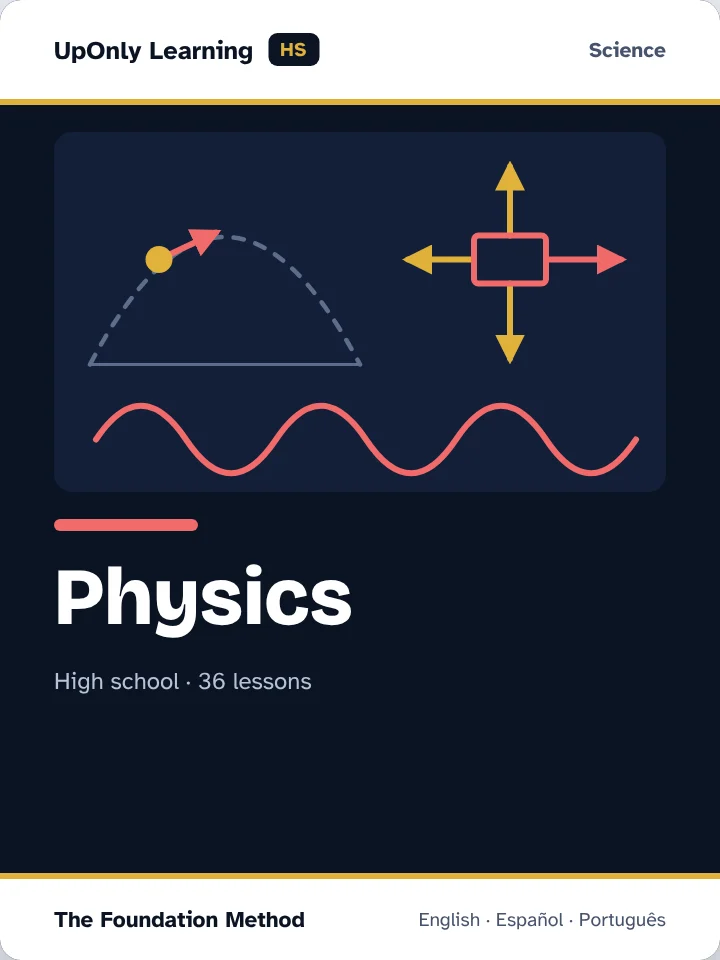 Physics
 Anatomy and Physiology
Written by Dr. Evan J. Hasson, Founder of UpOnly Learning.