
HSScience · Usually grade 11 or 12
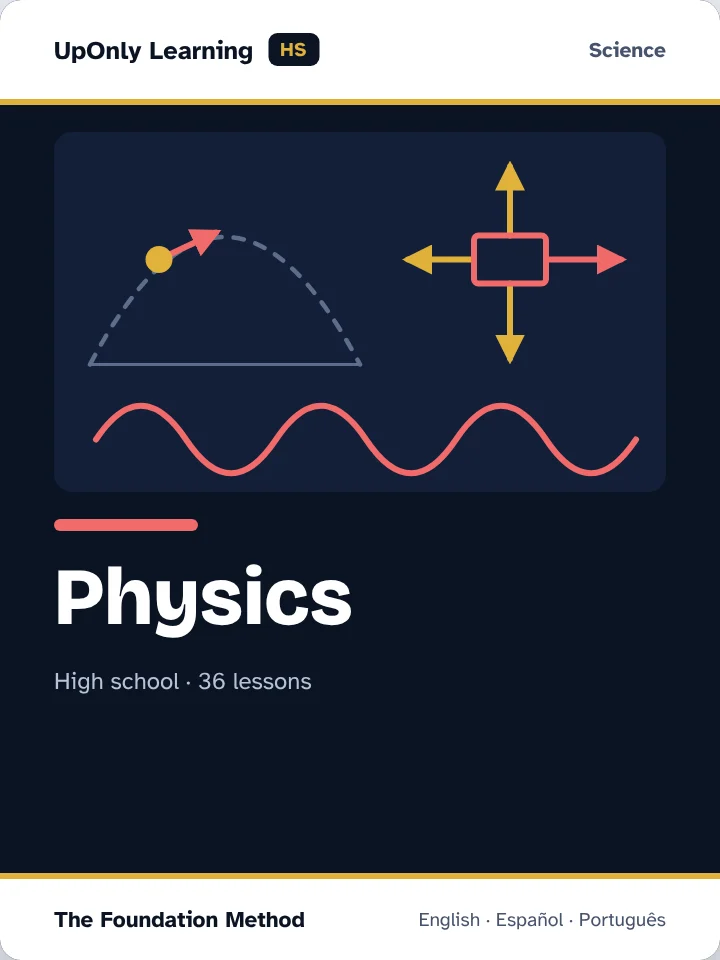
Physics
Motion, forces, energy, circuits, waves and light, with a diagram for every idea.
- 36lessons
- 4,320practice questions
- 222drawings
- 260flashcards
- EN · ES · PTEnglish, Spanish, Portuguese
Start with One Step: one high school course for $9.99 a month. Switch courses once every 30 days.
Start One StepAll 7 courses for up to 10 students: Every Step, $29.99 a month.
What this course covers
Physics explains how things move and why: what a force does, where energy goes, how a circuit carries current and how light and sound travel. Students learn to draw the situation, pick the law that fits and work out a number with units, then check that the answer makes sense. It is the science behind every engineering field and a required course for medicine, dentistry, physical therapy and most health programs.
Our course follows the Next Generation Science Standards for high school physical science in 36 lessons, with free-body diagrams, vector drawings, circuit diagrams and ray diagrams built from the numbers in each problem. It moves from motion and Newton's laws to gravity and orbits, momentum and energy, heat and fluids, electricity and magnetism, waves, sound and light, and ends with atoms and nuclear energy.
Standards: Next Generation Science Standards, high school physical sciences (HS-PS2 to HS-PS4). Every lesson lists its standard code.
By the end of the course, the student can
- Describe motion with graphs and equations, including free fall and projectiles
- Draw free-body diagrams and use Newton's laws to find forces and acceleration
- Use momentum and energy conservation to predict what happens in collisions and machines
- Solve series and parallel circuits and explain how waves, sound and light behave
Before you start: Algebra 1 and Geometry, including right triangle trigonometry; Algebra 2 can be taken at the same time.
What comes next: Anatomy and Physiology
Inside every lesson
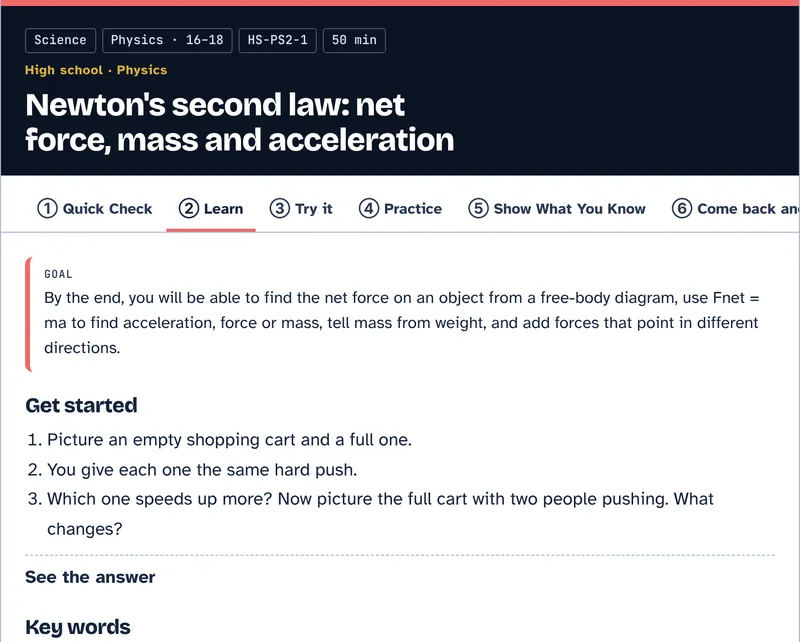
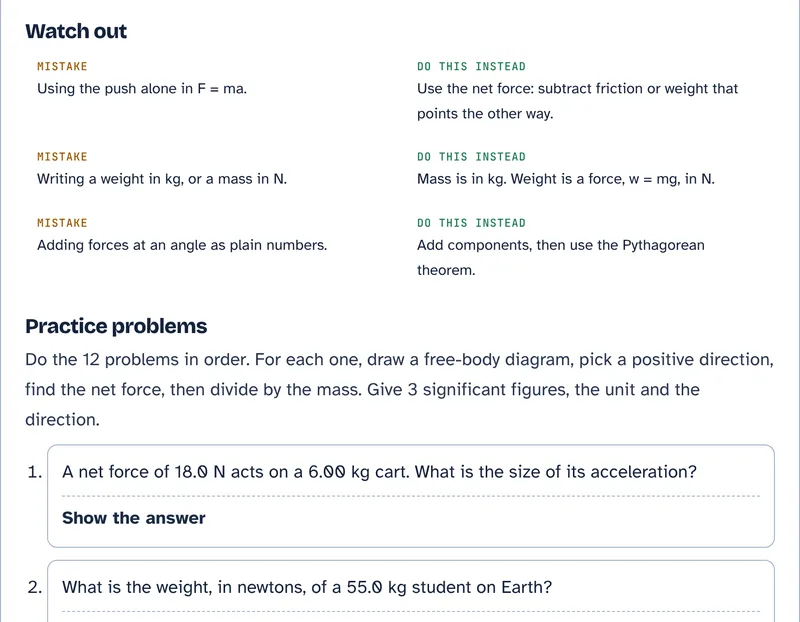
Each lesson runs the same six steps, so the student always knows what comes next. These are real screens from the Physics course.
- Quick CheckThree questions on the skills this lesson needs. Miss two or more and the lesson points to what to review first.
- LearnThe idea in plain words, key vocabulary and worked examples, with a drawing whenever it helps.
- Try itGuided problems with the first steps shown, then fewer hints each time.
- PracticeThe common mistakes with the fix, then a full set of practice problems.
- Show What You KnowA scored check from a bank of 120 questions per lesson, with an explanation for every answer.
- Come back another dayA short spaced review a few days later, so the skill stays.
Drawings from the course
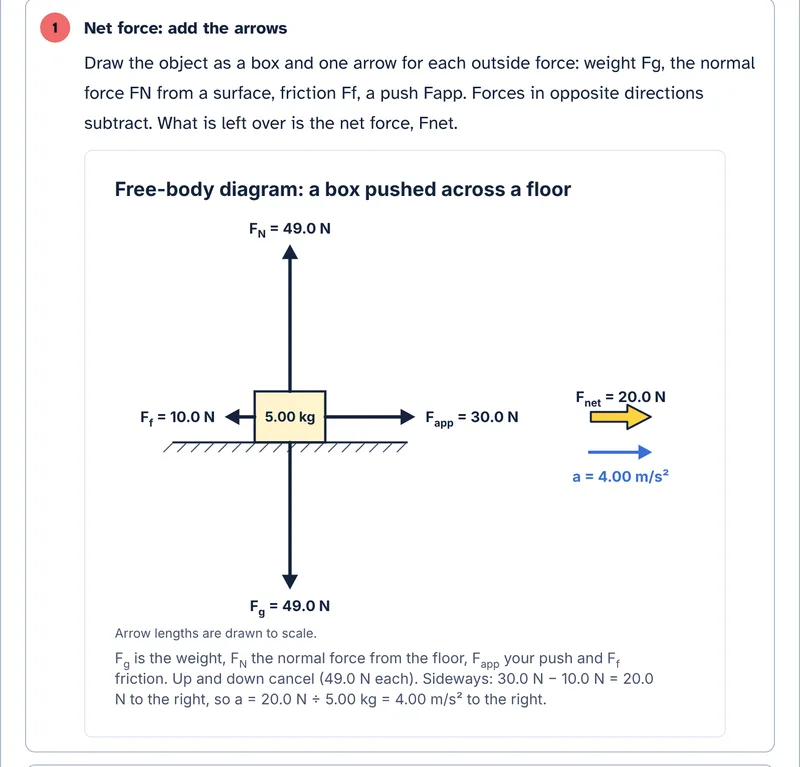
Every drawing is our own and is labeled for screen readers. A few of the 222 in this course:
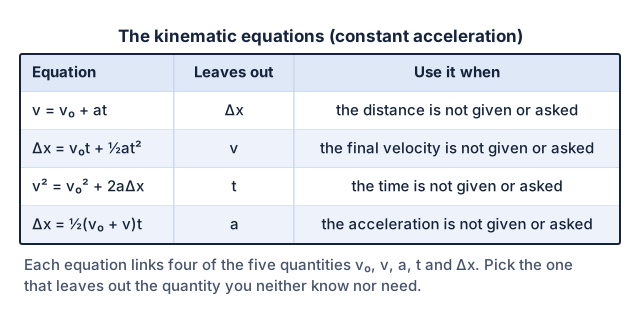
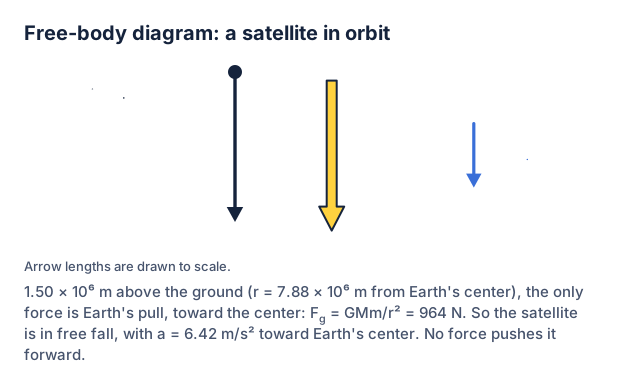
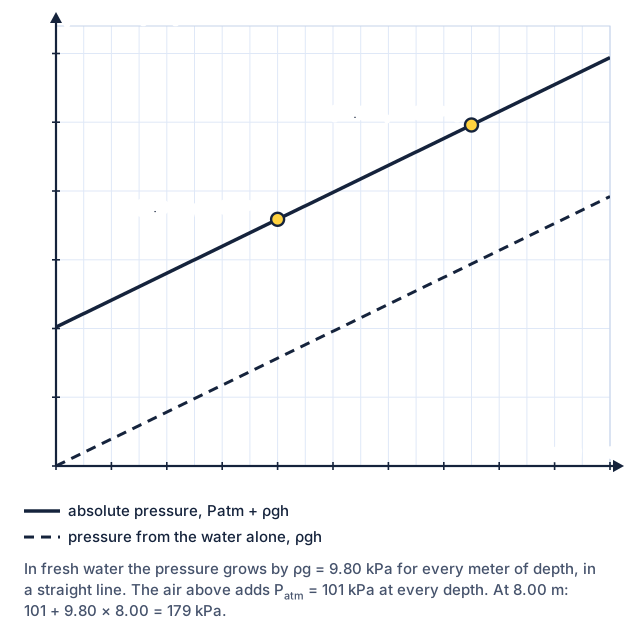
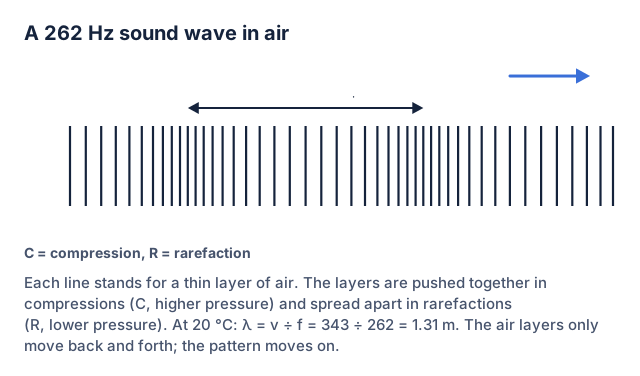
Full course outline
36 lessons in 8 units, in the order we teach them. Each lesson lists its standard. Members open any lesson from here. High school lessons are part of membership. There is no free trial lesson.
Unit 1Motion
Unit 2Forces and Newton's laws
Unit 3Gravity and orbits
Unit 4Momentum, work and energy
- 13Momentum and its conservation
HS-PS2-2 - 14Impulse and designing for safer collisions
HS-PS2-3 - 15Work and power
HS-PS3-1 - 16Forms of energy: motion and stored energy in fields
HS-PS3-2 - 17Conservation of energy: modeling energy in a system
HS-PS3-1 - 18Designing energy-conversion devices: power and efficiency
HS-PS3-3
Unit 5Heat, thermodynamics and fluids
Unit 6Electricity and magnetism
Unit 7Waves, sound and light
- 28Simple harmonic motion: springs and pendulums
HS-PS3-2 - 29Waves: frequency, wavelength and speed
HS-PS4-1 - 30Sound
HS-PS4-1 - 31Wave behavior: reflection, refraction, interference
HS-PS4-1 - 32Light as a wave and as a particle
HS-PS4-3 - 33Mirrors and lenses
HS-PS4-5 - 34Electromagnetic radiation and health
HS-PS4-4 - 35Digital information and waves
HS-PS4-2
Unit 8Modern physics
Try three practice questions
These come straight from the lesson banks, from three different lessons, from warm-up to stretch. Pick an answer, then open the explanation.
From lesson 5: Newton's first law and forces
What is the weight of a box with a mass of 2.40 kg?
Show the answer
Answer: 23.5 N. Weight is the force of gravity: Fg = mg = 2.40 kg × 9.80 m/s² = 23.5 N, downward. 2.40 kg is the mass, not the weight.
From lesson 17: Conservation of energy: modeling energy in a system
A coaster car starts at rest 22.0 m above the ground on a track with negligible friction. How fast is it moving when it is 8.00 m above the ground?
Show the answer
Answer: 16.6 m/s. Only the drop matters: Δh = 22.0 − 8.00 = 14.0 m. mgΔh = ½mv², so v = √(2 × 9.80 × 14.0) = 16.6 m/s.
From lesson 29: Waves: frequency, wavelength and speed
A 441 Hz sound travels from air (343 m/s) into fresh water (1,480 m/s). What is its wavelength in the water?
Show the answer
Answer: 3.36 m. The frequency stays 441 Hz; the speed changes. λ = 1,480 m/s ÷ 441 Hz = 3.36 m, longer than the 0.778 m in air.
Physics flashcards
260 cards with the vocabulary of every lesson, each with a definition. Flip, sort the ones you know, and review the rest. Included with membership to use on screen, or $14.99 for the set. Digital only, with no printable version.
- significant figuresThe digits in a measurement that are known, plus one estimated digit. They show how precise the measurement is.
- Newton's third lawWhen object A exerts a force on object B, B exerts a force on A that is equal in size and opposite in direction.
- conservation of momentumIn an isolated system, the total momentum before an interaction equals the total momentum after it: m₁v₁ + m₂v₂ = m₁v₁′ + m₂v₂′.
- conduction, convection, radiationHeat moves by direct contact (conduction), by a moving fluid such as air or water (convection), or by light and infrared that need no material at all (radiation).
- electromagnetic inductionMaking an emf, and a current in a closed circuit, by changing the magnetic flux through a coil.
- total internal reflectionWhen light inside a material with a larger n hits a surface at more than the critical angle, sin θc = n₂ ÷ n₁, all of it reflects back inside.
Studying more than one course? Save with a pass
Best for high school
High School Flashcards pass
$59.99one-time payment
All 7 high school courses, 1,812 cards, new courses added free
Save $44.94 compared with buying the 7 sets one at a time
Get the High School passEverything
All Flashcards pass
$79.99one-time payment
Every set on UpOnly Learning, 19 sets: high school, K to 8 and languages
Get everything for $79.99Membership includes every flashcard deck to use on screen. Printing is not included. See membership
Workbook coming soonWorkbook coming soon
A printable Physics workbook is in the works. Until then, every lesson, practice set and flashcard deck is ready online, and each lesson prints cleanly from the browser.
Where Physics leads
Physics is part of the high school preparation for these college programs and majors. Each page lists the requirements with sources.
Health professions
College majors
- Aerospace Engineering
- Astronomy
- Biology
- Biomedical Engineering
- Chemical Engineering
- Chemistry
- Civil Engineering
- Computer Engineering
- Cybersecurity
- Electrical Engineering
- Engineering: the first-year core and how to choose a major
- Environmental Engineering
- Industrial Engineering
- Information Technology
- Kinesiology and Exercise Science
- Materials Engineering
- Mechanical Engineering
- Physics
How to start today
- Become a memberStart with One Step: one high school course for $9.99 a month. Switch courses once every 30 days. For all 7 courses: Every Step is $29.99 a month or $249 a year. It opens all 7 high school courses, every K to 8 lesson and every flashcard deck for up to 10 students at home.
- Open lesson 1Start with Physics skills: units, vectors and graphs. The Quick Check takes a few minutes.
- Follow the Quick CheckIf it shows a gap, review that one skill first. Then go lesson by lesson, at your own pace.
Questions families ask
How much math does high school physics need?
Algebra 1 and the right triangle trigonometry from Geometry: solving for one variable, ratios, scientific notation, sine, cosine and tangent. Every calculation lesson writes the units at each step, and lesson 1 reviews units, vectors and graphs before the course starts.
What is a free-body diagram?
A drawing of one object with an arrow for every force on it: weight, the push of the floor, friction, a pull or a push. Lessons 5 to 10 use them throughout, because once the forces are drawn, Newton's second law gives the acceleration.
Is physics required for college?
Medicine, dentistry, physical therapy, physician assistant and veterinary programs require college physics, and every engineering major starts with it. The College prep pages below list each program's requirements with sources.
 Algebra 1
 Geometry
 Algebra 2
 Biology
 Chemistry
 Anatomy and Physiology
Written by Dr. Evan J. Hasson, Founder of UpOnly Learning.