
HSScience · Usually grade 9 or 10
Biology
From molecules and cells to DNA, evolution and whole ecosystems.
- 36lessons
- 4,320practice questions
- 136drawings
- 283flashcards
- EN · ES · PTEnglish, Spanish, Portuguese
Start with One Step: one high school course for $9.99 a month. Switch courses once every 30 days.
Start One StepAll 7 courses for up to 10 students: Every Step, $29.99 a month.
What this course covers
Biology is the study of how living things work, from the molecules inside a cell to the food webs that connect a whole ecosystem. It is the first lab science most high school students take, and it is the foundation for every health career: medicine, nursing, dentistry, physical therapy and veterinary medicine all start here.
Our course follows the Next Generation Science Standards for high school life science in 36 lessons, with 136 of our own drawings of cells, processes and cycles. It moves from how science works and the molecules of life to cells and body systems, energy in photosynthesis and respiration, DNA and protein synthesis, genetics, evolution and ecology.
Standards: Next Generation Science Standards, high school life sciences (HS-LS1 to HS-LS4). Every lesson lists its standard code.
By the end of the course, the student can
- Explain how cell parts, membranes and enzymes keep a cell alive and in balance
- Trace energy through photosynthesis and cellular respiration, and matter through the carbon cycle
- Follow DNA to protein, predict inheritance with Punnett squares and read pedigrees
- Use evidence from fossils, anatomy and DNA to explain natural selection and common ancestry
Before you start: Middle school life science and basic graph reading; no algebra is required.
What comes next: Chemistry
Inside every lesson
Each lesson runs the same six steps, so the student always knows what comes next. These are real screens from the Biology course.
- Quick CheckThree questions on the skills this lesson needs. Miss two or more and the lesson points to what to review first.
- LearnThe idea in plain words, key vocabulary and worked examples, with a drawing whenever it helps.
- Try itGuided problems with the first steps shown, then fewer hints each time.
- PracticeThe common mistakes with the fix, then a full set of practice problems.
- Show What You KnowA scored check from a bank of 120 questions per lesson, with an explanation for every answer.
- Come back another dayA short spaced review a few days later, so the skill stays.
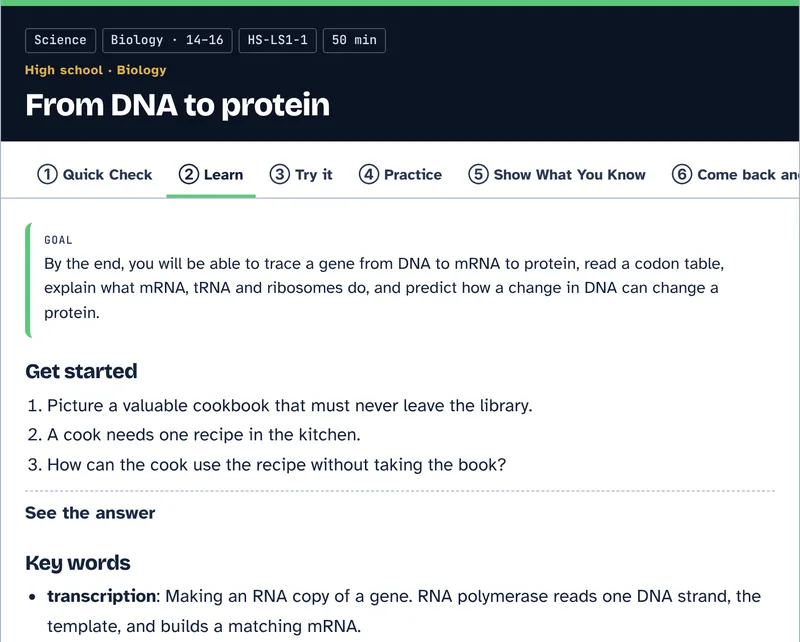
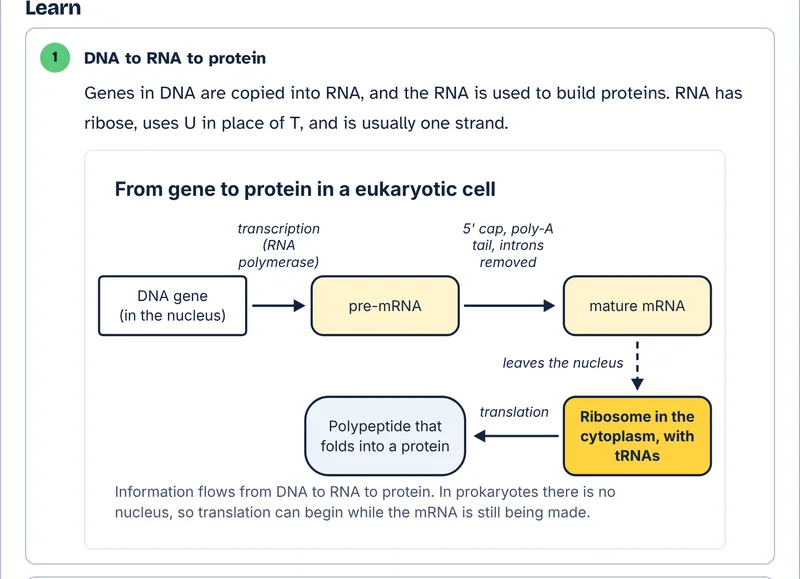
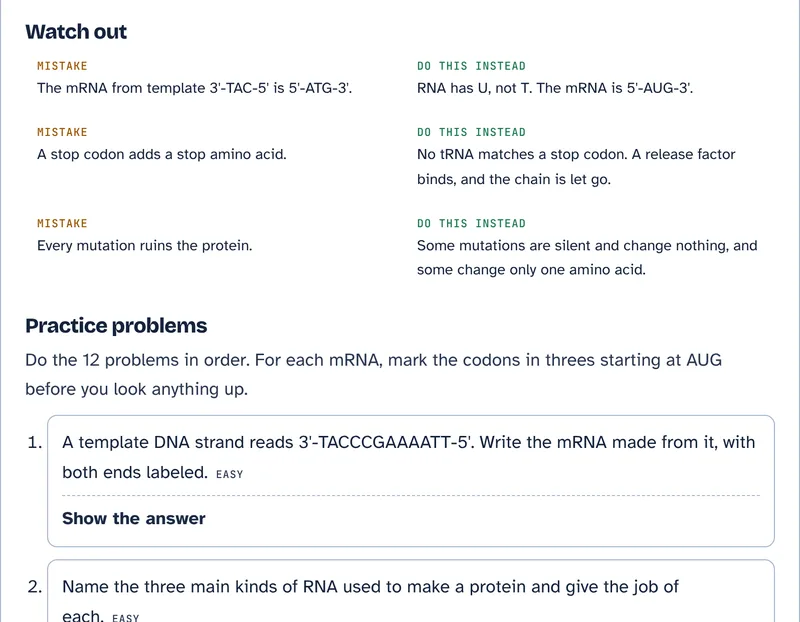
Drawings from the course
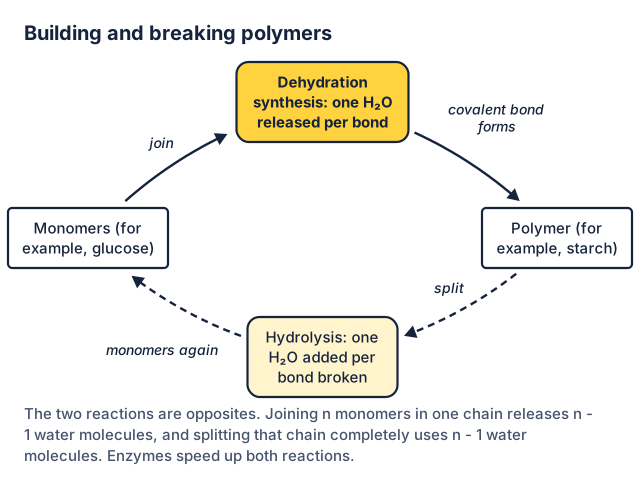
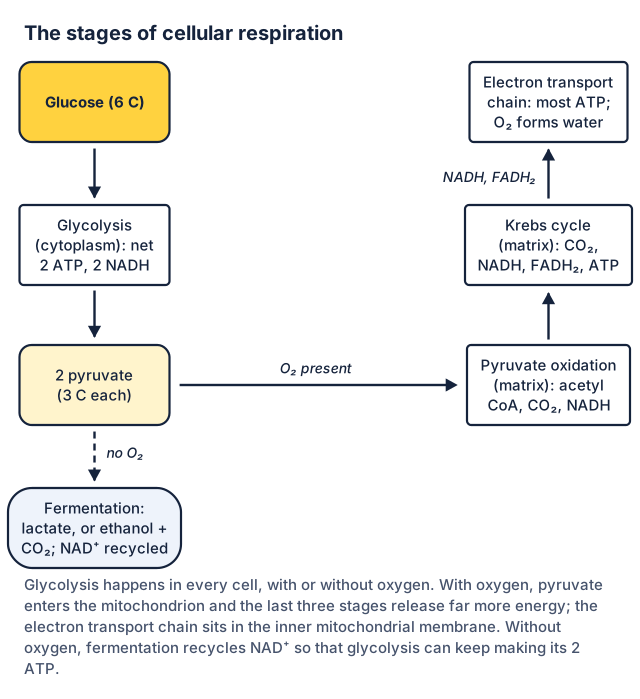
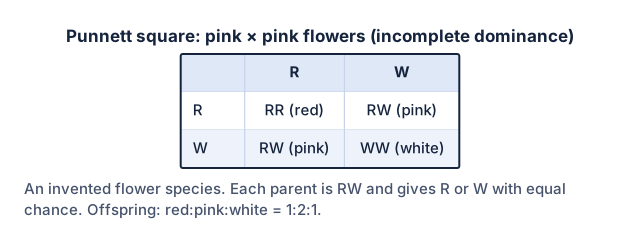
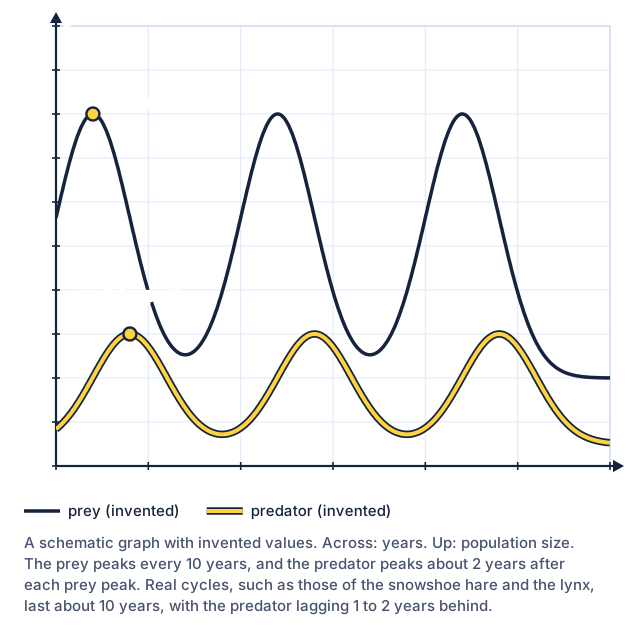
Every drawing is our own and is labeled for screen readers. A few of the 136 in this course:
Full course outline
36 lessons in 7 units, in the order we teach them. Each lesson lists its standard. Members open any lesson from here. High school lessons are part of membership. There is no free trial lesson.
Unit 1The science of life and its molecules
Unit 2Cells and body systems
Unit 3Energy in cells
Unit 4Cell growth, DNA and proteins
Unit 5Genetics and inheritance
Unit 6Evolution
Unit 7Ecology
- 28Populations and carrying capacity
HS-LS2-1 - 29Biodiversity and ecosystem factors
HS-LS2-2 - 30Ecological relationships: predation, competition and symbiosis
HS-LS2-1 - 31Energy flow in ecosystems
HS-LS2-4 - 32Matter cycling: aerobic and anaerobic processes
HS-LS2-3 - 33The carbon cycle in living systems
HS-LS2-5 - 34Ecosystem stability and change
HS-LS2-6 - 35Human impact and solutions for biodiversity
HS-LS2-7 - 36Group behavior and survival
HS-LS2-8
Try three practice questions
These come straight from the lesson banks, from three different lessons, from warm-up to stretch. Pick an answer, then open the explanation.
From lesson 5: Cell structure: prokaryotes and eukaryotes
A model cell is a cube with sides of 2 µm. What is its surface area?
Show the answer
Answer: 24 µm². A cube has 6 square faces, each 2 × 2 = 4 µm². So SA = 6 × 4 = 24 µm². Counting only 4 faces or using s³ (the volume) are common slips.
From lesson 17: Gene regulation and expression
In a model, a cell has 640 copies of an mRNA and stops making it. The mRNA has a half-life of 1 hour. How many copies are left after 3 hours?
Show the answer
Answer: 80. 3 ÷ 1 = 3 half-lives, so halve 3 times: 640 × (1/2)3 = 80. Dividing by 3 instead of halving 3 times is a common slip.
From lesson 29: Biodiversity and ecosystem factors
An invented survey found 4 species with 10, 5, 5, 5 individuals. Find the diversity index D = 1 − (sum of p²).
Show the answer
Answer: 0.72. Total = 25. Sum of p² = 0.16 + 0.04 + 0.04 + 0.04 = 0.28. D = 1 − 0.28 = 0.72. 0.75 would be D only if all 4 species had equal counts.
Biology flashcards
283 cards with the vocabulary of every lesson, each with a definition. Flip, sort the ones you know, and review the rest. Included with membership to use on screen, or $14.99 for the set. Digital only, with no printable version.
- controlled variablesFactors kept the same in every group, so they cannot explain a difference in results.
- effectorA muscle or gland that carries out the response, for example sweat glands or shivering muscles.
- centromereThe pinched region where sister chromatids are held most tightly together and where spindle fibers attach.
- autosomes and sex chromosomesHumans have 22 pairs of autosomes and 1 pair of sex chromosomes: XX in females and XY in males.
- Hardy-Weinberg modelA reference model saying that allele and genotype frequencies stay the same from generation to generation when no evolutionary force acts.
- producerAn organism that makes its own food from carbon dioxide, usually with light energy (plants, algae, cyanobacteria). Some bacteria use chemical energy instead. Also called an autotroph.
Studying more than one course? Save with a pass
Best for high school
High School Flashcards pass
$59.99one-time payment
All 7 high school courses, 1,812 cards, new courses added free
Save $44.94 compared with buying the 7 sets one at a time
Get the High School passEverything
All Flashcards pass
$79.99one-time payment
Every set on UpOnly Learning, 19 sets: high school, K to 8 and languages
Get everything for $79.99Membership includes every flashcard deck to use on screen. Printing is not included. See membership
Workbook coming soonWorkbook coming soon
A printable Biology workbook is in the works. Until then, every lesson, practice set and flashcard deck is ready online, and each lesson prints cleanly from the browser.
Where Biology leads
Biology is part of the high school preparation for these college programs and majors. Each page lists the requirements with sources.
Health professions
How to start today
- Become a memberStart with One Step: one high school course for $9.99 a month. Switch courses once every 30 days. For all 7 courses: Every Step is $29.99 a month or $249 a year. It opens all 7 high school courses, every K to 8 lesson and every flashcard deck for up to 10 students at home.
- Open lesson 1Start with Biology as a science: questions, evidence and experiments. The Quick Check takes a few minutes.
- Follow the Quick CheckIf it shows a gap, review that one skill first. Then go lesson by lesson, at your own pace.
Questions families ask
Is Biology usually taken in 9th or 10th grade?
Biology is the most common first high school science and is usually taken in grade 9 or 10. It does not require algebra, which is why many schools place it before Chemistry.
Does the course cover genetics and DNA?
Yes, in depth. Lessons 15 to 22 cover DNA structure and replication, protein synthesis, gene regulation, meiosis and mutations, Mendelian inheritance with Punnett squares, incomplete dominance, sex-linked traits, pedigrees and biotechnology.
Which careers start with high school biology?
Every health profession: medicine, nursing, dentistry, pharmacy, physical and occupational therapy, physician assistant and veterinary medicine, plus majors like biochemistry, neuroscience and kinesiology. The College prep pages below list each one's requirements.
 Algebra 1
 Geometry
 Algebra 2
 Chemistry
 Physics
 Anatomy and Physiology
Written by Dr. Evan J. Hasson, Founder of UpOnly Learning.