
HSMathematics · Usually grade 9 or 10
Geometry
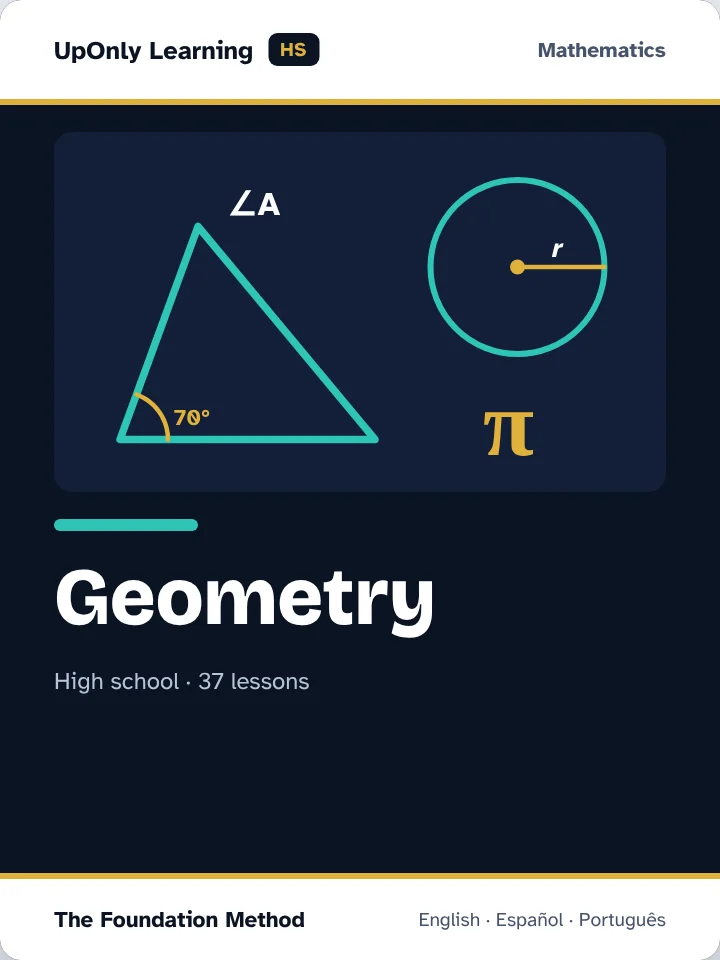
Proofs, transformations, triangles, circles and solids, with a drawing for every idea.
- 37lessons
- 4,440practice questions
- 144drawings
- 238flashcards
- EN · ES · PTEnglish, Spanish, Portuguese
Start with One Step: one high school course for $9.99 a month. Switch courses once every 30 days.
Start One StepAll 7 courses for up to 10 students: Every Step, $29.99 a month.
What this course covers
Geometry is where students learn to prove that something is true, not just to calculate it. They reason from definitions and theorems, write two-column and paragraph proofs, and use transformations to explain why two figures match. The same habit of step-by-step reasoning shows up later in writing, science and law.
Our course follows the Common Core geometry standards in 37 lessons, with 144 of our own drawings so every theorem can be seen. It moves from points and angles to proofs, congruence and similarity, then right triangle trigonometry, coordinate geometry, circles, area and volume, and closes with probability and counting.
Standards: Common Core State Standards for Mathematics, high school (Geometry course). Every lesson lists its standard code.
By the end of the course, the student can
- Write two-column and paragraph proofs about angles, triangles and parallelograms
- Prove triangles congruent or similar and use that to find missing sides and angles
- Use sine, cosine, tangent and the Pythagorean theorem to solve right triangles
- Find arc length, sector area, surface area and volume, and see how they change with scale
Before you start: Algebra 1: solving equations, slope and graphing lines, and square roots.
What comes next: Algebra 2
Inside every lesson
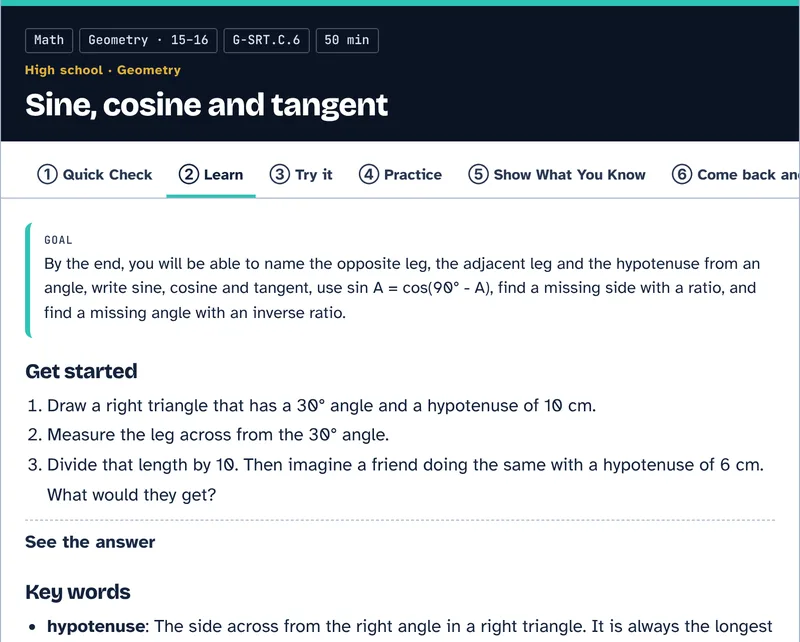
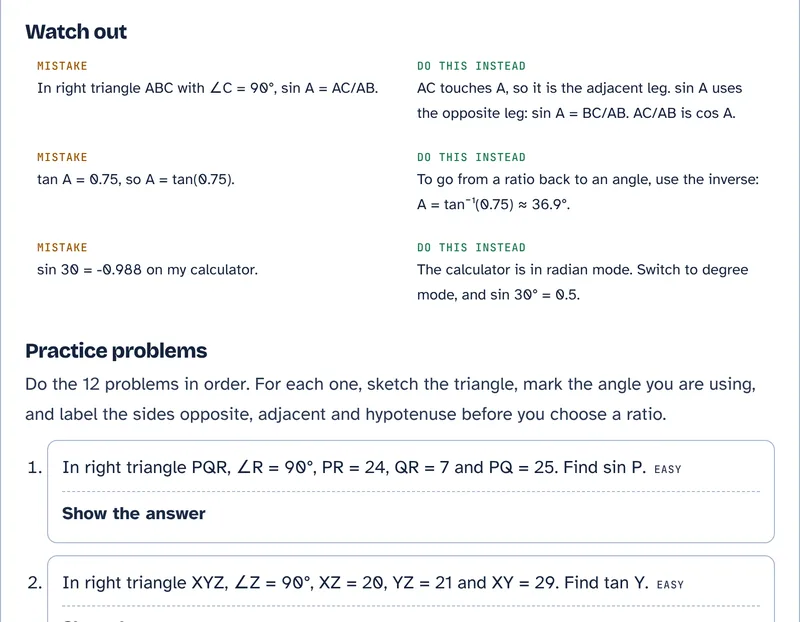
Each lesson runs the same six steps, so the student always knows what comes next. These are real screens from the Geometry course.
- Quick CheckThree questions on the skills this lesson needs. Miss two or more and the lesson points to what to review first.
- LearnThe idea in plain words, key vocabulary and worked examples, with a drawing whenever it helps.
- Try itGuided problems with the first steps shown, then fewer hints each time.
- PracticeThe common mistakes with the fix, then a full set of practice problems.
- Show What You KnowA scored check from a bank of 120 questions per lesson, with an explanation for every answer.
- Come back another dayA short spaced review a few days later, so the skill stays.
Drawings from the course
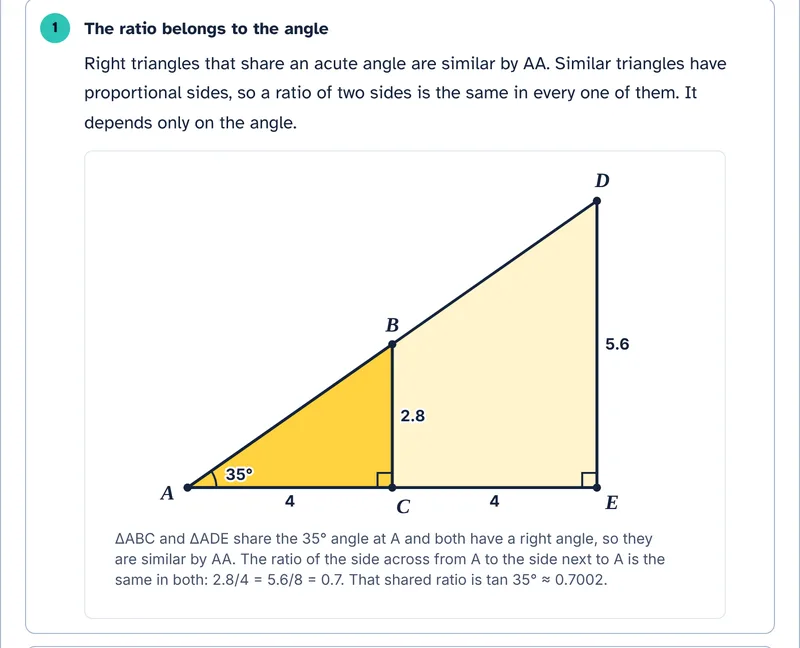
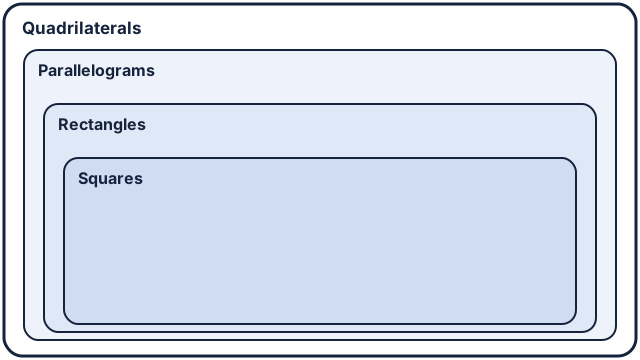
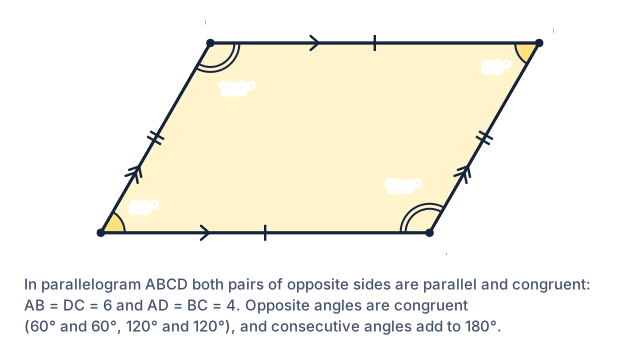
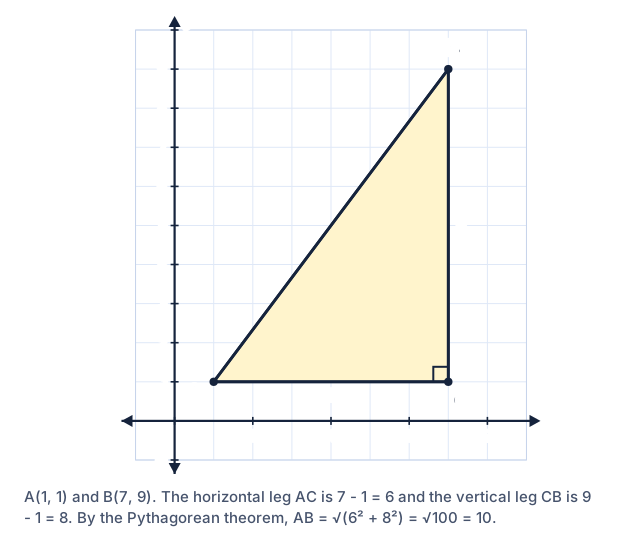
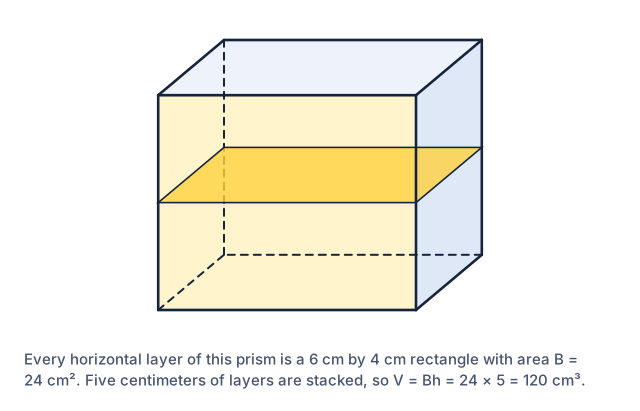
Every drawing is our own and is labeled for screen readers. A few of the 144 in this course:
Full course outline
37 lessons in 7 units, in the order we teach them. Each lesson lists its standard. Members open any lesson from here. High school lessons are part of membership. There is no free trial lesson.
Unit 1Tools of geometry and proof
Unit 2Transformations, congruence and triangle theorems
- 6Translations, reflections and rotations
G-CO.A.2 - 7Symmetry and compositions of transformations
G-CO.A.3 - 8Congruence through rigid motions
G-CO.B.6 - 9Triangle congruence: SSS, SAS, ASA, AAS, HL
G-CO.B.8 - 10Theorems about triangles
G-CO.C.10 - 11The triangle inequality and special segments
G-CO.C.10 - 12Theorems about parallelograms
G-CO.C.11 - 13Constructions with compass and straightedge
G-CO.D.12
Unit 3Similarity, right triangles and trigonometry
Unit 4Coordinate geometry
Unit 5Circles
Unit 6Area, volume and modeling
- 28Area of polygons and composite figures
G-MG.A.1 - 29Circumference and area of a circle
G-GMD.A.1 - 30Volume of prisms, cylinders, pyramids and cones
G-GMD.A.1 - 31Spheres and surface area
G-GMD.A.3 - 32Scale factors: how area and volume change
G-GMD.A.3 - 33Cross-sections and solids of revolution
G-GMD.B.4 - 34Modeling with geometry: density and design
G-MG.A.2
Unit 7Probability and counting
Try three practice questions
These come straight from the lesson banks, from three different lessons, from warm-up to stretch. Pick an answer, then open the explanation.
From lesson 5: Writing two-column and paragraph proofs
In a proof, one step goes from 3(x - 4) = 2x + 5 to 3x - 12 = 2x + 5. Which reason justifies this step?
Show the answer
Answer: Distributive property. From 3(x - 4) = 2x + 5 to 3x - 12 = 2x + 5, the number outside the parentheses was multiplied by each term inside, so the reason is the distributive property.
From lesson 17: The Pythagorean theorem and its converse
A 13 m ladder leans against a wall. Its foot is 5 m from the wall. How high up the wall does it reach?
Show the answer
Answer: 12 m. The ladder is the hypotenuse and the distance on the ground is a leg. b² = 13² - 5² = 169 - 25 = 144, so b = √144 = 12 m.
From lesson 29: Circumference and area of a circle
Two circles have the same center. Their radii are 10 cm and 6 cm. Find the area of the ring between them, in terms of π.
Show the answer
Answer: 64π cm². Subtract the inner circle from the outer one: π(10²) - π(6²) = 100π - 36π = 64π cm². Squaring the difference, π(10 - 6)², gives 16π, which is not the same.
Geometry flashcards
238 cards with the vocabulary of every lesson, each with a definition. Flip, sort the ones you know, and review the rest. Included with membership to use on screen, or $14.99 for the set. Digital only, with no printable version.
- angleA figure made of two rays that share the same endpoint, called the vertex. In angle ABC the vertex is B, the middle letter.
- translationA slide: every point moves the same distance in the same direction. Rule: (x, y) → (x + a, y + b).
- squareA parallelogram that is both a rectangle and a rhombus: four right angles and four congruent sides.
- cosineFor an acute angle A of a right triangle, cos A = (leg adjacent to ∠A) / hypotenuse.
- arc lengthThe distance along an arc, measured in units of length. For a central angle of d°, it is (d/360) × 2πr.
- ratio of lengthsFor similar figures with scale factor k, every pair of matching lengths, perimeters or circumferences has ratio k.
Studying more than one course? Save with a pass
Best for high school
High School Flashcards pass
$59.99one-time payment
All 7 high school courses, 1,812 cards, new courses added free
Save $44.94 compared with buying the 7 sets one at a time
Get the High School passEverything
All Flashcards pass
$79.99one-time payment
Every set on UpOnly Learning, 19 sets: high school, K to 8 and languages
Get everything for $79.99Membership includes every flashcard deck to use on screen. Printing is not included. See membership
Workbook coming soonWorkbook coming soon
A printable Geometry workbook is in the works. Until then, every lesson, practice set and flashcard deck is ready online, and each lesson prints cleanly from the browser.
Where Geometry leads
Geometry is part of the high school preparation for these college programs and majors. Each page lists the requirements with sources.
Health professions
College majors
- Actuarial Science
- Aerospace Engineering
- Applied Mathematics
- Civil Engineering
- Computer Engineering
- Computer Science
- Earth and Environmental Science
- Engineering: the first-year core and how to choose a major
- Health Science
- Industrial Engineering
- Information Technology
- Mathematics
- Mechanical Engineering
- Neuroscience
- Nutrition
- Psychology
- Statistics
How to start today
- Become a memberStart with One Step: one high school course for $9.99 a month. Switch courses once every 30 days. For all 7 courses: Every Step is $29.99 a month or $249 a year. It opens all 7 high school courses, every K to 8 lesson and every flashcard deck for up to 10 students at home.
- Open lesson 1Start with Points, lines, planes and precise definitions. The Quick Check takes a few minutes.
- Follow the Quick CheckIf it shows a gap, review that one skill first. Then go lesson by lesson, at your own pace.
Questions families ask
Should Geometry come before or after Algebra 2?
In the usual sequence it comes between them: Algebra 1, then Geometry, then Algebra 2. Geometry uses Algebra 1 skills constantly (solving for x in angle and similarity problems, slope in coordinate proofs), and Algebra 2 later uses the right triangle trigonometry learned here.
How does the course teach proofs?
Proofs start in lesson 3 with conditional statements and grow in small steps: angle pairs, then two-column and paragraph proofs, then triangle congruence and parallelogram theorems. Every proof lesson has a worked proof, the reasons students forget to write, and practice that checks each step.
Does the course include trigonometry?
Yes, right triangle trigonometry: the Pythagorean theorem, special right triangles, sine, cosine and tangent, and angles of elevation and depression (lessons 17 to 20). The unit circle and trigonometric graphs come later in Algebra 2.
 Algebra 1
 Algebra 2
 Biology
 Chemistry
 Physics
 Anatomy and Physiology
Written by Dr. Evan J. Hasson, Founder of UpOnly Learning.