
Money & Economics · free reference
Part 6: Borrowing, interest and credit scores
How borrowing works, Credit reports and scores and Paying for college: student aid basics. Every fact lists its source, and you can share a link to any topic.
How borrowing works
In short: Borrowing lets you have something now and pay later, but borrowed money must be paid back, plus a fee called interest.[1]
Facts
- A loan lets you have something now and pay for it later.[1]3–5
- Borrowed money is not your money. It has to be paid back.[1]3–5
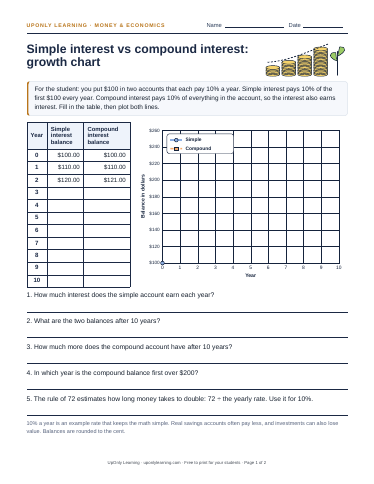
- The fee you pay for borrowing money is called interest.[1]3–5
- It is very important to pay loans back on time.[1]3–5
- The amount of money you borrow is called the principal, and the time you take to pay it back is called the term.[1]6–8
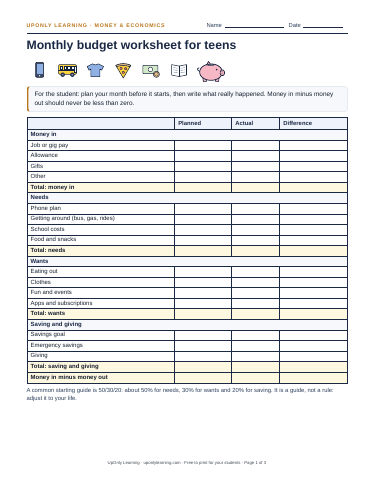
- Before borrowing from any lender, think about your income, your expenses and whether you can pay the loan back.[1]6–8
Go deeper: for teens and grown-ups (2)
Key words in three languages
| English | Spanish | Portuguese |
|---|---|---|
| loan[3] | préstamo[4] | empréstimo[5] |
| interest[1] | interés[4] | juros[5] |
| principal[1] | capital[4] | not sourced yet |
| annual percentage rate[2] | tasa de porcentaje anual[4] | not sourced yet |
| lender[1] | prestamista[4] | credor[5] |
Each word cites a page that uses it.
Practice this
- Life Skills practice questions, Grade 7Questions from every Life Skills topic in the grade, with answers · freeFree
- Life Skills practice questions, Grade 8Questions from every Life Skills topic in the grade, with answers · freeFree
- Business practice questions, Grade 7Questions from every Business topic in the grade, with answers · freeFree
- Lesson: Saving goals, compound interest and the basics of creditGrade 7 · free sample lessonFree
- Lesson: Credit, loans and debtGrade 8 · free sample lessonFree
- Lesson: Accounts, compound interest and creditGrade 7 · free sample lessonFree
Sources (5)
- Federal Deposit Insurance Corporation, Money Smart News for Kids · Chapter 7: Loans and Credit · fdic.gov/resources/consumers/money-smart/money-smart-news/kids/chapter-7.html (checked Oct 27, 2026)
- Consumer Financial Protection Bureau · What is the difference between a mortgage interest rate and an APR? · consumerfinance.gov/ask-cfpb/what-is-the-difference-between-a-mortgage-interest-rate-and-an-apr-en-135 (checked Oct 27, 2026)
- Federal Deposit Insurance Corporation, Money Smart News for Kids · What Is a Bank? · fdic.gov/resources/consumers/money-smart/money-smart-news/kids/documents/ch1.pdf (checked Oct 27, 2026)
- Consumer Financial Protection Bureau · Glossary of English-Spanish financial terms (Spanish style guide and glossary) · files.consumerfinance.gov/f/documents/cfpb_adult-fin-ed_spanish-style-guide-glossary.pdf (checked Oct 27, 2026)
- Wikipédia em português · Juro · pt.wikipedia.org/wiki/Juro (checked Oct 27, 2026)
See something we should correct about “How borrowing works”? Tell us.
Credit reports and scores
In short: Your credit depends on how you paid back loans. You can see your credit reports free once a week, and most credit scores range from 300 to 850.[1][2][3]
Facts
- Your credit is your ability to get a loan, based on how you paid back other loans.[1]6–8
Go deeper: for teens and grown-ups (5)
- Anyone with a credit report can see it online for free once a week at AnnualCreditReport.com.[2]Teens
- The three major credit reporting companies are Equifax, Experian and TransUnion.[2]Teens
- A credit score is a prediction of how you will handle credit, such as how likely you are to pay a loan back on time.[3]Teens
- Most credit scores range from 300 to 850.[3]Teens
- Scores usually look at your bill-paying history, how much you still owe, how much of your available credit you are using and new applications for credit.[3]Teens
Sources (4)
- Federal Deposit Insurance Corporation, Money Smart News for Kids · Chapter 7: Loans and Credit · fdic.gov/resources/consumers/money-smart/money-smart-news/kids/chapter-7.html (checked Oct 27, 2026)
- Consumer Financial Protection Bureau · How do I get a free copy of my credit reports? · consumerfinance.gov/ask-cfpb/how-do-i-get-a-free-copy-of-my-credit-reports-en-5 (checked Oct 27, 2026)
- Consumer Financial Protection Bureau · What is a credit score? · consumerfinance.gov/ask-cfpb/what-is-a-credit-score-en-315 (checked Oct 27, 2026)
- Consumer Financial Protection Bureau · Glossary of English-Spanish financial terms (Spanish style guide and glossary) · files.consumerfinance.gov/f/documents/cfpb_adult-fin-ed_spanish-style-guide-glossary.pdf (checked Oct 27, 2026)
See something we should correct about “Credit reports and scores”? Tell us.
Paying for college: student aid basics
In short: The FAFSA is the free form students use to find out if they can get federal help paying for school.[1]
Facts
- Students use the FAFSA, the Free Application for Federal Student Aid, to learn if they can get help paying for school.[1]Teens
- Filling out and sending the FAFSA is free, and it opens the door to the largest source of financial aid for school.[1]Teens
- For the 2026–27 school year, the federal deadline to send the FAFSA is June 30, 2027.[1]Teens
Key words in three languages
Each word cites a page that uses it.
Practice this
- Life Skills practice questions, Grade 7Questions from every Life Skills topic in the grade, with answers · freeFree
- Life Skills practice questions, Grade 8Questions from every Life Skills topic in the grade, with answers · freeFree
- Lesson: Career exploration: interests, skills and pathwaysGrade 7 · full lesson with practice and a checkMembers
- Lesson: Setting long-term goals and planning for high schoolGrade 8 · full lesson with practice and a checkMembers
Each word cites a page that uses it.
Sources (2)
- USAGov (General Services Administration) · Free Application for Federal Student Aid (FAFSA) · usa.gov/fafsa (checked Oct 27, 2026)
- Consumer Financial Protection Bureau · Glossary of English-Spanish financial terms (Spanish style guide and glossary) · files.consumerfinance.gov/f/documents/cfpb_adult-fin-ed_spanish-style-guide-glossary.pdf (checked Oct 27, 2026)
See something we should correct about “Paying for college: student aid basics”? Tell us.
Free printables for this part
Printables that go with the topics on this page.
Every printable comes in full color and in black and white line art (low ink, ready to color in).
Questions parents ask
What is a credit score?
A credit score is a prediction of how you will handle credit, such as how likely you are to pay a loan back on time.[1] Most credit scores range from 300 to 850.[1] Scores usually look at your bill-paying history, how much you still owe, how much of your available credit you are using and new applications for credit.[1] Anyone with a credit report can see it online for free once a week at AnnualCreditReport.com.[2]
What is interest on a loan?
The fee you pay for borrowing money is called interest.[3] The amount of money you borrow is called the principal, and the time you take to pay it back is called the term.[3] An interest rate is the yearly cost of borrowing money, shown as a percentage. It does not include fees.[4] The annual percentage rate (APR) is a broader measure of what borrowing costs, because it also counts fees and other charges.[4]
Is the FAFSA free?
Students use the FAFSA, the Free Application for Federal Student Aid, to learn if they can get help paying for school.[5] Filling out and sending the FAFSA is free, and it opens the door to the largest source of financial aid for school.[5] For the 2026–27 school year, the federal deadline to send the FAFSA is June 30, 2027.[5]
Sources for these answers (5)
- Consumer Financial Protection Bureau · What is a credit score? · consumerfinance.gov/ask-cfpb/what-is-a-credit-score-en-315 (checked Oct 27, 2026)
- Consumer Financial Protection Bureau · How do I get a free copy of my credit reports? · consumerfinance.gov/ask-cfpb/how-do-i-get-a-free-copy-of-my-credit-reports-en-5 (checked Oct 27, 2026)
- Federal Deposit Insurance Corporation, Money Smart News for Kids · Chapter 7: Loans and Credit · fdic.gov/resources/consumers/money-smart/money-smart-news/kids/chapter-7.html (checked Oct 27, 2026)
- Consumer Financial Protection Bureau · What is the difference between a mortgage interest rate and an APR? · consumerfinance.gov/ask-cfpb/what-is-the-difference-between-a-mortgage-interest-rate-and-an-apr-en-135 (checked Oct 27, 2026)
- USAGov (General Services Administration) · Free Application for Federal Student Aid (FAFSA) · usa.gov/fafsa (checked Oct 27, 2026)