
Money & Economics · free reference
Part 7: Investing basics: stocks, bonds and funds
Interest and time, What is a stock?, Bonds, Mutual funds and index funds, Risk and diversification, How stock markets work, Retirement accounts and Accounts for kids. Every fact lists its source, and you can share a link to any topic.
Interest and time
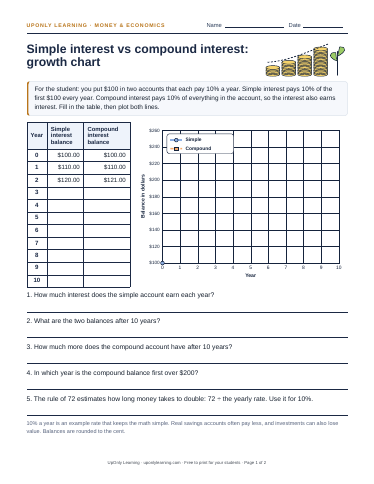
In short: When money earns interest, the interest can earn interest too. That is compound interest, and the longer money is left alone, the more it grows.[1]
Facts
- Compound interest means earning interest on your interest.[1]3–5
- If $100 earns 5 percent interest a year, you have $105 after one year.[1]3–5
- After the second year you have $110.25, because the interest now also earns interest.[1]6–8
- Left alone at 5 percent, that $100 grows to more than $162 in 10 years and almost $340 in 25 years.[1]6–8
- The Rule of 72 tells you about how long it takes money to double in value.[1]6–8
- For example, at a 9 percent yearly return, money doubles about every 8 years.[1]6–8
Key words in three languages
| English | Spanish | Portuguese |
|---|---|---|
| compound interest[1] | interés compuesto[2] | juros compostos[3] |
| interest rate[4] | tasa de interés[2] | taxa de juros[5] |
Each word cites a page that uses it.
Practice this
- Life Skills practice questions, Grade 5Questions from every Life Skills topic in the grade, with answers · freeFree
- Life Skills practice questions, Grade 7Questions from every Life Skills topic in the grade, with answers · freeFree
- Lesson: Saving goals, compound interest and the basics of creditGrade 7 · free sample lessonFree
- Lesson: Saving, banks and interestGrade 5 · full lesson with practice and a checkMembers
Members-only lessons are marked. The practice pages by grade and The Business You Build check are free.
Sources (5)
- U.S. Securities and Exchange Commission, Investor.gov · What is compound interest? · investor.gov/additional-resources/information/youth/teachers-classroom-resources/what-compound-interest (checked Oct 27, 2026)
- Consumer Financial Protection Bureau · Glossary of English-Spanish financial terms (Spanish style guide and glossary) · files.consumerfinance.gov/f/documents/cfpb_adult-fin-ed_spanish-style-guide-glossary.pdf (checked Oct 27, 2026)
- Wikipédia em português · Juro · pt.wikipedia.org/wiki/Juro (checked Oct 27, 2026)
- Consumer Financial Protection Bureau · What is the difference between a mortgage interest rate and an APR? · consumerfinance.gov/ask-cfpb/what-is-the-difference-between-a-mortgage-interest-rate-and-an-apr-en-135 (checked Oct 27, 2026)
- Wikipédia em português · Banco central · pt.wikipedia.org/wiki/Banco_central (checked Oct 27, 2026)
See something we should correct about “Interest and time”? Tell us.
What is a stock?
In short: A share of stock is a small piece of a company. Stock prices can go down as well as up, so people can lose money.[1]
Facts
- When you own a share of stock, you own a small part of a company.[1]6–8
- Companies sell stock to raise money for things they need.[1]6–8
- Stock prices go down as well as up, so people can lose money on stocks.[1]6–8
Go deeper: for teens and grown-ups (4)
- Some companies pay dividends: they share part of their earnings with the people who own their stock.[1]Teens
- There are two main kinds of stock: common stock and preferred stock.[1]Teens
- Stocks of large companies, as a group, have lost money on average about one year out of every three.[1]Teens
- Brokers buy and sell shares for customers for a fee, called a commission.[1]Teens
Key words in three languages
| English | Spanish | Portuguese |
|---|---|---|
| stock[1] | acciones[2] | ações[3] |
| dividend[1] | dividendo[4] | dividendos[3] |
| broker[1] | corredor[4] | corretora[3] |
Each word cites a page that uses it.
Practice this
- Business practice questions, Grade 8Questions from every Business topic in the grade, with answers · freeFree
- Lesson: Loans, investors and crowdfundingGrade 8 · full lesson with practice and a checkMembers
Members-only lessons are marked. The practice pages by grade and The Business You Build check are free.
Sources (4)
- U.S. Securities and Exchange Commission, Investor.gov · Stocks · investor.gov/introduction-investing/investing-basics/investment-products/stocks (checked Oct 27, 2026)
- Wikipedia en español · Bolsa de valores · es.wikipedia.org/wiki/Bolsa_de_valores (checked Oct 27, 2026)
- Wikipédia em português · Ação (finanças) · pt.wikipedia.org/wiki/A%C3%A7%C3%A3o_(finan%C3%A7as) (checked Oct 27, 2026)
- Consumer Financial Protection Bureau · Glossary of English-Spanish financial terms (Spanish style guide and glossary) · files.consumerfinance.gov/f/documents/cfpb_adult-fin-ed_spanish-style-guide-glossary.pdf (checked Oct 27, 2026)
See something we should correct about “What is a stock?”? Tell us.
Bonds
In short: A bond is like an IOU: the buyer lends money to a government or company, which usually pays interest on a schedule, unless it defaults.[1]
Facts
- A bond is like an IOU: the buyer lends money to a government or company for a set amount of time.[1]6–8
Go deeper: for teens and grown-ups (5)
- Bonds can be issued by a government, a city or other local government, or a corporation.[1]Teens
- U.S. Treasury bonds are issued by the Treasury Department on behalf of the U.S. government.[1]Teens
- Bonds usually pay interest on a regular schedule, such as every six months.[1]Teens
- Bonds carry risk too: the issuer might not pay the interest or the money back on time. That is called a default.[1]Teens
- When interest rates change, the value of a bond can change too. An older bond with a lower rate may have to be sold at a discount.[1]Grown-ups
Key words in three languages
| English | Spanish | Portuguese |
|---|---|---|
| bond[1] | bono[2] | not sourced yet |
| debt[1] | deuda[2] | endividamento[3] |
| default[1] | incumplimiento[2] | not sourced yet |
Each word cites a page that uses it.
Practice this
- Business practice questions, Grade 5Questions from every Business topic in the grade, with answers · freeFree
- Lesson: Banks, loans and interestGrade 5 · full lesson with practice and a checkMembers
- Lesson: Loans, investors and crowdfundingGrade 8 · full lesson with practice and a checkMembers
Each word cites a page that uses it.
Sources (3)
- U.S. Securities and Exchange Commission, Investor.gov · Bonds · investor.gov/introduction-investing/investing-basics/investment-products/bonds-or-fixed-income-products/bonds (checked Oct 27, 2026)
- Consumer Financial Protection Bureau · Glossary of English-Spanish financial terms (Spanish style guide and glossary) · files.consumerfinance.gov/f/documents/cfpb_adult-fin-ed_spanish-style-guide-glossary.pdf (checked Oct 27, 2026)
- Wikipédia em português · Educação financeira · pt.wikipedia.org/wiki/Educa%C3%A7%C3%A3o_financeira (checked Oct 27, 2026)
See something we should correct about “Bonds”? Tell us.
Mutual funds and index funds
In short: A mutual fund pools money from many people and invests it together. An index fund tries to match the returns of a market index.[1][2]
Facts
- A mutual fund pools money from many people and invests it together.[1]6–8
Go deeper: for teens and grown-ups (7)
- Because a fund holds many investments, one company failing hurts less.[1]Teens
- Mutual funds are run by investment advisers registered with the SEC.[1]Teens
- Mutual funds are not guaranteed or insured by the FDIC or any other government agency.[1]Teens
- An index fund is a mutual fund or exchange-traded fund (ETF) that tries to match the returns of a market index.[2]Teens
- Funds charge fees and expenses, which are taken out of the fund’s value.[1]Grown-ups
- Index funds usually invest in a passive way, which may let them save on costs.[2]Grown-ups
- An index fund has the same general risks as the investments in the index it follows, and it may not match its index perfectly.[2]Grown-ups
Key words in three languages
| English | Spanish | Portuguese |
|---|---|---|
| mutual fund[1] | fondo mutuo[3] | fundo de investimento[4] |
| index fund[2] | fondos indexados[3] | not sourced yet |
| fees[1] | comisiones[3] | taxa de administração[4] |
Each word cites a page that uses it.
Practice this
We do not have a lesson on this yet. The facts above are the teaching here.
Sources (4)
- U.S. Securities and Exchange Commission, Investor.gov · Mutual Funds · investor.gov/introduction-investing/investing-basics/investment-products/mutual-funds-and-exchange-traded-1 (checked Oct 27, 2026)
- U.S. Securities and Exchange Commission, Investor.gov · Index Funds · investor.gov/introduction-investing/basics/investment-products/index-funds (checked Oct 27, 2026)
- Wikipedia en español · Fondo de inversión · es.wikipedia.org/wiki/Fondo_de_inversi%C3%B3n (checked Oct 27, 2026)
- Wikipédia em português · Fundo de investimento · pt.wikipedia.org/wiki/Fundo_de_investimento (checked Oct 27, 2026)
See something we should correct about “Mutual funds and index funds”? Tell us.
Risk and diversification
In short: Spreading money among different investments is called diversification, and it lowers risk.[1]
Facts
- Diversification means spreading money among different investments to lower risk: “don’t put all your eggs in one basket.”[1]6–8
Go deeper: for teens and grown-ups (4)
- Asset allocation means dividing your investments among different kinds of assets, such as stocks, bonds and cash.[1]Teens
- Risk tolerance is how able and willing you are to lose some or all of the money you put in.[1]Teens
- How long you plan to invest is called your time horizon.[1]Teens
- Rebalancing means bringing your investments back to the mix you first chose.[1]Grown-ups
Key words in three languages
| English | Spanish | Portuguese |
|---|---|---|
| diversification[1] | diversificación[2] | diversificação[3] |
| asset allocation[1] | asignación de activos[2] | not sourced yet |
| portfolio[1] | cartera[2] | not sourced yet |
Each word cites a page that uses it.
Practice this
- Business practice questions, Grade 8Questions from every Business topic in the grade, with answers · freeFree
- Lesson: Managing business risk and insuranceGrade 8 · full lesson with practice and a checkMembers
Members-only lessons are marked. The practice pages by grade and The Business You Build check are free.
Sources (3)
- U.S. Securities and Exchange Commission, Investor.gov · Beginners’ Guide to Asset Allocation, Diversification, and Rebalancing · investor.gov/introduction-investing/getting-started/asset-allocation (checked Oct 27, 2026)
- Consumer Financial Protection Bureau · Glossary of English-Spanish financial terms (Spanish style guide and glossary) · files.consumerfinance.gov/f/documents/cfpb_adult-fin-ed_spanish-style-guide-glossary.pdf (checked Oct 27, 2026)
- Wikipédia em português · Fundo de investimento · pt.wikipedia.org/wiki/Fundo_de_investimento (checked Oct 27, 2026)
See something we should correct about “Risk and diversification”? Tell us.
How stock markets work
In short: The New York Stock Exchange traces its start to 1792. Today’s national securities exchanges register with the SEC, and market indexes follow groups of stocks.[1][2][3]
Facts
- The New York Stock Exchange traces its start to the Buttonwood Agreement, signed by 24 stockbrokers on May 17, 1792.[1]6–8
- A market index follows the ups and downs of a “basket” of stocks that stands for a market or part of the economy.[3]6–8
Go deeper: for teens and grown-ups (3)
- The exchange adopted a constitution on March 8, 1817.[1]Teens
- A national securities exchange is an exchange registered with the SEC under the Securities Exchange Act of 1934. The New York Stock Exchange and Nasdaq are on the SEC’s list. Exchanges are marketplaces that register with the SEC; they are not the regulator.[2]Teens
- The Dow Jones Industrial Average is an index of 30 large U.S. company stocks. The S&P 500 is another well-known index. Index names are examples, not recommendations.[3]Teens
Key words in three languages
| English | Spanish | Portuguese |
|---|---|---|
| securities exchange[2] | bolsa de valores[4] | bolsa de valores[5] |
| investors[6] | inversionistas[4] | investidores[5] |
Each word cites a page that uses it.
Practice this
- Business practice questions, Grade 8Questions from every Business topic in the grade, with answers · freeFree
- Lesson: Loans, investors and crowdfundingGrade 8 · full lesson with practice and a checkMembers
Each word cites a page that uses it.
Sources (6)
- New York Stock Exchange (Intercontinental Exchange) · History of NYSE · nyse.com/history-of-nyse (checked Oct 27, 2026)
- U.S. Securities and Exchange Commission · National Securities Exchanges · sec.gov/about/divisions-offices/division-trading-markets/national-securities-exchanges (checked Oct 27, 2026)
- U.S. Securities and Exchange Commission, Investor.gov · Market Indices · investor.gov/introduction-investing/investing-basics/glossary/market-indices (checked Oct 27, 2026)
- Wikipedia en español · Bolsa de valores · es.wikipedia.org/wiki/Bolsa_de_valores (checked Oct 27, 2026)
- Wikipédia em português · Bolsa de valores · pt.wikipedia.org/wiki/Bolsa_de_valores (checked Oct 27, 2026)
- U.S. Securities and Exchange Commission · Mission · sec.gov/about/mission (checked Oct 27, 2026)
See something we should correct about “How stock markets work”? Tell us.
Retirement accounts
In short: IRAs and 401(k)s are savings plans for retirement with tax benefits. To put money in an IRA, you need taxable compensation, such as pay from a job.[1][2]
Facts
- An IRA (individual retirement arrangement) is a personal savings plan with tax benefits, meant for retirement.[1]Teens
- To put money in an IRA, you (or your spouse, on a joint return) must have taxable compensation, such as pay from a job.[1]Teens
- There is no age limit for making regular contributions to a traditional or Roth IRA.[3]Grown-ups
- For 2026, the most you can put into all your IRAs is $7,500 ($8,600 if you are 50 or older), or your taxable compensation for the year if that is less.[3]Grown-ups
- With a traditional IRA, you may be able to deduct some or all of what you put in.[1]Grown-ups
- With a Roth IRA, what you put in is not deductible, but earnings on qualified withdrawals are not taxed.[1]Grown-ups
- A 401(k) is a retirement plan offered through a job. Workers put in part of their pay, and employers can add money to workers’ accounts.[2]Grown-ups
Key words in three languages
| English | Spanish | Portuguese |
|---|---|---|
| retirement[1] | jubilación[4] | aposentadoria[5] |
| pensions[6] | pensión[7] | not sourced yet |
Each word cites a page that uses it.
Practice this
- Life Skills practice questions, Grade 7Questions from every Life Skills topic in the grade, with answers · freeFree
- Lesson: Saving goals, compound interest and the basics of creditGrade 7 · free sample lessonFree
Each word cites a page that uses it.
Sources (7)
- Internal Revenue Service · Topic no. 451, Individual retirement arrangements (IRAs) · irs.gov/taxtopics/tc451 (page updated Sep 24, 2026; checked Oct 27, 2026)
- Internal Revenue Service · 401(k) plans · irs.gov/retirement-plans/401k-plans (page updated Jan 30, 2026; checked Oct 27, 2026)
- Internal Revenue Service · Retirement topics: IRA contribution limits · irs.gov/retirement-plans/plan-participant-employee/retirement-topics-ira-contribution-limits (page updated Sep 23, 2026; checked Oct 27, 2026)
- Wikipedia en español · Educación financiera · es.wikipedia.org/wiki/Educaci%C3%B3n_financiera (checked Oct 27, 2026)
- Wikipédia em português · Finanças pessoais · pt.wikipedia.org/wiki/Finan%C3%A7as_pessoais (checked Oct 27, 2026)
- U.S. Bureau of Labor Statistics, The Economics Daily · Housing and transportation accounted for 50 percent of household spending in 2024 · bls.gov/opub/ted/2026/housing-and-transportation-accounted-for-50-percent-of-household-spending-in-2024.htm (page updated Feb 12, 2026; checked Oct 27, 2026)
- Consumer Financial Protection Bureau · Glossary of English-Spanish financial terms (Spanish style guide and glossary) · files.consumerfinance.gov/f/documents/cfpb_adult-fin-ed_spanish-style-guide-glossary.pdf (checked Oct 27, 2026)
See something we should correct about “Retirement accounts”? Tell us.
Accounts for kids
In short: Families can save for children in different kinds of accounts, such as 529 education savings plans, custodial (UTMA/UGMA) accounts and Trump Accounts. Each has its own rules.[1][2][3]
Facts
- A 529 plan is a savings plan with tax advantages, meant to help families save for future education costs.[1]Grown-ups
- There are two kinds of 529 plans: education savings plans and prepaid tuition plans.[1]Grown-ups
- 529 plans are sponsored by states, state agencies or schools.[1]Grown-ups
- When the money is used for qualified education costs, the earnings in a 529 account are not subject to federal income tax.[1]Grown-ups
- A 529 plan can also pay tuition at a public, private or religious elementary or secondary school, up to a yearly limit of $20,000 per student.[1]Grown-ups
- As with most investments, you can lose money in a 529 education savings plan.[1]Grown-ups
- In a UTMA or UGMA custodial account, the child legally owns the money or investments from the moment of the gift.[2]Grown-ups
- An adult custodian manages and invests the account for the child, then must hand it over when the child reaches the age of majority.[2]Grown-ups
- A Trump Account is a kind of traditional IRA for children, set up under section 530A of the tax code.[3]Grown-ups
- Any U.S. child under 18 with a Social Security number can have one. A parent or guardian is the custodian until the child turns 18.[3]Grown-ups
- For U.S. citizens born from January 1, 2025, through December 31, 2028, the federal government makes a one-time $1,000 deposit into the child’s account.[3]Grown-ups
- Money in these accounts must be invested in low-cost mutual funds or ETFs that track broad U.S. stock indexes.[3]Grown-ups
- A parent or guardian must claim the child’s account.[3]Grown-ups
Key words in three languages
Each word cites a page that uses it.
Practice this
- Life Skills practice questions, Grade 5Questions from every Life Skills topic in the grade, with answers · freeFree
- Lesson: Saving, banks and interestGrade 5 · full lesson with practice and a checkMembers
Each word cites a page that uses it.
Sources (7)
- U.S. Securities and Exchange Commission, Investor.gov · Saving for Education – 529 Plans · investor.gov/introduction-investing/basics/investment-products/saving-education-529-plans (checked Oct 27, 2026)
- FINRA (Financial Industry Regulatory Authority) · UTMA and UGMA Accounts (2019 Report on Examination Findings and Observations) · finra.org/rules-guidance/guidance/reports/2019-report-exam-findings-and-observations/utma-and-ugma (page updated 2019; checked Oct 27, 2026)
- U.S. Securities and Exchange Commission, Investor.gov · Trump Accounts · investor.gov/introduction-investing/investing-basics/investment-accounts/tax-advantaged-accounts/trump-accounts (checked Oct 27, 2026)
- Consumer Financial Protection Bureau · Glossary of English-Spanish financial terms (Spanish style guide and glossary) · files.consumerfinance.gov/f/documents/cfpb_adult-fin-ed_spanish-style-guide-glossary.pdf (checked Oct 27, 2026)
- Federal Deposit Insurance Corporation, Money Smart News for Kids · What Is a Bank? · fdic.gov/resources/consumers/money-smart/money-smart-news/kids/documents/ch1.pdf (checked Oct 27, 2026)
- Wikipedia en español · Educación financiera · es.wikipedia.org/wiki/Educaci%C3%B3n_financiera (checked Oct 27, 2026)
- Wikipédia em português · Finanças pessoais · pt.wikipedia.org/wiki/Finan%C3%A7as_pessoais (checked Oct 27, 2026)
See something we should correct about “Accounts for kids”? Tell us.
Free printables for this part
Printables that go with the topics on this page.
Every printable comes in full color and in black and white line art (low ink, ready to color in).
Questions parents ask
How can I invest money for my child?
This page explains account types; it does not recommend any product or investment. Options in the United States include 529 education savings plans[1], custodial UTMA/UGMA accounts[2] and Trump Accounts[3]. Each has its own rules, and as with most investments, you can lose money[1]. Account types differ from country to country.
What is a custodial account (UTMA/UGMA)?
In a UTMA or UGMA custodial account, the child legally owns the money or investments from the moment of the gift[2]. An adult custodian manages and invests the account for the child, then must hand it over when the child reaches the age of majority[2].
What is the difference between a 529 plan and a custodial account?
A 529 plan is a tax-advantaged savings plan for future education costs[1]; when the money pays qualified education costs, its earnings are not subject to federal income tax[1]. A custodial (UTMA/UGMA) account belongs to the child from the moment of the gift[2], and an adult manages it until it is handed to the child at the age of majority[2]. Read each account’s rules before choosing.
What is a Trump Account?
A Trump Account is a type of traditional IRA for children, set up under section 530A of the tax code[3]. Any U.S. child under 18 with a Social Security number can have one[3]. For U.S. citizens born from January 1, 2025, through December 31, 2028, the federal government makes a one-time $1,000 deposit[3], and the money must be invested in low-cost funds that track broad U.S. stock indexes[3].
Can I open a Roth IRA for my child?
To put money in an IRA, a person needs taxable compensation, such as pay from a job[4]. There is no age limit for regular contributions to a traditional or Roth IRA[5], and for 2026 the most anyone can put into all their IRAs is $7,500, or their taxable compensation if that is less[5]. Roth contributions are not deductible, but earnings on qualified withdrawals are not taxed[4]. Check the IRS rules, or ask a tax professional, for your family’s situation.
Can kids buy stocks under 18?
Owning a share of stock means owning a small part of a company[6], and stock prices go down as well as up[6]. Brokers buy and sell shares for customers for a fee[6]. One way families invest for a child is a custodial (UTMA/UGMA) account, where an adult custodian manages and invests for the child[2].
How does the stock market work? (And how do you explain it to a child?)
A share of stock is a small piece of a company[6]. Shares trade on exchanges that register with the SEC[7], and brokers buy and sell shares for customers[6]. Prices go up and down: large company stocks as a group have lost money on average about one year out of every three[6]. A market index follows a “basket” of stocks to show how a market is doing[8].
What is compound interest, explained for kids?
Compound interest means earning interest on your interest.[9] If $100 earns 5 percent interest a year, you have $105 after one year.[9] After the second year you have $110.25, because the interest now also earns interest.[9] Left alone at 5 percent, that $100 grows to more than $162 in 10 years and almost $340 in 25 years.[9]
Sources for these answers (9)
- U.S. Securities and Exchange Commission, Investor.gov · Saving for Education – 529 Plans · investor.gov/introduction-investing/basics/investment-products/saving-education-529-plans (checked Oct 27, 2026)
- FINRA (Financial Industry Regulatory Authority) · UTMA and UGMA Accounts (2019 Report on Examination Findings and Observations) · finra.org/rules-guidance/guidance/reports/2019-report-exam-findings-and-observations/utma-and-ugma (page updated 2019; checked Oct 27, 2026)
- U.S. Securities and Exchange Commission, Investor.gov · Trump Accounts · investor.gov/introduction-investing/investing-basics/investment-accounts/tax-advantaged-accounts/trump-accounts (checked Oct 27, 2026)
- Internal Revenue Service · Topic no. 451, Individual retirement arrangements (IRAs) · irs.gov/taxtopics/tc451 (page updated Sep 24, 2026; checked Oct 27, 2026)
- Internal Revenue Service · Retirement topics: IRA contribution limits · irs.gov/retirement-plans/plan-participant-employee/retirement-topics-ira-contribution-limits (page updated Sep 23, 2026; checked Oct 27, 2026)
- U.S. Securities and Exchange Commission, Investor.gov · Stocks · investor.gov/introduction-investing/investing-basics/investment-products/stocks (checked Oct 27, 2026)
- U.S. Securities and Exchange Commission · National Securities Exchanges · sec.gov/about/divisions-offices/division-trading-markets/national-securities-exchanges (checked Oct 27, 2026)
- U.S. Securities and Exchange Commission, Investor.gov · Market Indices · investor.gov/introduction-investing/investing-basics/glossary/market-indices (checked Oct 27, 2026)
- U.S. Securities and Exchange Commission, Investor.gov · What is compound interest? · investor.gov/additional-resources/information/youth/teachers-classroom-resources/what-compound-interest (checked Oct 27, 2026)