
Money & Economics · free reference
Part 3: How people earn money: jobs, paychecks and taxes
How people earn, Careers and pay, Rules for young workers and Taxes and what they pay for. Every fact lists its source, and you can share a link to any topic.
How people earn
In short: People earn money by working. Employers must pay at least the federal minimum wage of $7.25 an hour, and many states have their own minimum wage laws.[1]
Facts
- The federal minimum wage is $7.25 an hour, and it has been since July 24, 2009.[1]6–8
- Many states have their own minimum wage laws. Where a state law protects workers more, employers must follow both laws.[1]6–8
- In the third quarter of 2026, the middle (median) weekly pay for full-time workers in the United States was $1,232.[2]6–8
Go deeper: for teens and grown-ups (2)
Key words in three languages
| English | Spanish | Portuguese |
|---|---|---|
| minimum wage[1] | salario mínimo[3] | not sourced yet |
| earnings[2] | ingresos[4] | not sourced yet |
Each word cites a page that uses it.
Practice this
- Life Skills practice questions, Grade 1Questions from every Life Skills topic in the grade, with answers · freeFree
- Business practice questions, Grade 1Questions from every Business topic in the grade, with answers · freeFree
- How to teach kids to start a businessBlog guide · from idea to first sale, step by stepFree
- Lesson: Earning, saving and spendingGrade 1 · full lesson with practice and a checkMembers
- Lesson: How people earn moneyGrade 1 · full lesson with practice and a checkMembers
Each word cites a page that uses it.
Sources (4)
- U.S. Department of Labor, Wage and Hour Division · Minimum Wage · dol.gov/agencies/whd/minimum-wage (checked Oct 27, 2026)
- U.S. Bureau of Labor Statistics · Usual Weekly Earnings of Wage and Salary Workers, Third Quarter 2026 · bls.gov/news.release/archives/wkyeng_10212026.htm (page updated Oct 21, 2026; checked Oct 27, 2026)
- USAGov en Español · Salario mínimo en Estados Unidos · usa.gov/es/salario-minimo (checked Oct 27, 2026)
- Consumer Financial Protection Bureau · Glossary of English-Spanish financial terms (Spanish style guide and glossary) · files.consumerfinance.gov/f/documents/cfpb_adult-fin-ed_spanish-style-guide-glossary.pdf (checked Oct 27, 2026)
See something we should correct about “How people earn”? Tell us.
Careers and pay
In short: Different jobs pay different amounts. On average, workers who finish more school earn more and are out of work less often.[1][2]
Facts
- In general, the more school a worker has finished, the more they earn and the less likely they are to be out of work.[1]6–8
- In 2024, full-time workers aged 25 and over with a high school diploma had median weekly earnings of $930.[1]6–8
- Workers with a bachelor’s degree had median weekly earnings of $1,543, and workers with a doctoral degree $2,278.[1]6–8
- The government’s Occupational Outlook Handbook shows typical pay for almost every job it describes.[2]6–8
- It also tells you the schooling most workers need to start in each job.[2]6–8
Go deeper: for teens and grown-ups (3)
- Workers without a high school diploma had the highest unemployment rate, 6.2 percent, and the lowest median weekly earnings, $738.[1]Teens
- Workers with graduate degrees had the lowest unemployment rates and the highest earnings.[1]Teens
- It lists how many openings each job is expected to have each year, on average, over the decade.[2]Teens
Key words in three languages
| English | Spanish | Portuguese |
|---|---|---|
| unemployment rate[1] | tasa de desempleo[3] | taxa de desemprego[4] |
| earnings[5] | ingresos[6] | not sourced yet |
Each word cites a page that uses it.
Practice this
- Life Skills practice questions, Grade 7Questions from every Life Skills topic in the grade, with answers · freeFree
- Business practice questions, Grade 7Questions from every Business topic in the grade, with answers · freeFree
- Lesson: Career exploration: interests, skills and pathwaysGrade 7 · full lesson with practice and a checkMembers
- Lesson: Jobs, wages and skillsGrade 7 · full lesson with practice and a checkMembers
Members-only lessons are marked. The practice pages by grade and The Business You Build check are free.
Sources (6)
- U.S. Bureau of Labor Statistics, Career Outlook · Education pays, 2024 · bls.gov/careeroutlook/2025/data-on-display/education-pays.htm (page updated May 2025; checked Oct 27, 2026)
- U.S. Bureau of Labor Statistics, Occupational Outlook Handbook · Occupational Information Included in the OOH · bls.gov/ooh/about/occupational-information-included-in-the-ooh.htm (page updated Aug 27, 2026; checked Oct 27, 2026)
- Wikipedia en español · Desempleo · es.wikipedia.org/wiki/Desempleo (checked Oct 27, 2026)
- Wikipédia em português · Desemprego · pt.wikipedia.org/wiki/Desemprego (checked Oct 27, 2026)
- U.S. Bureau of Labor Statistics · Usual Weekly Earnings of Wage and Salary Workers, Third Quarter 2026 · bls.gov/news.release/archives/wkyeng_10212026.htm (page updated Oct 21, 2026; checked Oct 27, 2026)
- Consumer Financial Protection Bureau · Glossary of English-Spanish financial terms (Spanish style guide and glossary) · files.consumerfinance.gov/f/documents/cfpb_adult-fin-ed_spanish-style-guide-glossary.pdf (checked Oct 27, 2026)
See something we should correct about “Careers and pay”? Tell us.
Rules for young workers
In short: Federal law sets rules for young workers: most jobs start at age 14, and 14- and 15-year-olds can work only limited hours, especially on school days.[1]
Facts
- Under federal law, most jobs outside farming start at age 14.[1]6–8
- Workers aged 14 and 15 can work at most 3 hours on a school day and 18 hours in a school week.[1]6–8
- On a day with no school they can work up to 8 hours, and up to 40 hours in a week with no school.[1]6–8
- Workers aged 14 and 15 must work between 7 a.m. and 7 p.m. From June 1 through Labor Day, they can work until 9 p.m.[1]6–8
- July is usually the busiest month of the year for young people’s summer jobs.[2]6–8
- A quarter of working young people (25 percent, or 5.3 million) worked in leisure and hospitality, such as restaurants and hotels.[2]6–8
Go deeper: for teens and grown-ups (4)
- Federal law does not limit the hours or times of day for workers aged 16 and older.[1]Teens
- Many states have their own rules for young workers. When both apply, the stricter rule must be followed.[1]Teens
- In July 2026, 21.3 million young people aged 16 to 24 had jobs.[2]Teens
- In July 2026, 9.1 percent of young people who were looking for work could not find a job, down from 10.8 percent a year before.[2]Teens
Key words in three languages
| English | Spanish | Portuguese |
|---|---|---|
| employment[1] | empleo[3] | emprego[4] |
| minimum wage[5] | salario mínimo[6] | not sourced yet |
Each word cites a page that uses it.
Practice this
- Life Skills practice questions, Grade 8Questions from every Life Skills topic in the grade, with answers · freeFree
- Lesson: Jobs, paychecks and taxesGrade 8 · full lesson with practice and a checkMembers
Members-only lessons are marked. The practice pages by grade and The Business You Build check are free.
Sources (6)
- U.S. Department of Labor (elaws FLSA Advisor) · When and how many hours can youth work? · webapps.dol.gov/elaws/faq/esa/flsa/028.htm (checked Oct 27, 2026)
- U.S. Bureau of Labor Statistics · Employment and Unemployment Among Youth — Summer 2026 · bls.gov/news.release/archives/youth_08202026.htm (page updated Aug 20, 2026; checked Oct 27, 2026)
- Wikipedia en español · Desempleo · es.wikipedia.org/wiki/Desempleo (checked Oct 27, 2026)
- Wikipédia em português · Desemprego · pt.wikipedia.org/wiki/Desemprego (checked Oct 27, 2026)
- U.S. Department of Labor, Wage and Hour Division · Minimum Wage · dol.gov/agencies/whd/minimum-wage (checked Oct 27, 2026)
- USAGov en Español · Salario mínimo en Estados Unidos · usa.gov/es/salario-minimo (checked Oct 27, 2026)
See something we should correct about “Rules for young workers”? Tell us.
Taxes and what they pay for
In short: When you work, taxes come out of your paycheck, including Social Security and Medicare taxes. The Social Security tax pays for Social Security benefits.[1][2]
Facts
- The Social Security tax pays for benefits from the Social Security system.[1]3–5
- At a new job, workers fill out a form so the employer can work out how much federal income tax to take out of each paycheck.[1]6–8
- The form workers fill out at a new job is called Form W-4.[3]6–8
- Social Security tax is 6.2 percent of pay for the worker and another 6.2 percent paid by the employer, 12.4 percent in all.[2]6–8
- Medicare tax is 1.45 percent for the worker and 1.45 percent for the employer, 2.9 percent in all.[2]6–8
Go deeper: for teens and grown-ups (4)
- Social Security tax applies only up to a yearly limit. For pay earned in 2026, the limit is $184,500.[2]Teens
- Teens who babysit, mow lawns or do gig work are usually self-employed, and money from self-employment is taxable.[1]Teens
- In fiscal year 2025, the federal government collected $5.2 trillion.[4]Teens
- Individual income taxes were the biggest source, $2,656 billion, followed by payroll taxes at $1,748 billion.[4]Teens
Key words in three languages
Each word cites a page that uses it.
Practice this
- Life Skills practice questions, Grade 8Questions from every Life Skills topic in the grade, with answers · freeFree
- Business practice questions, Grade 8Questions from every Business topic in the grade, with answers · freeFree
- Lesson: Jobs, paychecks and taxesGrade 8 · full lesson with practice and a checkMembers
- Lesson: Taxes and regulationGrade 8 · full lesson with practice and a checkMembers
Members-only lessons are marked. The practice pages by grade and The Business You Build check are free.
Sources (6)
- Internal Revenue Service · Tax tips for students working summer jobs (Tax Tip 2021-108, marked historical by the IRS) · irs.gov/newsroom/tax-tips-for-students-working-summer-jobs (page updated Jul 27, 2021; checked Oct 27, 2026)
- Internal Revenue Service · Topic no. 751, Social Security and Medicare withholding rates · irs.gov/taxtopics/tc751 (page updated Sep 24, 2026; checked Oct 27, 2026)
- Internal Revenue Service · Tips for teenage taxpayers starting a summer job (Tax Tip 2018-82, marked historical by the IRS) · irs.gov/node/58331 (page updated May 29, 2018; checked Oct 27, 2026)
- Congressional Budget Office · Monthly Budget Review: Summary for Fiscal Year 2025 · cbo.gov/system/files/2025-11/61307-MBR-FY25-final.pdf (page updated Nov 10, 2025; checked Oct 27, 2026)
- Consumer Financial Protection Bureau · Glossary of English-Spanish financial terms (Spanish style guide and glossary) · files.consumerfinance.gov/f/documents/cfpb_adult-fin-ed_spanish-style-guide-glossary.pdf (checked Oct 27, 2026)
- Wikipédia em português · Imposto de renda · pt.wikipedia.org/wiki/Imposto_de_renda (checked Oct 27, 2026)
See something we should correct about “Taxes and what they pay for”? Tell us.
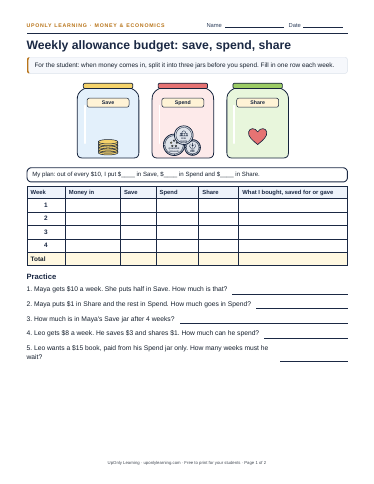
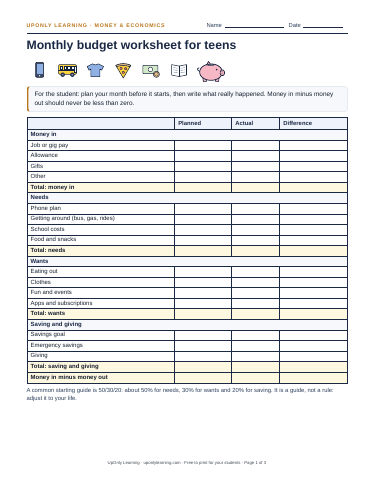
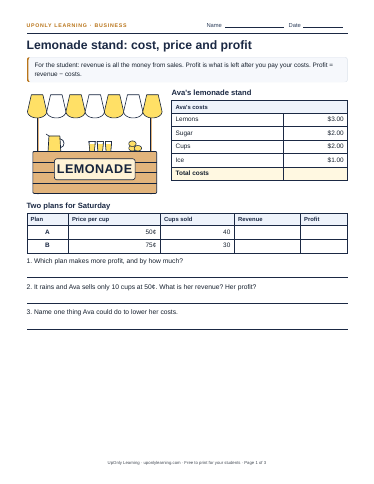
Free printables for this part
Printables that go with the topics on this page.
Every printable comes in full color and in black and white line art (low ink, ready to color in).
Questions parents ask
At what age can a kid get a job?
Under federal law, most jobs outside farming start at age 14.[1] Workers aged 14 and 15 can work at most 3 hours on a school day and 18 hours in a school week.[1] Federal law does not limit the hours or times of day for workers aged 16 and older.[1] Many states have their own rules for young workers. When both apply, the stricter rule must be followed.[1]
Why do taxes come out of a paycheck?
At a new job, workers fill out a form so the employer can work out how much federal income tax to take out of each paycheck.[2] Social Security tax is 6.2 percent of pay for the worker and another 6.2 percent paid by the employer, 12.4 percent in all.[3] Medicare tax is 1.45 percent for the worker and 1.45 percent for the employer, 2.9 percent in all.[3] The Social Security tax pays for benefits from the Social Security system.[2]
Do teens pay taxes on babysitting or lawn mowing money?
Teens who babysit, mow lawns or do gig work are usually self-employed, and money from self-employment is taxable.[2]
Sources for these answers (3)
- U.S. Department of Labor (elaws FLSA Advisor) · When and how many hours can youth work? · webapps.dol.gov/elaws/faq/esa/flsa/028.htm (checked Oct 27, 2026)
- Internal Revenue Service · Tax tips for students working summer jobs (Tax Tip 2021-108, marked historical by the IRS) · irs.gov/newsroom/tax-tips-for-students-working-summer-jobs (page updated Jul 27, 2021; checked Oct 27, 2026)
- Internal Revenue Service · Topic no. 751, Social Security and Medicare withholding rates · irs.gov/taxtopics/tc751 (page updated Sep 24, 2026; checked Oct 27, 2026)