
Money & Economics · free reference
Part 9: How the economy works: supply, demand, GDP and the Fed
Supply and demand, GDP and growth, Jobs and unemployment, The Federal Reserve, Interest rates, Trade, Government budgets and taxes and Comparing countries’ economies. Every fact lists its source, and you can share a link to any topic.
Supply and demand
In short: Prices are set by buyers and sellers. When a price goes up, people usually buy less and sellers usually offer more.[1]
Facts
- Demand is how much of something buyers are willing and able to buy at each price.[1]3–5
- Supply is how much of something sellers are willing to make or bring to market at each price.[1]3–5
- When the price goes up, people usually buy less. Economists call this the law of demand.[1]6–8
- When the price goes up, sellers usually offer more. This is the law of supply.[1]6–8
Go deeper: for teens and grown-ups (2)
Key words in three languages
| English | Spanish | Portuguese |
|---|---|---|
| supply[1] | oferta[2] | oferta[3] |
| demand[1] | demanda[2] | demanda[3] |
| law of demand[1] | ley de la demanda[2] | lei da demanda[3] |
| equilibrium price[1] | precio de equilibrio[2] | not sourced yet |
| surplus[1] | excedente[2] | not sourced yet |
| shortage[1] | escasez[2] | escassez[3] |
Each word cites a page that uses it.
Practice this
- Business practice questions, Grade 3Questions from every Business topic in the grade, with answers · freeFree
- Business practice questions, Grade 6Questions from every Business topic in the grade, with answers · freeFree
- The Business You BuildFree business mindset checkFree
- Lesson: Buyers, sellers and pricesGrade 3 · full lesson with practice and a checkMembers
- Lesson: Why prices move: supply and demandGrade 6 · full lesson with practice and a checkMembers
Members-only lessons are marked. The practice pages by grade and The Business You Build check are free.
Sources (3)
- OpenStax, Rice University · Principles of Economics 3e, 3.1 Demand, Supply, and Equilibrium in Markets for Goods and Services · openstax.org/books/principles-economics-3e/pages/3-1-demand-supply-and-equilibrium-in-markets-for-goods-and-services (checked Oct 27, 2026)
- LibreTexts Español (OpenStax, Macroeconomía) · 3.1: Demanda, oferta y equilibrio en los mercados de bienes y servicios · espanol.libretexts.org/Bookshelves/Ciencias_Sociales/Economia/Libro%3A_Macroeconomia_%28OpenStax%29/03%3A_Demanda_y_oferta/3.1%3A_Demanda%2C_oferta_y_equilibrio_en_los_mercados_de_bienes_y_servicios (checked Oct 27, 2026)
- Wikipédia em português · Oferta e demanda · pt.wikipedia.org/wiki/Oferta_e_demanda (checked Oct 27, 2026)
See something we should correct about “Supply and demand”? Tell us.
GDP and growth
In short: GDP measures the value of the final goods and services made in a country. In the second quarter of 2026, U.S. real GDP grew at a yearly rate of 2.2 percent.[1][2]
Facts
- GDP (gross domestic product) measures the value of the final goods and services made in a country.[1]6–8
Go deeper: for teens and grown-ups (2)
Key words in three languages
| English | Spanish | Portuguese |
|---|---|---|
| gross domestic product[1] | producto interno bruto[3] | produto interno bruto[4] |
| goods and services[1] | bienes y servicios[3] | bens e serviços[4] |
| net exports[1] | exportaciones netas[3] | not sourced yet |
Each word cites a page that uses it.
Practice this
- Business practice questions, Grade 4Questions from every Business topic in the grade, with answers · freeFree
- Lesson: Inventors and innovationGrade 4 · full lesson with practice and a checkMembers
Each word cites a page that uses it.
Sources (4)
- U.S. Bureau of Economic Analysis · Glossary: Gross Domestic Product (GDP) · bea.gov/help/glossary/gross-domestic-product-gdp (checked Oct 27, 2026)
- U.S. Bureau of Economic Analysis · GDP (Third Estimate), Industries, Corporate Profits, State GDP, and State Personal Income, 2nd Quarter 2026 · bea.gov/news/2026/gdp-third-estimate-industries-corporate-profits-state-gdp-and-state-personal-income-2nd (page updated Sep 30, 2026; checked Oct 27, 2026)
- Wikipedia en español · Producto interno bruto · es.wikipedia.org/wiki/Producto_interno_bruto (checked Oct 27, 2026)
- Wikipédia em português · Produto interno bruto · pt.wikipedia.org/wiki/Produto_interno_bruto (checked Oct 27, 2026)
See something we should correct about “GDP and growth”? Tell us.
Jobs and unemployment
In short: People count as unemployed when they have no job, are looking for one and can start now. In September 2026, the U.S. unemployment rate was 4.2 percent.[1][2]
Facts
- To count as unemployed, a person has no job, has looked for work in the past 4 weeks and is ready to work now.[1]6–8
- A person counts as employed if they did any work at all for pay or profit during the survey week.[1]6–8
Go deeper: for teens and grown-ups (3)
Key words in three languages
| English | Spanish | Portuguese |
|---|---|---|
| unemployed[1] | desempleados[3] | desempregados[4] |
| labor force[1] | fuerza laboral[3] | força de trabalho[4] |
| unemployment rate[5] | tasa de desempleo[3] | taxa de desemprego[4] |
Each word cites a page that uses it.
Practice this
- Life Skills practice questions, Grade 7Questions from every Life Skills topic in the grade, with answers · freeFree
- Business practice questions, Grade 7Questions from every Business topic in the grade, with answers · freeFree
- Lesson: Career exploration: interests, skills and pathwaysGrade 7 · full lesson with practice and a checkMembers
- Lesson: Jobs, wages and skillsGrade 7 · full lesson with practice and a checkMembers
Each word cites a page that uses it.
Sources (5)
- U.S. Bureau of Labor Statistics · Labor Force Statistics from the Current Population Survey: Frequently Asked Questions · bls.gov/cps/faq.htm (checked Oct 27, 2026)
- U.S. Bureau of Labor Statistics · The Employment Situation — September 2026 · bls.gov/news.release/archives/empsit_10022026.htm (page updated Oct 2, 2026; checked Oct 27, 2026)
- Wikipedia en español · Desempleo · es.wikipedia.org/wiki/Desempleo (checked Oct 27, 2026)
- Wikipédia em português · Desemprego · pt.wikipedia.org/wiki/Desemprego (checked Oct 27, 2026)
- U.S. Bureau of Labor Statistics, Career Outlook · Education pays, 2024 · bls.gov/careeroutlook/2025/data-on-display/education-pays.htm (page updated May 2025; checked Oct 27, 2026)
See something we should correct about “Jobs and unemployment”? Tell us.
The Federal Reserve
In short: The Federal Reserve is the central bank of the United States, created in 1913. Its two main goals are maximum employment and stable prices.[1][2]
Facts
- The Federal Reserve, the central bank of the United States, was created on December 23, 1913.[1]6–8
- Congress gave the Fed two main goals for its monetary policy, maximum employment and stable prices, often called its “dual mandate.”[2]6–8
Go deeper: for teens and grown-ups (3)
- Among its jobs, the Fed works to keep the financial system stable and helps run and oversee the country’s payment systems.[1]Teens
- Maximum employment means the highest level of employment, or the lowest level of unemployment, that the economy can keep up while prices stay stable.[2]Teens
- Members of the Fed’s Board of Governors are nominated by the President and confirmed by the Senate. A full term is 14 years.[3]Teens
Key words in three languages
| English | Spanish | Portuguese |
|---|---|---|
| central bank[4] | banco central[5] | banco central[6] |
| monetary policy[2] | política monetaria[7] | política monetária[8] |
Each word cites a page that uses it.
Practice this
- Business practice questions, Grade 5Questions from every Business topic in the grade, with answers · freeFree
- Lesson: Banks, loans and interestGrade 5 · full lesson with practice and a checkMembers
Each word cites a page that uses it.
Sources (8)
- Board of Governors of the Federal Reserve System · What is the purpose of the Federal Reserve System? · federalreserve.gov/faqs/about_12594.htm (page updated Nov 3, 2016; checked Oct 27, 2026)
- Board of Governors of the Federal Reserve System · What economic goals does the Federal Reserve seek to achieve through its monetary policy? · federalreserve.gov/faqs/what-economic-goals-does-federal-reserve-seek-to-achieve-through-monetary-policy.htm (page updated Aug 22, 2025; checked Oct 27, 2026)
- Board of Governors of the Federal Reserve System · Who are the members of the Federal Reserve Board, and how are they selected? · federalreserve.gov/faqs/about_12591.htm (checked Oct 27, 2026)
- Bank for International Settlements · About BIS · bis.org/about/index.htm (checked Oct 27, 2026)
- Banco Central Europeo · Nuestro dinero · ecb.europa.eu/euro/intro/html/index.es.html (checked Oct 27, 2026)
- Wikipédia em português · Banco central · pt.wikipedia.org/wiki/Banco_central (checked Oct 27, 2026)
- Consumer Financial Protection Bureau · Glossary of English-Spanish financial terms (Spanish style guide and glossary) · files.consumerfinance.gov/f/documents/cfpb_adult-fin-ed_spanish-style-guide-glossary.pdf (checked Oct 27, 2026)
- Wikipédia em português · Inflação · pt.wikipedia.org/wiki/Infla%C3%A7%C3%A3o (checked Oct 27, 2026)
See something we should correct about “The Federal Reserve”? Tell us.
Interest rates
In short: The Fed’s Federal Open Market Committee meets eight times a year and sets a target range for the federal funds rate, a key interest rate.[1][2]
Facts
- The Fed’s interest-rate decisions are made by the Federal Open Market Committee (FOMC), which has 12 members.[1]Teens
- The FOMC holds eight regular meetings a year.[1]Teens
- They are the 7 members of the Board of Governors, the president of the New York Fed and 4 of the other 11 Reserve Bank presidents, who take turns for one-year terms.[1]Grown-ups
- At its meetings the Committee reviews the economy and decides on the stance of monetary policy.[1]Grown-ups
- On September 16, 2026, the FOMC raised its target range for the federal funds rate by 1/4 percentage point, to 3-3/4 to 4 percent.[2]Grown-ups
Key words in three languages
| English | Spanish | Portuguese |
|---|---|---|
| interest rate[3] | tasa de interés[4] | taxa de juros[5] |
| monetary policy[6] | política monetaria[4] | política monetária[7] |
Each word cites a page that uses it.
Practice this
- Business practice questions, Grade 5Questions from every Business topic in the grade, with answers · freeFree
- Life Skills practice questions, Grade 7Questions from every Life Skills topic in the grade, with answers · freeFree
- Lesson: Banks, loans and interestGrade 5 · full lesson with practice and a checkMembers
- Lesson: Saving goals, compound interest and the basics of creditGrade 7 · free sample lessonFree
Each word cites a page that uses it.
Sources (7)
- Board of Governors of the Federal Reserve System · Federal Open Market Committee · federalreserve.gov/monetarypolicy/fomc.htm (checked Oct 27, 2026)
- Board of Governors of the Federal Reserve System · Federal Reserve issues FOMC statement (September 16, 2026) · federalreserve.gov/newsevents/pressreleases/monetary20260916a.htm (page updated Sep 16, 2026; checked Oct 27, 2026)
- Consumer Financial Protection Bureau · What is the difference between a mortgage interest rate and an APR? · consumerfinance.gov/ask-cfpb/what-is-the-difference-between-a-mortgage-interest-rate-and-an-apr-en-135 (checked Oct 27, 2026)
- Consumer Financial Protection Bureau · Glossary of English-Spanish financial terms (Spanish style guide and glossary) · files.consumerfinance.gov/f/documents/cfpb_adult-fin-ed_spanish-style-guide-glossary.pdf (checked Oct 27, 2026)
- Wikipédia em português · Banco central · pt.wikipedia.org/wiki/Banco_central (checked Oct 27, 2026)
- Board of Governors of the Federal Reserve System · What economic goals does the Federal Reserve seek to achieve through its monetary policy? · federalreserve.gov/faqs/what-economic-goals-does-federal-reserve-seek-to-achieve-through-monetary-policy.htm (page updated Aug 22, 2025; checked Oct 27, 2026)
- Wikipédia em português · Inflação · pt.wikipedia.org/wiki/Infla%C3%A7%C3%A3o (checked Oct 27, 2026)
See something we should correct about “Interest rates”? Tell us.
Trade
In short: Countries buy from and sell to each other. In 2025, the United States bought $901.5 billion more from other countries than it sold to them, a trade deficit.[1]
Facts
- In 2025, U.S. exports (goods and services sold to other countries) were worth $3,432.3 billion.[1]6–8
- U.S. imports (goods and services bought from other countries) were worth $4,333.8 billion.[1]6–8
Go deeper: for teens and grown-ups (2)
Key words in three languages
| English | Spanish | Portuguese |
|---|---|---|
| exports[1] | exportaciones[2] | exportações[3] |
| imports[1] | importaciones[2] | importações[3] |
| deficit[1] | déficit comercial[2] | deficit comercial[3] |
Each word cites a page that uses it.
Practice this
- Business practice questions, Grade 5Questions from every Business topic in the grade, with answers · freeFree
- Lesson: Trade around the worldGrade 5 · full lesson with practice and a checkMembers
Members-only lessons are marked. The practice pages by grade and The Business You Build check are free.
Sources (3)
- U.S. Bureau of Economic Analysis and U.S. Census Bureau · U.S. International Trade in Goods and Services, December and Annual 2025 · bea.gov/news/2026/us-international-trade-goods-and-services-december-and-annual-2025 (page updated Feb 19, 2026; checked Oct 27, 2026)
- Wikipedia en español · Balanza comercial · es.wikipedia.org/wiki/Balanza_comercial (checked Oct 27, 2026)
- Wikipédia em português · Balança comercial · pt.wikipedia.org/wiki/Balan%C3%A7a_comercial (checked Oct 27, 2026)
See something we should correct about “Trade”? Tell us.
Government budgets and taxes
In short: The federal government collects taxes and spends money on programs. In fiscal year 2025, it spent $1.8 trillion more than it collected.[1]
Facts
- In fiscal year 2025, the federal government spent $7.0 trillion.[1]Teens
- It spent more than it collected, so the federal budget deficit was $1.8 trillion.[1]Teens
- The biggest spending item was Social Security benefits: $1,569 billion.[1]Teens
- Medicare cost $992 billion, and interest on the public debt cost $1,028 billion.[1]Grown-ups
Key words in three languages
| English | Spanish | Portuguese |
|---|---|---|
| income tax[2] | impuestos sobre la renta[3] | imposto de renda[4] |
| debt[5] | deuda[3] | endividamento[6] |
Each word cites a page that uses it.
Practice this
- Business practice questions, Grade 8Questions from every Business topic in the grade, with answers · freeFree
- Lesson: Taxes and regulationGrade 8 · full lesson with practice and a checkMembers
Members-only lessons are marked. The practice pages by grade and The Business You Build check are free.
Sources (6)
- Congressional Budget Office · Monthly Budget Review: Summary for Fiscal Year 2025 · cbo.gov/system/files/2025-11/61307-MBR-FY25-final.pdf (page updated Nov 10, 2025; checked Oct 27, 2026)
- Internal Revenue Service · Tax tips for students working summer jobs (Tax Tip 2021-108, marked historical by the IRS) · irs.gov/newsroom/tax-tips-for-students-working-summer-jobs (page updated Jul 27, 2021; checked Oct 27, 2026)
- Consumer Financial Protection Bureau · Glossary of English-Spanish financial terms (Spanish style guide and glossary) · files.consumerfinance.gov/f/documents/cfpb_adult-fin-ed_spanish-style-guide-glossary.pdf (checked Oct 27, 2026)
- Wikipédia em português · Imposto de renda · pt.wikipedia.org/wiki/Imposto_de_renda (checked Oct 27, 2026)
- U.S. Securities and Exchange Commission, Investor.gov · Bonds · investor.gov/introduction-investing/investing-basics/investment-products/bonds-or-fixed-income-products/bonds (checked Oct 27, 2026)
- Wikipédia em português · Educação financeira · pt.wikipedia.org/wiki/Educa%C3%A7%C3%A3o_financeira (checked Oct 27, 2026)
See something we should correct about “Government budgets and taxes”? Tell us.
Comparing countries’ economies
In short: One way to compare countries is income per person. The World Bank uses it to sort countries into four income groups.[1]
Facts
- The World Bank sorts countries into four income groups, using income per person (GNI per capita) and its Atlas method.[1]Teens
- For its 2027 fiscal year, low-income countries had a GNI per person of $1,175 or less in 2025.[1]Teens
- Lower middle-income countries were between $1,176 and $4,635, and upper middle-income countries between $4,636 and $14,375.[1]Teens
- High-income countries had a GNI per person of more than $14,375.[1]Teens
Key words in three languages
Each word cites a page that uses it.
Practice this
We do not have a lesson on this yet. The facts above are the teaching here.
Sources (3)
- World Bank, Data Help Desk · World Bank Country and Lending Groups · datahelpdesk.worldbank.org/knowledgebase/articles/906519-world-bank-country-and-lending-groups (checked Oct 27, 2026)
- Wikipedia en español · Producto interno bruto · es.wikipedia.org/wiki/Producto_interno_bruto (checked Oct 27, 2026)
- Wikipédia em português · Produto interno bruto · pt.wikipedia.org/wiki/Produto_interno_bruto (checked Oct 27, 2026)
See something we should correct about “Comparing countries’ economies”? Tell us.
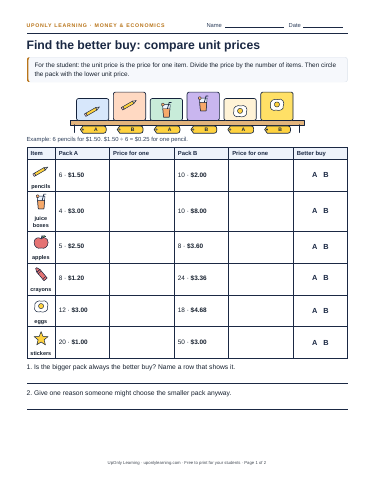
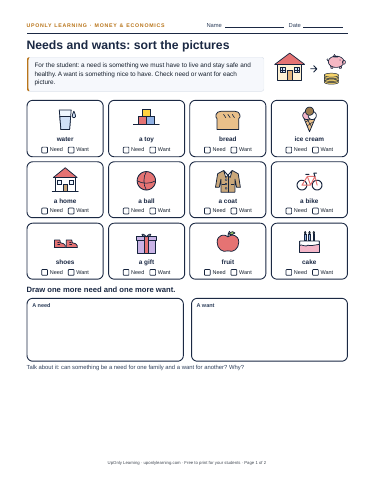
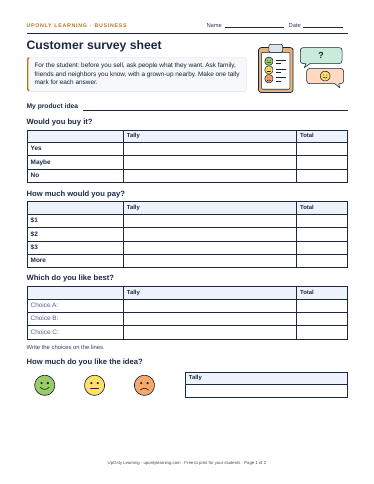
Free printables for this part
Printables that go with the topics on this page.
Every printable comes in full color and in black and white line art (low ink, ready to color in).
Questions parents ask
What does the Federal Reserve do?
The Federal Reserve is the central bank of the United States, created on December 23, 1913[1]. Congress gave it two main goals for monetary policy: maximum employment and stable prices[2]. Its Federal Open Market Committee sets a target range for the federal funds rate, a key interest rate[3], and the Fed also works to keep the financial system stable[1].
What is GDP? (Explained simply)
GDP, gross domestic product, measures the value of the final goods and services made in a country[4]. It adds up what people spend, what businesses invest, net exports, and what government spends and invests[4]. In the second quarter of 2026, U.S. real GDP grew at a yearly rate of 2.2 percent[5].
What is supply and demand, explained for kids?
Demand is how much of something buyers are willing and able to buy at each price.[6] Supply is how much of something sellers are willing to make or bring to market at each price.[6] When the price goes up, people usually buy less. Economists call this the law of demand.[6] When the price goes up, sellers usually offer more. This is the law of supply.[6]
What is a trade deficit?
In 2025, U.S. exports (goods and services sold to other countries) were worth $3,432.3 billion.[7] U.S. imports (goods and services bought from other countries) were worth $4,333.8 billion.[7] So in 2025 the United States bought $901.5 billion more from other countries than it sold to them. That gap is called a trade deficit.[7]
Sources for these answers (7)
- Board of Governors of the Federal Reserve System · What is the purpose of the Federal Reserve System? · federalreserve.gov/faqs/about_12594.htm (page updated Nov 3, 2016; checked Oct 27, 2026)
- Board of Governors of the Federal Reserve System · What economic goals does the Federal Reserve seek to achieve through its monetary policy? · federalreserve.gov/faqs/what-economic-goals-does-federal-reserve-seek-to-achieve-through-monetary-policy.htm (page updated Aug 22, 2025; checked Oct 27, 2026)
- Board of Governors of the Federal Reserve System · Federal Reserve issues FOMC statement (September 16, 2026) · federalreserve.gov/newsevents/pressreleases/monetary20260916a.htm (page updated Sep 16, 2026; checked Oct 27, 2026)
- U.S. Bureau of Economic Analysis · Glossary: Gross Domestic Product (GDP) · bea.gov/help/glossary/gross-domestic-product-gdp (checked Oct 27, 2026)
- U.S. Bureau of Economic Analysis · GDP (Third Estimate), Industries, Corporate Profits, State GDP, and State Personal Income, 2nd Quarter 2026 · bea.gov/news/2026/gdp-third-estimate-industries-corporate-profits-state-gdp-and-state-personal-income-2nd (page updated Sep 30, 2026; checked Oct 27, 2026)
- OpenStax, Rice University · Principles of Economics 3e, 3.1 Demand, Supply, and Equilibrium in Markets for Goods and Services · openstax.org/books/principles-economics-3e/pages/3-1-demand-supply-and-equilibrium-in-markets-for-goods-and-services (checked Oct 27, 2026)
- U.S. Bureau of Economic Analysis and U.S. Census Bureau · U.S. International Trade in Goods and Services, December and Annual 2025 · bea.gov/news/2026/us-international-trade-goods-and-services-december-and-annual-2025 (page updated Feb 19, 2026; checked Oct 27, 2026)