
Money & Economics · free reference
Money guide for parents
A reading list for parents and caregivers, then the Grown-ups’ Corner: teaching kids by age, allowance, money apps and financial education in schools.
The reading list
- Step 1Teaching kids about money, age by ageWhat children can learn at each age, from the CFPBFor Grown-upsGrown-ups
- Step 2Allowance and choresAllowance and chores: the approaches families useFor Grown-upsGrown-ups
- Step 3Money apps and kids’ accountsMoney apps and kids’ cards: what to checkFor Grown-upsGrown-ups
- Step 4Accounts for kidsAccount types for children, explained neutrallyInvesting BasicsGrown-ups
- Step 5Retirement accountsIRAs and 401(k)s, as conceptsInvesting BasicsTeensGrown-ups
- Step 6Emergency savingsEmergency savings, and how many families have themSaving and BankingTeensGrown-ups
- Step 7Keeping deposits safeWhat deposit insurance covers, and what it does notSaving and BankingK–23–56–8Teens
- Step 8Protecting your identityProtecting a child’s identity and creditProtecting Your Money6–8TeensGrown-ups
- Step 9Scams and fraudThe four signs of a scamProtecting Your MoneyK–23–56–8TeensGrown-ups
- Step 10Financial education in schoolsFinancial education in schools: the state countsFor Grown-upsGrown-ups
Questions about Bitcoin at home? See how to explain Bitcoin to kids by age
Grown-ups’ Corner
Teaching kids about money, age by age
In short: The CFPB describes three building blocks children need to handle money well, built in stages from age 3 to 21.[1]
Facts
- The CFPB describes three building blocks children need to handle money well: executive function, financial habits and norms, and financial knowledge and decision-making skills.[1]Grown-ups
- Children and young people need all three connected building blocks to become financially capable.[1]Grown-ups
- The CFPB groups the growing-up years into three stages: early childhood (ages 3–5), middle childhood (ages 6–12), and adolescence and young adulthood (13–21).[1]Grown-ups
- In early childhood, children begin to build executive function, the self-control and planning skills that money skills rest on.[1]Grown-ups
- Money habits and norms really start to take shape as children form their own identities and watch how family members and friends handle money.[1]Grown-ups
Key words in three languages
Each word cites a page that uses it.
Practice this
- Life Skills practice questions, KindergartenQuestions from every Life Skills topic in the grade, with answers · freeFree
- Life Skills practice questions, Grade 1Questions from every Life Skills topic in the grade, with answers · freeFree
- How to teach kids about money, age by ageBlog guide · what to teach at each ageFree
- Lesson: Coins, needs and wantsKindergarten · full lesson with practice and a checkMembers
- Lesson: Earning, saving and spendingGrade 1 · full lesson with practice and a checkMembers
Each word cites a page that uses it.
Sources (7)
- Consumer Financial Protection Bureau · Learn about the building blocks (youth financial education) · consumerfinance.gov/consumer-tools/educator-tools/youth-financial-education/learn (checked Oct 27, 2026)
- Federal Reserve Education (Federal Reserve System) · What Is Money? · federalreserveeducation.org/teaching-resources/economics/money/what-is-money (checked Oct 27, 2026)
- Consumer Financial Protection Bureau · Glossary of English-Spanish financial terms (Spanish style guide and glossary) · files.consumerfinance.gov/f/documents/cfpb_adult-fin-ed_spanish-style-guide-glossary.pdf (checked Oct 27, 2026)
- Wikipédia em português · Inflação · pt.wikipedia.org/wiki/Infla%C3%A7%C3%A3o (checked Oct 27, 2026)
- Consumer Financial Protection Bureau · Money as You Grow: Young children · consumerfinance.gov/consumer-tools/money-as-you-grow/young-children (checked Oct 27, 2026)
- Wikipedia en español · Educación financiera · es.wikipedia.org/wiki/Educaci%C3%B3n_financiera (checked Oct 27, 2026)
- Wikipédia em português · Educação financeira · pt.wikipedia.org/wiki/Educa%C3%A7%C3%A3o_financeira (checked Oct 27, 2026)
See something we should correct about “Teaching kids about money, age by age”? Tell us.
Allowance and chores
In short: Families handle allowance and chores in different ways. The CFPB says kids can earn through an allowance or by doing jobs, and NDSU Extension suggests paying for extra jobs rather than all household chores.[1][2]
Facts
- The CFPB tells school-age kids they can earn money through an allowance or by doing jobs for the family or others.[1]Grown-ups
- NDSU Extension calls an allowance one way to help children gain experience handling money.[2]Grown-ups
- NDSU Extension suggests one way to set an amount: keep a record of the money you already give your child, then give that amount as an allowance your child manages.[2]Grown-ups
- It suggests talking about the allowance with your child every week and adjusting it as needed.[2]Grown-ups
- On chores, NDSU Extension says paying for all household chores is not considered a good idea, but parents may want to pay for “extra” jobs, like cleaning the car or weeding the garden.[2]Grown-ups
- Deciding how to spend money is a step toward independence. Preteens will make spending mistakes, and adults can help them learn from those mistakes.[2]Grown-ups
Key words in three languages
Each word cites a page that uses it.
Practice this
- Life Skills practice questions, Grade 3Questions from every Life Skills topic in the grade, with answers · freeFree
- Life Skills practice questions, Grade 6Questions from every Life Skills topic in the grade, with answers · freeFree
- How much allowance by age, and how to set itBlog guide · amounts, rules and choresFree
- Lesson: Budgeting and my first incomeGrade 6 · free sample lessonFree
- Lesson: Budgeting my allowanceGrade 3 · full lesson with practice and a checkMembers
Each word cites a page that uses it.
Sources (5)
- Consumer Financial Protection Bureau · Money as You Grow: School-age children to preteens · consumerfinance.gov/consumer-tools/money-as-you-grow/middle-childhood (checked Oct 27, 2026)
- NDSU Extension (North Dakota State University) · Preteens and Money (6th grade parent newsletter) · ndsu.edu/agriculture/sites/default/files/2024-02/09%20may_post_6%20Preteens%20and%20Money.pdf (page updated Feb 2024; checked Oct 27, 2026)
- Wikipédia em português · Educação financeira · pt.wikipedia.org/wiki/Educa%C3%A7%C3%A3o_financeira (checked Oct 27, 2026)
- Federal Trade Commission, consumer.gov · Making a Budget · consumer.gov/your-money/making-budget (checked Oct 27, 2026)
- Consumer Financial Protection Bureau · Glossary of English-Spanish financial terms (Spanish style guide and glossary) · files.consumerfinance.gov/f/documents/cfpb_adult-fin-ed_spanish-style-guide-glossary.pdf (checked Oct 27, 2026)
See something we should correct about “Allowance and chores”? Tell us.
Money apps and kids’ accounts
In short: Money apps and kids’ cards are a type of product, not one brand. Before choosing one, check whether the money has deposit insurance and how the app handles your child’s information.[1][2]
Facts
- Money kept in a nonbank payment app often is not protected by federal deposit insurance.[1]Grown-ups
- Deposit insurance does not apply when a nonbank payment company fails.[1]Grown-ups
- The CFPB suggests moving money from an app to a bank, credit union or card account so it can be covered by deposit insurance.[1]Grown-ups
- A federal rule called COPPA covers apps and websites aimed at children under 13 that collect personal information from them.[2]Grown-ups
- Those apps must tell parents and get verifiable parental consent before collecting a child’s personal information online.[2]Grown-ups
Key words in three languages
| English | Spanish | Portuguese |
|---|---|---|
| bank[3] | banco[4] | banco[5] |
| personal information[6] | not sourced yet | informações pessoais[7] |
Each word cites a page that uses it.
Practice this
- Life Skills practice questions, Grade 5Questions from every Life Skills topic in the grade, with answers · freeFree
- Life Skills practice questions, Grade 6Questions from every Life Skills topic in the grade, with answers · freeFree
- Lesson: Saving, banks and interestGrade 5 · full lesson with practice and a checkMembers
- Lesson: Digital citizenship and online safetyGrade 6 · full lesson with practice and a checkMembers
Each word cites a page that uses it.
Sources (7)
- Consumer Financial Protection Bureau · Consumer Advisory: Your money is at greater risk when you hold it in a payment app instead of moving it to an account with deposit insurance · consumerfinance.gov/about-us/newsroom/consumer-advisory-your-money-is-at-greater-risk-when-you-hold-it-in-a-payment-app-instead-of-moving-it-to-an-account-with-deposit-insurance (page updated Jun 1, 2023; checked Oct 27, 2026)
- Federal Trade Commission · Complying with COPPA: Frequently Asked Questions · ftc.gov/business-guidance/resources/complying-coppa-frequently-asked-questions (checked Oct 27, 2026)
- Federal Deposit Insurance Corporation, Money Smart News for Kids · What Is a Bank? · fdic.gov/resources/consumers/money-smart/money-smart-news/kids/documents/ch1.pdf (checked Oct 27, 2026)
- Consumer Financial Protection Bureau · Glossary of English-Spanish financial terms (Spanish style guide and glossary) · files.consumerfinance.gov/f/documents/cfpb_adult-fin-ed_spanish-style-guide-glossary.pdf (checked Oct 27, 2026)
- Wikipédia em português · Banco · pt.wikipedia.org/wiki/Banco (checked Oct 27, 2026)
- Federal Trade Commission, Consumer Advice · How To Avoid a Scam · consumer.ftc.gov/articles/how-avoid-scam (checked Oct 27, 2026)
- Wikipédia em português · Roubo de identidade · pt.wikipedia.org/wiki/Roubo_de_identidade (checked Oct 27, 2026)
See something we should correct about “Money apps and kids’ accounts”? Tell us.
Financial education in schools
In short: Many states now require personal finance in high school, but counts differ: 39 states by one count and 30 by another. In PISA 2022, U.S. 15-year-olds scored about the same as the OECD average.[1][2][3][4]
Facts
- As of March 2026, the Council for Economic Education counts 39 states that require personal finance courses for high school graduation.[1]Grown-ups
- Only 22 states required economics for graduation in 2026, down from 26 in 2024.[1]Grown-ups
- Counts differ by definition: Next Gen Personal Finance counts 30 states that require a stand-alone personal finance course.[2]Grown-ups
- Once those 30 states fully roll out their rules, 76 percent of U.S. public high school students (the Class of 2031) will be covered, NGPF estimates.[2]Grown-ups
- The National Standards for Personal Financial Education cover six areas: earning income, spending, saving, investing, managing credit and managing risk.[5]Grown-ups
- By fourth grade, the standards look at the different ways people earn income.[5]Grown-ups
- The FDIC’s Money Smart for Young People offers four free, age-appropriate curricula for Pre-K through 12th grade.[6]Grown-ups
- A Federal Reserve Bank of Kansas City study found students who take personal finance in high school are significantly less likely to grow into adults who are unbanked.[6]Grown-ups
- In PISA 2022, 15-year-olds in 20 countries and economies took the international financial literacy test.[3]Grown-ups
- U.S. students scored 505 points on average, not significantly different from the OECD average of 498.[4]Grown-ups
- About 17 percent of U.S. students did not reach the baseline level (Level 2), and 13.5 percent were top performers (Level 5).[4]Grown-ups
- Across OECD countries, 18 percent of students did not reach that baseline.[3]Grown-ups
Key words in three languages
| English | Spanish | Portuguese |
|---|---|---|
| personal finance[1] | finanzas personales[7] | finanças pessoais[8] |
| financial literacy[3] | educación financiera[7] | educação financeira[8] |
Each word cites a page that uses it.
Practice this
- Life Skills practice questions, Grade 6Questions from every Life Skills topic in the grade, with answers · freeFree
- Lesson: Budgeting and my first incomeGrade 6 · free sample lessonFree
Each word cites a page that uses it.
Sources (8)
- Council for Economic Education · Four New States Implement Personal Finance Courses as CEE’s Survey of the States Reveals Positive Momentum in Financial Literacy Education in America · councilforeconed.org/four-new-states-implement-personal-finance-courses-as-cees-survey-of-the-states-reveals-positive-momentum-in-financial-literacy-education-in-america (page updated Mar 18, 2026; checked Oct 27, 2026)
- Next Gen Personal Finance (NGPF) · How many states require students to take a personal finance course for high school graduation? · ngpf.org/blog/advocacy/how-many-states-require-students-to-take-a-personal-finance-course-for-high-school-graduation (page updated Apr 6, 2026; checked Oct 27, 2026)
- Council of Ministers of Education, Canada (CMEC), reporting OECD PISA 2022 · PISA 2022 Financial Literacy: Highlights · cmec.ca/docs/pisa2022/PISA_2022_FL_Highlights_EN.pdf (checked Oct 27, 2026)
- OECD · PISA 2022 Results (Volume IV) – Factsheets: United States · read.oecd-ilibrary.org/en/publications/pisa-2022-results-volume-iv-factsheets_34d60137-en/united-states_baf87dc7-en.html (page updated Jun 2024; checked Oct 27, 2026)
- Council for Economic Education · New National Standards for Personal Financial Education · councilforeconed.org/new-national-standards-for-personal-financial-education (checked Oct 27, 2026)
- Federal Deposit Insurance Corporation, Consumer Resource Center · Youth Financial Education and Its Impact on Adult Financial Decisions · fdic.gov/consumer-resource-center/2026-02/youth-financial-education-and-its-impact-adult-financial-decisions (page updated Feb 2026; checked Oct 27, 2026)
- Wikipedia en español · Educación financiera · es.wikipedia.org/wiki/Educaci%C3%B3n_financiera (checked Oct 27, 2026)
- Wikipédia em português · Educação financeira · pt.wikipedia.org/wiki/Educa%C3%A7%C3%A3o_financeira (checked Oct 27, 2026)
See something we should correct about “Financial education in schools”? Tell us.
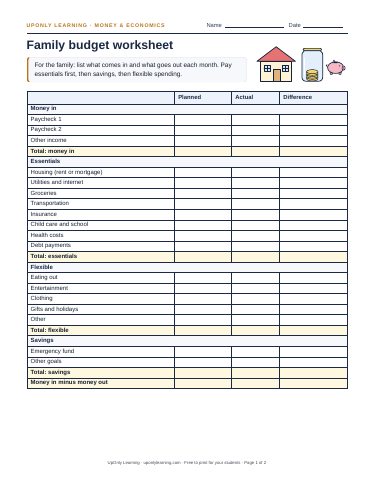
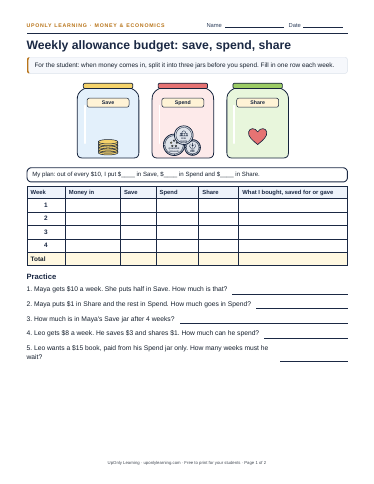
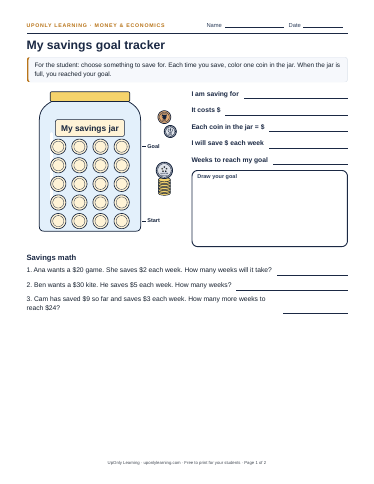
Free printables for this part
Printables that go with the topics on this page.
Every printable comes in full color and in black and white line art (low ink, ready to color in).
Questions parents ask
How do I decide how much allowance to give?
The sources we checked do not set an amount by age. NDSU Extension suggests one way to choose an amount: keep a record of the money you already give your child, then give that amount as an allowance your child manages[1], and talk about it every week[1]. The CFPB says kids can earn money through an allowance or by doing jobs for the family or others[2].
Should kids get paid for chores?
Families decide this in different ways. NDSU Extension says paying for all household chores is not considered a good idea, but parents may want to pay for “extra” jobs[1]. The CFPB tells kids they can earn money through an allowance or by doing jobs for the family or others[2]. Either way, an allowance gives children practice handling money[1].
At what age should kids learn about money?
Learning starts early. The CFPB describes three stages: early childhood (ages 3–5), middle childhood (ages 6–12), and adolescence and young adulthood (13–21)[3]. In early childhood, children begin to build executive function, the self-control and planning that money skills rest on[3], and money habits really start to take shape as children watch how family members and friends handle money[3].
What should I check before choosing a money app or debit card for my child?
We do not recommend brands, so here is what to check. Money kept in a nonbank payment app often is not protected by federal deposit insurance[4], and that insurance does not apply if a nonbank payment company fails[4]. Apps aimed at children under 13 must get verifiable parental consent before collecting a child’s personal information online[5]. Also ask about fees, parental controls and how to get help.
Sources for these answers (5)
- NDSU Extension (North Dakota State University) · Preteens and Money (6th grade parent newsletter) · ndsu.edu/agriculture/sites/default/files/2024-02/09%20may_post_6%20Preteens%20and%20Money.pdf (page updated Feb 2024; checked Oct 27, 2026)
- Consumer Financial Protection Bureau · Money as You Grow: School-age children to preteens · consumerfinance.gov/consumer-tools/money-as-you-grow/middle-childhood (checked Oct 27, 2026)
- Consumer Financial Protection Bureau · Learn about the building blocks (youth financial education) · consumerfinance.gov/consumer-tools/educator-tools/youth-financial-education/learn (checked Oct 27, 2026)
- Consumer Financial Protection Bureau · Consumer Advisory: Your money is at greater risk when you hold it in a payment app instead of moving it to an account with deposit insurance · consumerfinance.gov/about-us/newsroom/consumer-advisory-your-money-is-at-greater-risk-when-you-hold-it-in-a-payment-app-instead-of-moving-it-to-an-account-with-deposit-insurance (page updated Jun 1, 2023; checked Oct 27, 2026)
- Federal Trade Commission · Complying with COPPA: Frequently Asked Questions · ftc.gov/business-guidance/resources/complying-coppa-frequently-asked-questions (checked Oct 27, 2026)