
Money & Economics · free reference
Part 4: Needs and wants, budgets and prices
Needs, wants and choices, Budgeting basics, Where family money goes, Prices and inflation, Ways to pay and Consumer rights. Every fact lists its source, and you can share a link to any topic.
Needs, wants and choices
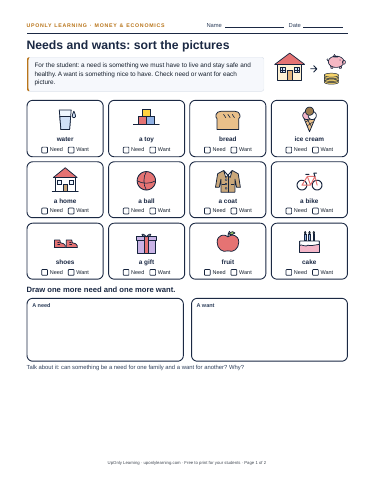
In short: There is a difference between needs and wants. We cannot have everything we want, so every choice means giving something else up. That is the opportunity cost.[1][2]
Facts
- There is a difference between things we need and things we want.[1]K–2
- Every time we spend money, we make a choice.[1]K–2
- For big events and everyday things, it helps to think ahead about what you will need.[1]K–2
- Scarcity means our wants are bigger than the things we have to meet them, so we always have to choose.[2]3–5
- The opportunity cost of a choice is the best thing you give up to get it.[2]3–5
- For example, if you spend your money on a video game, the opportunity cost is the DVD you can no longer buy.[2]3–5
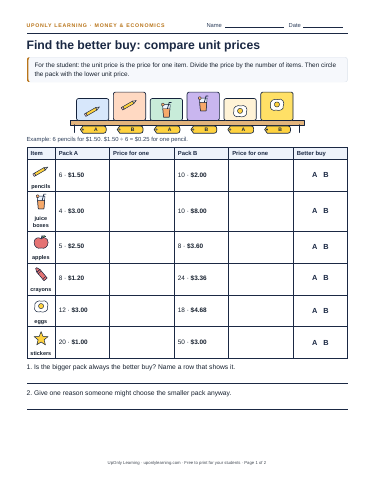
- Before you buy, shop around and compare prices and features.[3]3–5
Key words in three languages
| English | Spanish | Portuguese |
|---|---|---|
| opportunity cost[2] | coste de oportunidad[4] | custo de oportunidade[5] |
| scarcity[2] | escasez[4] | escassez[5] |
| choice[1] | elección[4] | escolha[5] |
Each word cites a page that uses it.
Practice this
- Life Skills practice questions, KindergartenQuestions from every Life Skills topic in the grade, with answers · freeFree
- Business practice questions, KindergartenQuestions from every Business topic in the grade, with answers · freeFree
- Business practice questions, Grade 3Questions from every Business topic in the grade, with answers · freeFree
- The Business You BuildFree business mindset checkFree
- Lesson: Coins, needs and wantsKindergarten · full lesson with practice and a checkMembers
- Lesson: Choosing: I can't have everythingKindergarten · full lesson with practice and a checkMembers
- Lesson: Opportunity costGrade 3 · full lesson with practice and a checkMembers
Members-only lessons are marked. The practice pages by grade and The Business You Build check are free.
Sources (5)
- Consumer Financial Protection Bureau · Money as You Grow: Young children · consumerfinance.gov/consumer-tools/money-as-you-grow/young-children (checked Oct 27, 2026)
- Federal Reserve Education (Federal Reserve System) · Opportunity Cost · federalreserveeducation.org/teaching-resources/economics/scarcity/opportunity-cost (checked Oct 27, 2026)
- Consumer Financial Protection Bureau · Money as You Grow: School-age children to preteens · consumerfinance.gov/consumer-tools/money-as-you-grow/middle-childhood (checked Oct 27, 2026)
- Wikipedia en español · Coste de oportunidad · es.wikipedia.org/wiki/Coste_de_oportunidad (checked Oct 27, 2026)
- Wikipédia em português · Custo de oportunidade · pt.wikipedia.org/wiki/Custo_de_oportunidade (checked Oct 27, 2026)
See something we should correct about “Needs, wants and choices”? Tell us.
Budgeting basics
In short: A budget is a written plan for how you will spend your money each month, so you have enough money every month.[1]
Facts
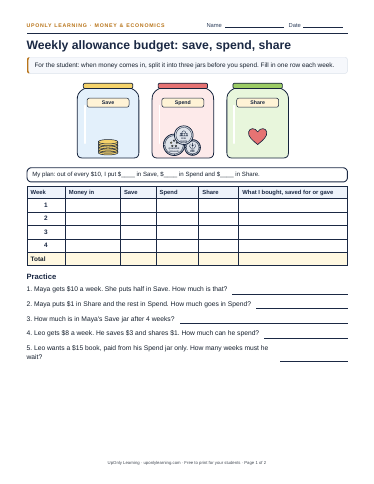
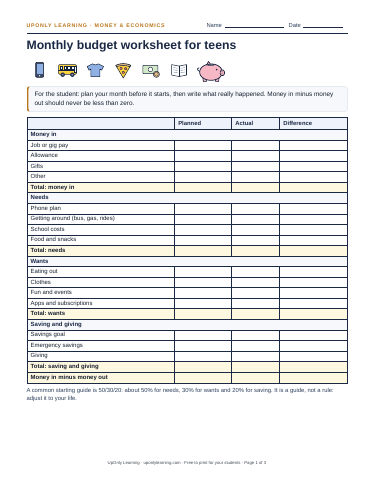
- A budget is a plan you write down to decide how you will spend your money each month.[1]3–5
- A budget helps make sure you will have enough money every month.[1]3–5
- Expenses are the things you spend money on, like food, gas, clothes and fun.[1]3–5
- School-age kids and preteens can learn that they need to make choices about how to spend their money.[2]3–5
- First, list your bills and other expenses, with the amounts.[1]6–8
- Next, use your pay stubs to write down how much money you make each month.[1]6–8
- Then subtract your monthly bills and expenses from the money you make in a month.[1]6–8
Key words in three languages
| English | Spanish | Portuguese |
|---|---|---|
| budget[1] | presupuesto[3] | orçamento[4] |
| expenses[1] | gastos[3] | despesas[5] |
| bills[1] | factura[3] | fatura[6] |
Each word cites a page that uses it.
Practice this
- Life Skills practice questions, Grade 3Questions from every Life Skills topic in the grade, with answers · freeFree
- Life Skills practice questions, Grade 6Questions from every Life Skills topic in the grade, with answers · freeFree
- Business practice questions, Grade 6Questions from every Business topic in the grade, with answers · freeFree
- How much allowance by age, and how to set itBlog guide · amounts, rules and choresFree
- Lesson: Budgeting and my first incomeGrade 6 · free sample lessonFree
- Lesson: Budgeting my allowanceGrade 3 · full lesson with practice and a checkMembers
- Lesson: A business budget: planned and actualGrade 6 · full lesson with practice and a checkMembers
Each word cites a page that uses it.
Sources (6)
- Federal Trade Commission, consumer.gov · Making a Budget · consumer.gov/your-money/making-budget (checked Oct 27, 2026)
- Consumer Financial Protection Bureau · Money as You Grow: School-age children to preteens · consumerfinance.gov/consumer-tools/money-as-you-grow/middle-childhood (checked Oct 27, 2026)
- Consumer Financial Protection Bureau · Glossary of English-Spanish financial terms (Spanish style guide and glossary) · files.consumerfinance.gov/f/documents/cfpb_adult-fin-ed_spanish-style-guide-glossary.pdf (checked Oct 27, 2026)
- Wikipédia em português · Educação financeira · pt.wikipedia.org/wiki/Educa%C3%A7%C3%A3o_financeira (checked Oct 27, 2026)
- Wikipédia em português · Finanças pessoais · pt.wikipedia.org/wiki/Finan%C3%A7as_pessoais (checked Oct 27, 2026)
- Wikipédia em português · Cartão de crédito · pt.wikipedia.org/wiki/Cart%C3%A3o_de_cr%C3%A9dito (checked Oct 27, 2026)
See something we should correct about “Budgeting basics”? Tell us.
Where family money goes
In short: On average, U.S. households spend the most on housing, then on getting around and on food. These are averages, not rules for any one family.[1]
Facts
- Housing is the biggest cost for families: an average of $26,266 a year ($2,189 a month), or 33.4 percent of spending.[1]3–5
- Food took 12.9 percent of household spending.[1]3–5
- In 2024, U.S. households spent an average of $78,535 in the year.[1]6–8
- Getting around (cars, gas, buses and more) took $13,318 a year, or 17.0 percent of household spending.[1]6–8
- Clothing, shoes and dry cleaning took 2.5 percent of spending.[1]6–8
- Half of U.S. households earned more than $83,730 in 2024 and half earned less. That middle number is called the median.[2]6–8
Go deeper: for teens and grown-ups (1)
- Households put 12.5 percent of their spending into personal insurance and pensions.[1]Teens
Key words in three languages
Each word cites a page that uses it.
Sources (6)
- U.S. Bureau of Labor Statistics, The Economics Daily · Housing and transportation accounted for 50 percent of household spending in 2024 · bls.gov/opub/ted/2026/housing-and-transportation-accounted-for-50-percent-of-household-spending-in-2024.htm (page updated Feb 12, 2026; checked Oct 27, 2026)
- U.S. Census Bureau · Income in the United States: 2024 (P60-286) · census.gov/library/publications/2025/demo/p60-286.html (page updated Sep 9, 2025; checked Oct 27, 2026)
- Federal Trade Commission, consumer.gov · Making a Budget · consumer.gov/your-money/making-budget (checked Oct 27, 2026)
- Consumer Financial Protection Bureau · Glossary of English-Spanish financial terms (Spanish style guide and glossary) · files.consumerfinance.gov/f/documents/cfpb_adult-fin-ed_spanish-style-guide-glossary.pdf (checked Oct 27, 2026)
- Wikipédia em português · Finanças pessoais · pt.wikipedia.org/wiki/Finan%C3%A7as_pessoais (checked Oct 27, 2026)
- Wikipédia em português · Educação financeira · pt.wikipedia.org/wiki/Educa%C3%A7%C3%A3o_financeira (checked Oct 27, 2026)
See something we should correct about “Where family money goes”? Tell us.
Prices and inflation
In short: Inflation means prices go up over time. The government tracks prices with the Consumer Price Index, and the Federal Reserve aims for prices to rise about 2 percent a year.[1][2]
Facts
- Inflation means the prices of the things we buy go up over time.[1]3–5
- The Consumer Price Index (CPI) measures how the prices people in cities and towns pay change over time.[2]6–8
- Prices measured by the CPI were 3.7 percent higher in September 2026 than a year before.[2]6–8
- The Federal Reserve aims for prices to rise about 2 percent a year over the long run.[1]6–8
Go deeper: for teens and grown-ups (3)
- From August to September 2026 alone, prices rose 0.6 percent, led by gasoline.[2]Teens
- Leaving out food and energy, whose prices jump around a lot, prices were 2.6 percent higher than a year before.[2]Teens
- The Fed watches a price index called PCE because it follows how Americans are actually spending their money at a given time.[1]Grown-ups
Key words in three languages
| English | Spanish | Portuguese |
|---|---|---|
| inflation[1] | inflación[3] | inflação[4] |
| Consumer Price Index[2] | not sourced yet | índice de preços ao consumidor[4] |
| price[1] | precio[3] | preços[4] |
Each word cites a page that uses it.
Practice this
- Business practice questions, Grade 6Questions from every Business topic in the grade, with answers · freeFree
- Lesson: Why prices move: supply and demandGrade 6 · full lesson with practice and a checkMembers
Members-only lessons are marked. The practice pages by grade and The Business You Build check are free.
Sources (4)
- Board of Governors of the Federal Reserve System · Economy at a Glance: Inflation (PCE) · federalreserve.gov/economy-at-a-glance-inflation-pce.htm (page updated Aug 2, 2024; checked Oct 27, 2026)
- U.S. Bureau of Labor Statistics · Consumer Price Index · bls.gov/cpi (page updated Oct 14, 2026; checked Oct 27, 2026)
- Consumer Financial Protection Bureau · Glossary of English-Spanish financial terms (Spanish style guide and glossary) · files.consumerfinance.gov/f/documents/cfpb_adult-fin-ed_spanish-style-guide-glossary.pdf (checked Oct 27, 2026)
- Wikipédia em português · Inflação · pt.wikipedia.org/wiki/Infla%C3%A7%C3%A3o (checked Oct 27, 2026)
See something we should correct about “Prices and inflation”? Tell us.
Ways to pay
In short: Credit cards and debit cards protect you in different ways when a card is lost. Whatever the card, report a lost one fast.[1]
Facts
- How well you are protected when a card is lost depends on the kind of card and how fast you report it.[1]6–8
- If someone uses a lost credit card before you report it, the most you might owe is $50.[1]6–8
Go deeper: for teens and grown-ups (3)
- With a lost debit card, reporting it within 2 business days keeps your loss to $50 at most. After that, you could lose up to $500.[1]Teens
- If you wait more than 60 days after your statement to report a lost debit card, you could lose all the money taken, and possibly more.[1]Teens
- For charges someone makes on your credit card without your permission, federal law limits what you owe to $50.[2]Teens
Key words in three languages
| English | Spanish | Portuguese |
|---|---|---|
| debit card[3] | tarjeta de débito[4] | cartões de débito[5] |
| ATM[1] | cajero automático[4] | not sourced yet |
Each word cites a page that uses it.
Practice this
- Life Skills practice questions, Grade 4Questions from every Life Skills topic in the grade, with answers · freeFree
- Lesson: Smart shopping: comparing pricesGrade 4 · full lesson with practice and a checkMembers
Members-only lessons are marked. The practice pages by grade and The Business You Build check are free.
Sources (5)
- Federal Trade Commission, Consumer Advice · Lost or Stolen Credit, ATM, and Debit Cards · consumer.ftc.gov/articles/lost-or-stolen-credit-atm-and-debit-cards (checked Oct 27, 2026)
- Federal Trade Commission, Consumer Advice · Using Credit Cards and Disputing Charges · consumer.ftc.gov/articles/using-credit-cards-and-disputing-charges (checked Oct 27, 2026)
- Federal Reserve Financial Services · 2025 Diary of Consumer Payment Choice · frbservices.org/news/research/2025-findings-from-the-diary-of-consumer-payment-choice (page updated May 2025; checked Oct 27, 2026)
- Consumer Financial Protection Bureau · Glossary of English-Spanish financial terms (Spanish style guide and glossary) · files.consumerfinance.gov/f/documents/cfpb_adult-fin-ed_spanish-style-guide-glossary.pdf (checked Oct 27, 2026)
- Wikipédia em português · Cartão de crédito · pt.wikipedia.org/wiki/Cart%C3%A3o_de_cr%C3%A9dito (checked Oct 27, 2026)
See something we should correct about “Ways to pay”? Tell us.
Consumer rights
In short: Buyers have rights: you can dispute a mistake on a credit card bill, cancel some sales made at home within three days and send a complaint to a government agency.[1][2][3]
Facts
- The FTC’s Cooling-Off Rule gives you three days to cancel some sales made at your home, workplace or dorm.[2]6–8
- You can send a complaint about a bank, card or loan to the Consumer Financial Protection Bureau, which sends it straight to the company.[3]6–8
Go deeper: for teens and grown-ups (5)
- If your credit card bill has a mistake, a federal law called the Fair Credit Billing Act gives you a way to dispute it.[1]Teens
- Your dispute letter must reach the card company within 60 days after the first bill with the mistake was sent.[1]Teens
- Your right to cancel for a full refund lasts until midnight of the third business day after the sale. Saturday counts as a business day; Sundays and federal holidays do not.[2]Teens
- The rule does not cover sales made entirely online, by mail or by phone, or sales under $25 made at your home.[2]Teens
- Most companies answer a CFPB complaint within 15 days.[3]Teens
Key words in three languages
| English | Spanish | Portuguese |
|---|---|---|
| refund[2] | reembolso[4] | restituição[5] |
| complaint[3] | queja[4] | not sourced yet |
| consumer[6] | consumidor[4] | not sourced yet |
Each word cites a page that uses it.
Practice this
- Life Skills practice questions, Grade 6Questions from every Life Skills topic in the grade, with answers · freeFree
- Lesson: Consumer smarts and advertisingGrade 6 · full lesson with practice and a checkMembers
Members-only lessons are marked. The practice pages by grade and The Business You Build check are free.
Sources (6)
- Federal Trade Commission, Consumer Advice · Using Credit Cards and Disputing Charges · consumer.ftc.gov/articles/using-credit-cards-and-disputing-charges (checked Oct 27, 2026)
- Federal Trade Commission, Consumer Advice · Buyer’s Remorse: The FTC’s Cooling-Off Rule May Help · consumer.ftc.gov/articles/buyers-remorse-ftcs-cooling-rule-may-help (checked Oct 27, 2026)
- Consumer Financial Protection Bureau · Submit a complaint · consumerfinance.gov/complaint (checked Oct 27, 2026)
- Consumer Financial Protection Bureau · Glossary of English-Spanish financial terms (Spanish style guide and glossary) · files.consumerfinance.gov/f/documents/cfpb_adult-fin-ed_spanish-style-guide-glossary.pdf (checked Oct 27, 2026)
- Wikipédia em português · Imposto de renda · pt.wikipedia.org/wiki/Imposto_de_renda (checked Oct 27, 2026)
- Consumer Financial Protection Bureau · The Bureau · consumerfinance.gov/about-us/the-bureau (checked Oct 27, 2026)
See something we should correct about “Consumer rights”? Tell us.
Free printables for this part
Printables that go with the topics on this page.
Every printable comes in full color and in black and white line art (low ink, ready to color in).
Questions parents ask
How do you explain inflation to kids?
Inflation means prices go up over time[1]. The government tracks it with the Consumer Price Index, which follows the prices people pay[2]. In September 2026, prices measured by the CPI were 3.7 percent higher than a year before[2]. The Federal Reserve aims for prices to rise about 2 percent a year over the long run[1].
What is the difference between needs and wants?
There is a difference between things we need and things we want.[3] Scarcity means our wants are bigger than the things we have to meet them, so we always have to choose.[4] The opportunity cost of a choice is the best thing you give up to get it.[4] Every time we spend money, we make a choice.[3]
How do you make a budget, step by step?
A budget is a plan you write down to decide how you will spend your money each month.[5] First, list your bills and other expenses, with the amounts.[5] Next, use your pay stubs to write down how much money you make each month.[5] Then subtract your monthly bills and expenses from the money you make in a month.[5]
Sources for these answers (5)
- Board of Governors of the Federal Reserve System · Economy at a Glance: Inflation (PCE) · federalreserve.gov/economy-at-a-glance-inflation-pce.htm (page updated Aug 2, 2024; checked Oct 27, 2026)
- U.S. Bureau of Labor Statistics · Consumer Price Index · bls.gov/cpi (page updated Oct 14, 2026; checked Oct 27, 2026)
- Consumer Financial Protection Bureau · Money as You Grow: Young children · consumerfinance.gov/consumer-tools/money-as-you-grow/young-children (checked Oct 27, 2026)
- Federal Reserve Education (Federal Reserve System) · Opportunity Cost · federalreserveeducation.org/teaching-resources/economics/scarcity/opportunity-cost (checked Oct 27, 2026)
- Federal Trade Commission, consumer.gov · Making a Budget · consumer.gov/your-money/making-budget (checked Oct 27, 2026)