
UpOnly Learning · free for anyone
Free kindergarten entrepreneurship worksheets with answers
50 questions with the answers, free to print and free to photocopy for your own students. Spotting problems, inventing, prices and profit, customers and honest business, at the level of the grade.
Enjoy them. If you want more, or something we do not have yet, ask on our Share your ideas page and a real person will read it.
Hide the answers to print a clean copy for your student, then show them again to print your answer key.
Entrepreneurship & Business — Kindergarten
50 questions · answers marked50 questions · answers hidden
- 1. Can we have everything we want?
- A. Yes, if we ask politely
- B. No, we must choose ← Answer
- C. Yes, always
- 2. Who is a customer?
- A. A store shelf
- B. A person who sells the goods
- C. A person who comes to buy ← Answer
- 3. Which one is a good you can hold?
- A. A haircut
- B. A car wash
- C. A toy car ← Answer
- 4. What is an inventor?
- A. A person who makes up new things ← Answer
- B. A person who sleeps all day
- C. A person who only buys toys at the store
- 5. What is a problem?
- A. A snack you like to eat
- B. Something that is fun to do
- C. Something that is wrong ← Answer
- 6. What is a price?
- A. How old something is
- B. How much something costs ← Answer
- C. How big something really is
- 7. What happens in a trade?
- A. You give and you get ← Answer
- B. You only take and keep it
- C. You only give
- 8. What does it mean to make a choice?
- A. To cry for more
- B. To get every single thing
- C. To pick one thing ← Answer
- 9. A customer walks up to your stand. What do you say first?
- A. What do you want?
- B. Go away, we are closed
- C. Hello, welcome! ← Answer
- 10. Which one is a service?
- A. A checkup ← Answer
- B. A spoon for soup
- C. A shoe
- 11. What does invent mean?
- A. To copy a friend's toy exactly
- B. To break something
- C. To make up something new ← Answer
- 12. Your juice spilled on the table. What is the problem?
- A. The table is wet and sticky ← Answer
- B. The juice is very tasty
- C. The cup is a nice blue
- 13. At a stand, who pays?
- A. The buyer ← Answer
- B. The sign
- C. The seller
- 14. What is another word for trade?
- A. Swap ← Answer
- B. Steal
- C. Hide
- 15. You pick the red cup, not the blue cup. What did you give up?
- A. The red cup
- B. The blue cup ← Answer
- C. Both cups
- 16. A customer comes to your stand. What do you do first?
- A. Say thank you
- B. Say hello ← Answer
- C. Say goodbye
- 17. A baker makes bread. Is bread a good or a service?
- A. A worker
- B. A service
- C. A good ← Answer
- 18. What do inventors usually do first?
- A. Build a model
- B. Imagine ← Answer
- C. Share with friends
- 19. Toys are on the stairs. Why is that a problem?
- A. The stairs are tall
- B. Someone could trip ← Answer
- C. Toys are fun to play with
- 20. What does the seller give?
- A. A big hug
- B. The goods ← Answer
- C. Money
- 21. Who must say yes for a trade to happen?
- A. Just you, nobody else
- B. Just your friend
- C. Both people ← Answer
- 22. What does choose mean?
- A. Get it all
- B. To sleep
- C. To pick ← Answer
- 23. You help a customer at your stand. What do you do at the end?
- A. Say thank you ← Answer
- B. Ask what they want
- C. Say hello
- 24. A bus driver drives kids to school. What is that?
- A. A good
- B. A service ← Answer
- C. A store on the corner
- 25. What do you use to imagine?
- A. Your shoes
- B. Your mind ← Answer
- C. Your feet
- 26. Your hands are dirty before lunch. What can fix it?
- A. Eat your lunch faster
- B. Wash your hands with soap ← Answer
- C. Put on a warm hat
- 27. What does sell mean?
- A. To hide goods
- B. To give goods and get money ← Answer
- C. To give money for something
- 28. Rio has a red car and wants a blue car. Who could he trade with?
- A. A kid with a blue car ← Answer
- B. A kid with no car
- C. A kid with a red car
- 29. Why do we have to choose?
- A. We have too much
- B. Things are free at the store
- C. We can't have it all ← Answer
- 30. What does greet mean?
- A. To say hello ← Answer
- B. To yell loudly
- C. To say goodbye
- 31. What are goods?
- A. Places where we live
- B. Jobs we do for others
- C. Things we can touch ← Answer
- 32. What is a design?
- A. A kind of snack
- B. A loud, happy song
- C. A plan or drawing ← Answer
- 33. A plant's dirt is dry and its leaves droop. What can help?
- A. Put it in a box
- B. Move it to a dark closet
- C. Give it some water ← Answer
- 34. What does buy mean?
- A. To get money for a new toy
- B. To pay to get something ← Answer
- C. To make a sign
- 35. Which is a polite way to ask for a trade?
- A. I'm taking it, it's mine now.
- B. Give me that now!
- C. Would you like to swap? ← Answer
- 36. You may have one snack: an apple or a pear. You take the apple. What did you give up?
- A. Nothing
- B. The pear ← Answer
- C. The apple
- 37. What does listen mean?
- A. Talk over someone loudly
- B. Look at the floor
- C. Pay attention to words ← Answer
- 38. What is a service?
- A. A place we go to play
- B. A thing we hold in our hand
- C. A job someone does for us ← Answer
- 39. What is a model?
- A. A small version of your idea ← Answer
- B. A big, loud truck that carries rocks
- C. A kind of fruit
- 40. Which steps help you fix a problem?
- A. Hide it, skip it, forget it
- B. Look, laugh, then walk away
- C. See it, say it, solve it ← Answer
- 41. What is a stand?
- A. A very big tree outside
- B. A kind of bed
- C. A table where you sell ← Answer
- 42. A friend asks to trade, but you want to keep your toy. What can you say?
- A. Go away and leave me alone!
- B. Grab it back
- C. No thank you ← Answer
- 43. When you choose, what do you give up?
- A. Getting both at the same time
- B. The thing you didn't pick ← Answer
- C. The thing you picked
- 44. Which is a polite word?
- A. Hurry up
- B. Whatever
- C. Please ← Answer
- 45. Who grows apples?
- A. A pilot
- B. A farmer ← Answer
- C. A dentist
- 46. Which one do inventors usually do last?
- A. Draw it
- B. Imagine it
- C. Share it ← Answer
- 47. Ana's room is dark at night and she feels scared. What could help?
- A. A small night light ← Answer
- B. Close the door tight
- C. Turn off every light
- 48. What goes on a stand sign?
- A. What you sell ← Answer
- B. Your bedtime
- C. Your shoe size
- 49. What does fair mean in a trade?
- A. Both are happy ← Answer
- B. Nobody gets a turn to play
- C. Only one person wins
- 50. Is time limited too?
- A. No, never
- B. Yes, it is ← Answer
- C. No, time is endless
What kindergarten entrepreneurship covers
Kindergarten entrepreneurship at UpOnly Learning is 7 topics, taught in this order: goods and services all around me, spotting problems to solve, imagine and invent, trading and swapping, choosing: I can't have everything, being kind to customers, and my first stand: making and selling. The 50 questions above are drawn from those topics, with the answer marked beside each one, so you can see what has stuck and what needs another lesson. The workbook teaches each topic with a 40-minute lesson; the free PDF sample has one full topic.
What's inside
- Goods and services all around me: Tell goods from services and name who makes or does them in my community
- Spotting problems to solve: Notice everyday problems and think of ways to help fix them
- Imagine and invent: Use imagination to dream up new toys, tools and ideas
- Trading and swapping: Explain why people trade and make a fair swap
- Choosing: I can't have everything: Understand that we can't have everything we want, so we choose
- Being kind to customers: Greet, listen and say thank you to the people we serve
- My first stand: making and selling: Plan a pretend stand: what to sell, a price and a sign
Keep going
Learn how money works: Money & Economics
Your next step
Entrepreneurship & Business Thinking · Kindergarten
$19.99. One-time purchase, no subscription.
147 pages · 791 questions with answers · 7 topics
See it in the storeA real page of Entrepreneurship & Business Thinking · Kindergarten
Pick One. Making Smart Choices
The student will explain that we cannot have everything we want because money, time and things are limited, so we make choices, and will name what they give up when they choose. · 40 min
“You picked one, so you did not get the other one. That is a choice.”
Kofi has 3 pennies. A ball costs 3 pennies and a car costs 3 pennies. Can he buy both?
Answer: No. 3 pennies buys only one of them, so he must choose. If he picks the ball, he gives up the car.
If I want something a lot, I should get it right away.
Explain that everyone, even grown-ups, has limited money and time. Wanting something a lot does not mean there is enough for everything, so we choose.
Say your own choices out loud, like 'I would like both, but I will pick this one and give up that one', so your student hears that adults choose too.
That is one topic of many. The free questions above check a skill; this is the part that teaches it.
Free printables for this grade
Business and money printables that fit this grade, with answer keys where there are answers.
Every printable comes in full color and in black and white line art (low ink, ready to color in).
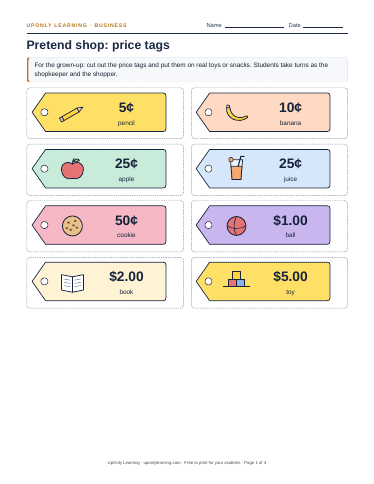
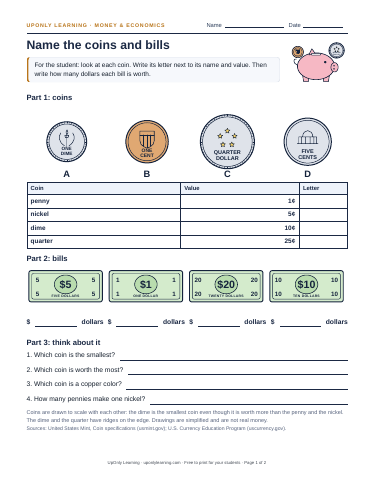
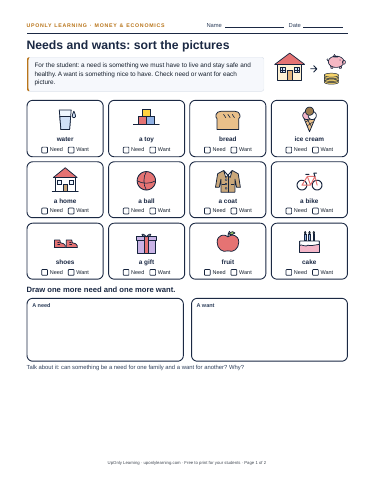
Practice checks. Our business and money workbooks teach.
These questions check a skill. The workbook teaches it.
- TeachesA 40-minute lesson per topic that tells you what to say.
- ExplainsWorked examples and the common mistakes, with fixes.
- ReviewsAnswers with short explanations, and fresh questions.
- PlansEvery topic in teaching order, matched to the standards.
Other grades
Kindergarten, other subjects
Questions parents ask
Are these business and money worksheets really free?
Yes. All 50 questions and their answers are on this page, free to print and free to photocopy for your own students. Printing needs only a free account. No card.
Can a teacher or a tutor use these with a class?
Yes. Print and photocopy them for the students you teach. The only thing we ask is that you do not republish them as your own or sell them.
Where are the answers?
Marked beside each question on this page, so it prints as its own answer key. For a clean copy, click Hide answers before you print; click Show answers again to print your answer key.
What grade are these for?
Kindergarten. Every other grade from kindergarten to grade 8 has its own page, linked at the foot of this one. If your student finds these hard, try the grade below — that is normal and it is not a problem.
What do the paid workbooks add?
These questions check a skill. The workbook teaches it: a forty-minute lesson that tells you what to say, two or three worked examples, the mistakes students actually make on that skill and how to correct each one, and an explanation beside every answer rather than a bare key.