
UpOnly Learning · free for anyone
Free 4th grade entrepreneurship worksheets with answers
50 questions with the answers, free to print and free to photocopy for your own students. Spotting problems, inventing, prices and profit, customers and honest business, at the level of the grade.
Enjoy them. If you want more, or something we do not have yet, ask on our Share your ideas page and a real person will read it.
Hide the answers to print a clean copy for your student, then show them again to print your answer key.
Entrepreneurship & Business — Grade 4
50 questions · answers marked50 questions · answers hidden
- 1. What is a brand?
- A. The list of supplies a business must buy
- B. The building where a business keeps its cash
- C. The amount of money that a business has saved up in the bank
- D. The name, look and message people link to a business ← Answer
- 2. What does the word ethics mean?
- A. The ads a store shows on its signs
- B. Rules about what is right and fair ← Answer
- C. Rules about how to count coins fast
- D. The prices a store puts on its items
- 3. Which word means something that makes a person more or less likely to do something?
- A. Incentive ← Answer
- B. Invoice
- C. Inventory
- D. Inspection
- 4. What is an invention?
- A. A sale at a store
- B. A list of things a store sells
- C. Something brand new ← Answer
- D. A copy of another person's idea
- 5. What is market research?
- A. Making a product as fast as you can
- B. Picking the prices that the seller likes the very best
- C. Counting the money at the end of the day
- D. Finding out what customers want before you sell ← Answer
- 6. What is a price?
- A. The number of items you can make
- B. The money a customer pays for an item ← Answer
- C. The money that is left after costs
- D. The money you spend on your supplies
- 7. What is a ledger?
- A. A drawing of the logo for a business
- B. A sign that shows the price of each item
- C. A list of all your customers' favorite colors
- D. A written record of money in and money out ← Answer
- 8. What is a logo?
- A. A simple picture or symbol for a business ← Answer
- B. A record of money in and money out
- C. A long story about how a business first began years ago
- D. A list of every price at a stand
- 9. Which word means telling the truth and not tricking people?
- A. Supply
- B. Discount
- C. Honesty ← Answer
- D. Profit
- 10. A reward that makes people more likely to do something is called a what?
- A. Negative incentive
- B. Parking fine
- C. Positive incentive ← Answer
- D. Late penalty
- 11. What is an innovation?
- A. A paper from the government
- B. A new idea that improves something ← Answer
- C. A thing that never existed before at all
- D. A worker who builds machines
- 12. What is a survey?
- A. A set of questions you ask many people ← Answer
- B. A list of all the supplies that you will need
- C. A sign that tells people your prices
- D. A chart that shows how much you spent
- 13. What is the cost of an item for a seller?
- A. The money a customer hands over
- B. The extra money earned from a sale
- C. The price another stand charges
- D. The money spent to make or buy it ← Answer
- 14. What is income?
- A. Money that comes in, such as from sales ← Answer
- B. Money spent on supplies for the stand
- C. The price that a competitor charges for a cup
- D. Money you owe to a friend or neighbor
- 15. What is a slogan?
- A. A long letter sent to every customer
- B. A short, catchy phrase about a business ← Answer
- C. A tally chart of customer answers
- D. The total profit from one whole week of sales
- 16. What is fairness?
- A. Giving friends lower prices in secret
- B. Letting only some people shop
- C. Same good rules for everyone ← Answer
- D. Charging whatever you feel like
- 17. A cost or penalty that makes people less likely to do something is called a what?
- A. Big bonus
- B. Free gift
- C. Positive incentive
- D. Negative incentive ← Answer
- 18. What is an inventor?
- A. A worker who sells movie tickets
- B. A person who fixes broken roads
- C. Someone who makes new things ← Answer
- D. A person who buys new inventions
- 19. What is a tally chart used for?
- A. Making a mark for each answer you get ← Answer
- B. Drawing a logo for your business
- C. Listing the steps to bake a cake
- D. Writing down the price of each item
- 20. What is a competitor?
- A. A helper who works at your stand
- B. A supplier who sells you materials
- C. Another business selling something like yours ← Answer
- D. A customer who buys from you often
- 21. What is an expense?
- A. Money that customers pay at the stand
- B. A coin you find on the sidewalk
- C. Money left over after a good day
- D. Money that goes out, such as for supplies ← Answer
- 22. What is marketing?
- A. Ways a business hides its prices
- B. Ways a business counts all of its coins and bills each night
- C. Ways a business makes its supplies
- D. Ways a business tells customers what it sells ← Answer
- 23. Which word means believing someone will be honest and keep their word?
- A. Price
- B. Cost
- C. Budget
- D. Trust ← Answer
- 24. A pool charges a $2 fee to anyone caught running on the wet deck. What kind of incentive is the fee?
- A. A negative incentive ← Answer
- B. A positive incentive
- C. Not an incentive
- D. A free reward
- 25. Who invented a machine that made flat-bottomed paper bags?
- A. Margaret Knight ← Answer
- B. Mary Anderson
- C. Madam C.J. Walker
- D. Josephine Cochrane
- 26. In a tally chart, how many marks are in one bundle with a line across it?
- A. 10
- B. 4
- C. 5 ← Answer
- D. 6
- 27. Profit per item equals...
- A. Price minus cost per item ← Answer
- B. Cost minus price per item
- C. Price plus cost per item
- D. Price times cost per item
- 28. When income is bigger than expenses, the business has...
- A. A profit ← Answer
- B. A break even
- C. A loss
- D. No income
- 29. A good business name should be...
- A. Long and hard to spell
- B. The same as another stand
- C. Short and easy to say ← Answer
- D. Full of random letters
- 30. What is a promise?
- A. A coin you hand back as change
- B. Saying you will do something ← Answer
- C. A sign that shows a price
- D. A list of things for sale
- 31. A pizza shop gives a free drink with every large pizza. Is the free drink a reward or a cost for shoppers?
- A. A fee
- B. A cost to pay
- C. A fine
- D. A reward ← Answer
- 32. Where did the Wright brothers make their famous 1903 flight?
- A. Boston, Massachusetts
- B. Chicago, Illinois
- C. Kitty Hawk, North Carolina ← Answer
- D. Dayton, Ohio
- 33. What do we call the facts and answers you collect in a survey?
- A. Data ← Answer
- B. Profit
- C. Slogans
- D. Prices
- 34. What happens if your price is lower than your cost?
- A. You lose money on each sale ← Answer
- B. Your costs go down to zero
- C. You earn more on each sale
- D. You break even on each sale
- 35. When expenses are bigger than income, the business has...
- A. A profit
- B. A bonus
- C. A loss ← Answer
- D. A break even
- 36. A good logo is usually...
- A. Packed with tiny details
- B. Drawn so small no one sees it
- C. Simple and easy to recognize ← Answer
- D. Different every single day
- 37. What is a reputation?
- A. The money you keep in a bank
- B. The supplies you buy each week
- C. The sign over your stand
- D. What people think and say about you ← Answer
- 38. Which of these is a positive incentive?
- A. A fine for parking in the wrong spot
- B. A fee for paying a phone bill late
- C. A lost turn for cheating at cards
- D. A sticker for finished homework ← Answer
- 39. What kind of shop did the Wright brothers run?
- A. A toy shop
- B. A shoe store
- C. A bakery
- D. A bicycle shop ← Answer
- 40. Who is a target customer?
- A. The other person who sells things right next to your stand
- B. The family member who buys your supplies
- C. The group of people you most want to sell to ← Answer
- D. Anyone who walks by, even a baby
- 41. Which three clues help you set a fair price?
- A. The color of the item, its name, its shape
- B. How tired you are, your age, your height
- C. Cost, what customers will pay, competitors' prices ← Answer
- D. Your favorite number, the weather, the day
- 42. What does break even mean?
- A. Expenses are much bigger than income
- B. The cash box was dropped and then it broke
- C. Income is much bigger than expenses
- D. Income and expenses are exactly the same ← Answer
- 43. Which slogan is honest for a stand selling homemade cookies?
- A. Eat one and you will never get sick again
- B. The only cookies on Earth
- C. These cookies make you fly
- D. Homemade cookies, baked fresh today ← Answer
- 44. A customer pays $1.00 for a 35-cent sticker. What is the correct change?
- A. 65 cents ← Answer
- B. 75 cents
- C. 55 cents
- D. 35 cents
- 45. Which of these is a negative incentive?
- A. A prize for the fastest runner
- B. A fee for returning a movie late ← Answer
- C. Praise for helping an older neighbor
- D. A coupon for a free smoothie
- 46. In 1879, Thomas Edison and his team developed a long-lasting what?
- A. Telephone
- B. Airplane
- C. Light bulb ← Answer
- D. Paper bag
- 47. Why do business owners ask customers what they want?
- A. So they never have to talk to customers again
- B. So they do not make things nobody will buy ← Answer
- C. So they can skip planning their business
- D. So they can raise prices whenever they like
- 48. If a price is far too high, what usually happens?
- A. Competitors raise their prices
- B. Few customers buy the item ← Answer
- C. Every customer buys two
- D. The cost of making it drops
- 49. To find profit or loss, you...
- A. Multiply income by expenses
- B. Compare income and expenses and subtract ← Answer
- C. Count only the coins in the box
- D. Add income and expenses together
- 50. Why should a brand fit the target customer?
- A. So the right people notice it and want to buy ← Answer
- B. So nobody else in town can ever sell the same thing
- C. So the business can raise its prices
- D. So the owner can skip making a product
What 4th grade entrepreneurship covers
4th grade entrepreneurship at UpOnly Learning is 7 topics, taught in this order: market research: asking what people want, setting a fair price, profit, loss and keeping records, branding and marketing, incentives: why people choose, honest business: ethics and trust, and inventors and innovation. The 50 questions above are drawn from those topics, with the answer marked beside each one, so you can see what has stuck and what needs another lesson. The workbook teaches each topic with a 40-minute lesson; the free PDF sample has one full topic.
What's inside
- Market research: asking what people want: Use a short survey and tally chart to learn what customers want
- Setting a fair price: Set a price using costs, what customers will pay and competitors' prices
- Profit, loss and keeping records: Track sales and costs in a simple ledger and find profit or loss
- Branding and marketing: Create a name, logo idea and message that fits the customer
- Incentives: why people choose: Explain how rewards and costs change what people choose
- Honest business: ethics and trust: Explain why honesty, fairness and keeping promises build trust
- Inventors and innovation: Explore how inventions and new ideas improve lives and grow economies
Keep going
Learn how money works: Money & Economics
Your next step
Entrepreneurship & Business Thinking · Grade 4
$19.99. One-time purchase, no subscription.
178 pages · 840 questions with answers · 7 topics
See it in the storeA real page of Entrepreneurship & Business Thinking · Grade 4
Brand Builders: Name, Logo and Message
The student will create a business name, a logo idea and a short, honest message that fit the target customer of a pretend business. · 40 min
“Every business wants customers to remember it. Today you build a brand people will notice, remember and trust.”
Which name fits a bike repair service for kids better: Spin Fix Kids or Zorbo Industries?
Answer: Spin Fix Kids. It is easy to say and tells customers what the business does and who it is for.
A logo should be full of detail so it looks impressive.
The best logos are simple so people can recognize them fast, even small on a sign or sticker.
Ask why for every choice (why this color, why this name). Explaining choices builds business thinking more than the drawing itself.
That is one topic of many. The free questions above check a skill; this is the part that teaches it.
Free printables for this grade
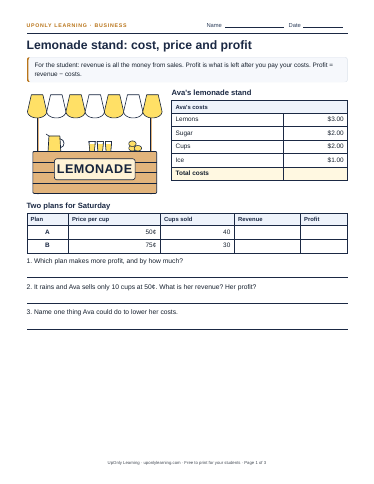
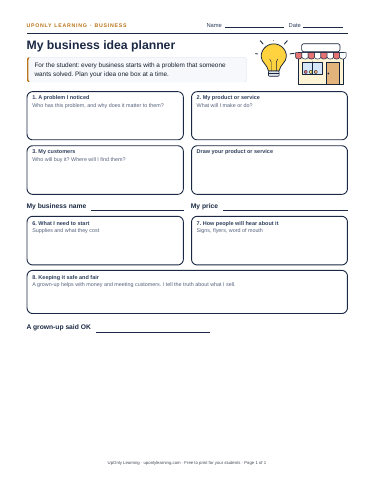
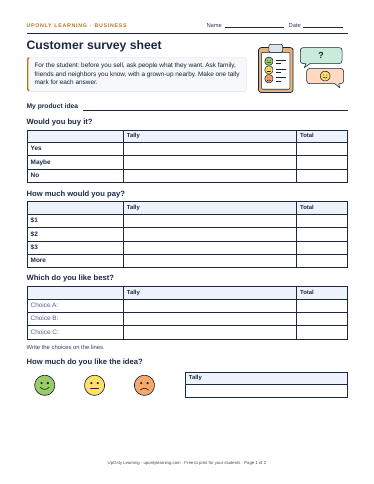
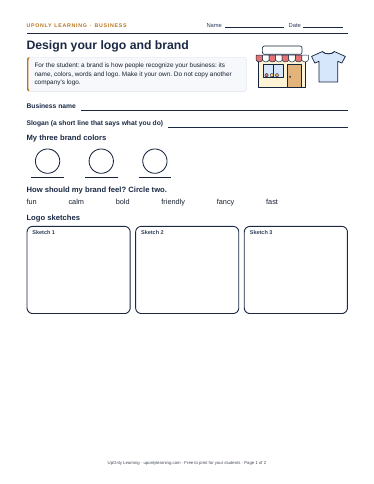
Business and money printables that fit this grade, with answer keys where there are answers.
Every printable comes in full color and in black and white line art (low ink, ready to color in).
Practice checks. Our business and money workbooks teach.
These questions check a skill. The workbook teaches it.
- TeachesA 40-minute lesson per topic that tells you what to say.
- ExplainsWorked examples and the common mistakes, with fixes.
- ReviewsAnswers with short explanations, and fresh questions.
- PlansEvery topic in teaching order, matched to the standards.
Other grades
Grade 4, other subjects
Questions parents ask
Are these business and money worksheets really free?
Yes. All 50 questions and their answers are on this page, free to print and free to photocopy for your own students. Printing needs only a free account. No card.
Can a teacher or a tutor use these with a class?
Yes. Print and photocopy them for the students you teach. The only thing we ask is that you do not republish them as your own or sell them.
Where are the answers?
Marked beside each question on this page, so it prints as its own answer key. For a clean copy, click Hide answers before you print; click Show answers again to print your answer key.
What grade are these for?
Grade 4. Every other grade from kindergarten to grade 8 has its own page, linked at the foot of this one. If your student finds these hard, try the grade below — that is normal and it is not a problem.
What do the paid workbooks add?
These questions check a skill. The workbook teaches it: a forty-minute lesson that tells you what to say, two or three worked examples, the mistakes students actually make on that skill and how to correct each one, and an explanation beside every answer rather than a bare key.