
UpOnly Learning · free for anyone
Free 6th grade entrepreneurship worksheets with answers
50 questions with the answers, free to print and free to photocopy for your own students. Spotting problems, inventing, prices and profit, customers and honest business, at the level of the grade.
Enjoy them. If you want more, or something we do not have yet, ask on our Share your ideas page and a real person will read it.
Hide the answers to print a clean copy for your student, then show them again to print your answer key.
Entrepreneurship & Business — Grade 6
50 questions · answers marked50 questions · answers hidden
- 1. What is a budget?
- A. A list of the prices a business charges its customers
- B. A plan for how much money will come in and go out in a set time ← Answer
- C. A record of every sale a business made during the last year
- D. A loan a bank gives to a business so it can start up
- 2. What is a business plan?
- A. A short written description of what a business will sell, to whom, and how it makes money ← Answer
- B. A list of the prices that every other business in town charges
- C. A bank form that lets a small business borrow money to start
- 3. What is a fixed cost?
- A. A cost that stays the same no matter how much is sold ← Answer
- B. The money a business takes in from all of its sales
- C. A cost that rises each time another item is made
- D. The part of each sale that is kept as profit
- 4. What is marketing?
- A. Everything a business does to learn about and reach customers ← Answer
- B. Only the ads a business puts on posters, flyers and signs
- C. Only the work of setting a price for each of its products
- D. The work of making a product in a factory or a kitchen
- 5. What is demand?
- A. The price at which buyers and sellers agree to trade
- B. The total amount of a product that a store keeps in stock
- C. How much buyers want and can pay for at each price ← Answer
- D. How much of a product sellers are ready to offer at a price
- 6. What is a survey?
- A. A record of the money that a business earned last month
- B. A set of questions asked to many people about wants ← Answer
- C. A single question that a business owner asks only a close friend
- D. A list of all the prices that competitors charge in town
- 7. What is a team?
- A. A group of people who compete to finish a task first
- B. People who work together toward the same goal ← Answer
- C. A set of tools that are kept together in one place
- 8. Which word means money coming in to a business, such as from sales?
- A. Income ← Answer
- B. Deposit
- C. Variance
- 9. Which question does a business plan answer first?
- A. How many days will I rest each week?
- B. What problem do I solve? ← Answer
- C. Who will be my best friend at work?
- D. Which store will rent me space?
- 10. Which is a fixed cost for a lemonade stand?
- A. Sugar poured into every pitcher
- B. Paper cups handed out per sale
- C. A $20 booth rental for the day ← Answer
- 11. Which list names the four Ps of marketing?
- A. Price, plan, packaging, payment
- B. Plan, profit, people, paper
- C. Product, price, place, promotion ← Answer
- D. Product, profit, payment, position
- 12. What is supply?
- A. How much of a product buyers want and can pay for
- B. The amount of a product left over after a big sale
- C. The lowest price a seller would accept for one item
- D. How much sellers will offer at each price ← Answer
- 13. What is a sample in a survey?
- A. The total number of customers who live in the whole town
- B. The product a business hands out for free to buyers
- C. The first question that is printed on the survey page
- D. The group of people who actually answer the survey ← Answer
- 14. What is a role on a team?
- A. The part each person plays on the team ← Answer
- B. The total profit that a team earns each month
- C. The name a team picks for its group
- D. The rule that every person must do the same task
- 15. Which word means money going out to pay for something?
- A. Expense ← Answer
- B. Income
- C. Profit
- D. Variance
- 16. Which is one of the six questions a business plan answers?
- A. What will it cost? ← Answer
- B. What is the weather today?
- C. Which color do I like best?
- 17. What is a variable cost?
- A. A cost that changes with how many items are made ← Answer
- B. The amount customers pay for one item
- C. A cost that stays the same whatever is sold
- D. The total of all money a business receives
- 18. What does 'product' mean in the four Ps?
- A. The number of people who see an advertisement
- B. The good or service a business sells ← Answer
- C. Where customers are able to buy the item
- 19. What is a shortage?
- A. When sellers have more than buyers want
- B. When buyers and sellers match exactly
- C. When buyers want more than sellers have ← Answer
- D. When a product costs too much to make
- 20. What is a biased question?
- A. A question with three clear and balanced answer choices
- B. A question that only one person in town can answer
- C. A question worded to push people toward one answer ← Answer
- D. A question that is asked on paper instead of online
- 21. What is a leader?
- A. A person who decides everything without any listening
- B. A person who only collects the profit at the very end
- C. A person who helps set goals and keep a team on track ← Answer
- D. A person who does every job with no help from others
- 22. What is a planned amount?
- A. The difference between two different monthly budgets
- B. The money left after every bill has been paid
- C. What the budget says will be earned or spent ← Answer
- D. What was really earned or spent during the last week
- 23. What is a target customer?
- A. The specific group a business most wants to serve ← Answer
- B. The group of workers who make the product each day
- C. Only the owner's closest friends and family members
- D. Every person who lives in the same country as the owner
- 24. Which is a variable cost for a cookie seller?
- A. Flour used in each batch of cookies ← Answer
- B. A fee paid to enter the market
- C. A sign bought once for the stand
- D. Rent for the table at the fair
- 25. What does 'price' mean in the four Ps?
- A. What the customer pays ← Answer
- B. How the business tells people about it
- C. What the business pays for supplies
- D. Where the customer finds the item
- 26. What is a surplus?
- A. When sellers have more than buyers want ← Answer
- B. When the price is exactly right for everyone
- C. When buyers want more than sellers have
- 27. What is a tally?
- A. A mark for each response so answers can be counted ← Answer
- B. A group of people who skipped answering the survey
- C. The total amount of money that the survey costs
- D. A question that is written without any answer choices
- 28. What does it mean to delegate?
- A. To give a task to someone and trust them to do it ← Answer
- B. To do every task yourself so that it is done right
- C. To ignore a task until the deadline has passed
- D. To split the profit equally without any discussion
- 29. What is an actual amount?
- A. What the budget predicted for the month
- B. The money saved in a bank account
- C. The price printed on a product
- D. What was really earned or spent ← Answer
- 30. Which target customer is the most specific?
- A. People who like having fun things
- B. Neighbors who work all day and own dogs ← Answer
- C. Anyone who happens to have money
- 31. What is total cost?
- A. The price of one item times the number sold
- B. Variable costs minus fixed costs
- C. Fixed costs plus variable costs ← Answer
- 32. What does 'place' mean in the four Ps?
- A. How a business tells customers about its product
- B. What a customer pays for the product
- C. Where and how customers can buy the product ← Answer
- D. The good or service a business sells
- 33. What is the equilibrium price?
- A. The price where amount wanted equals amount offered ← Answer
- B. The price a government sets for a product
- C. The price at which a seller earns the most profit
- D. The highest price any buyer would ever pay
- 34. What is a percent?
- A. A number out of 100, used to compare groups ← Answer
- B. The same thing as a plain count of the people asked
- C. The total price of an item once the tax has been added
- D. A number that is always smaller than ten or so
- 35. What is specialization?
- A. Letting the leader pick everyone's favorite job
- B. Working alone so no one disagrees
- C. Doing every job on the team in turn
- D. Focusing on one job so you can do it well ← Answer
- 36. What does variance mean in a budget?
- A. The difference between the planned and actual amount ← Answer
- B. The number of sales made in one month
- C. The money a business keeps as savings
- D. The total of all planned expenses together
- 37. What is a startup cost?
- A. The profit a business hopes to earn in its first month
- B. The cost of the supplies used for each item made
- C. Money spent once, before the first sale ← Answer
- D. Money earned from the first customer who buys
- 38. What is revenue?
- A. All the money a business takes in from sales ← Answer
- B. The money left after every cost is paid
- C. The rent paid for the booth each day
- 39. What does 'promotion' mean in the four Ps?
- A. How a business tells customers about its product ← Answer
- B. Where customers are able to buy the product
- C. What the product costs the business to make
- 40. What is scarcity?
- A. Having far more of something than anyone wants
- B. Not enough of something to meet everyone's wants ← Answer
- C. A price set too low for sellers to earn a profit
- D. A product that is sold in many different stores
- 41. What is market research?
- A. Setting the lowest price that the business can afford
- B. Printing posters and flyers for a stall at the market
- C. Counting the money in the cash box at closing time
- D. Gathering facts about customers before making decisions ← Answer
- 42. On a team that splits profit by effort, what is a fair share?
- A. An amount that matches the work a person did ← Answer
- B. An amount that is always exactly equal for everyone
- C. An amount chosen at random after the work is done
- 43. A budget has two halves. What are they?
- A. Savings and sales
- B. Income and expenses ← Answer
- C. Prices and customers
- 44. Which is an example of a startup cost for a dog-walking business?
- A. Money earned at the end of the first week
- B. A leash set bought before the first walk ← Answer
- C. Treats given to the dog on every walk
- 45. What is profit?
- A. Price times the number of customers
- B. Revenue plus total cost
- C. Fixed cost minus variable cost
- D. Revenue minus total cost ← Answer
- 46. What does 'reach' mean in advertising?
- A. The number of people who see a message ← Answer
- B. The number of items a business has sold
- C. The price a business pays to run an ad
- 47. If more people want a toy and the supply stays the same, what usually happens to the price?
- A. It rises ← Answer
- B. It falls
- C. It stays the same
- 48. Which question is the fairest?
- A. Which snack would you buy: cookies, chips or fruit? ← Answer
- B. Wouldn't you agree our delicious cookies beat boring chips?
- C. You want to buy our cookies today, right?
- D. Don't you just love our amazing cookies and prices?
- 49. Why do people form teams?
- A. One person can never finish any job alone
- B. Teams always finish faster no matter the job
- C. Jobs can be too big for one, and strengths differ ← Answer
- D. Teams let members avoid doing any of the work
- 50. A budget is balanced when which is true?
- A. Expenses are no more than income ← Answer
- B. Income is always twice the expenses
- C. The business spends nothing on wants
- D. Every planned amount equals the actual amount
What 6th grade entrepreneurship covers
6th grade entrepreneurship at UpOnly Learning is 7 topics, taught in this order: writing a one-page business plan, customer surveys and reading the results, why prices move: supply and demand, fixed and variable costs and profit margin, a business budget: planned and actual, marketing and the four Ps, and teams and leadership. The 50 questions above are drawn from those topics, with the answer marked beside each one, so you can see what has stuck and what needs another lesson. The workbook teaches each topic with a 40-minute lesson; the free PDF sample has one full topic.
What's inside
- Writing a one-page business plan: Describe a business on one page and use the numbers to test whether a profit goal is realistic
- Customer surveys and reading the results: Write fair survey questions and use counts and percents to decide what to make
- Why prices move: supply and demand: Explain how shortages and surpluses push prices up or down
- Fixed and variable costs and profit margin: Separate fixed and variable costs and find profit and profit margin
- A business budget: planned and actual: Build a business budget and adjust spending when income falls short
- Marketing and the four Ps: Describe product, price, place and promotion and compare ads by cost per person
- Teams and leadership: Assign team roles, delegate and share profit fairly
Keep going
Learn how money works: Money & Economics
Your next step
Entrepreneurship & Business Thinking · Grade 6
$19.99. One-time purchase, no subscription.
180 pages · 840 questions with answers · 7 topics
See it in the storeA real page of Entrepreneurship & Business Thinking · Grade 6
Plan the Money: A Business Budget
The student will build a simple monthly budget for a small business, compare planned and actual amounts, and adjust spending when income falls short. · 40 min
“A budget is a map for money. It tells you where you are headed before you spend.”
Planned income is $200 and planned expenses are $140. Actual income is $170 and actual expenses are $140. What is the actual leftover and the variance in income?
Answer: Leftover = $170 - $140 = $30. Income variance = $170 - $200 = -$30, so income was $30 below plan.
A budget is a limit that stops you from doing anything fun.
A budget is a plan you make yourself. It helps you decide on purpose so you can spend on what matters most.
Keep numbers small and round. Let the student decide what to cut and explain the choice.
That is one topic of many. The free questions above check a skill; this is the part that teaches it.
Free printables for this grade
Business and money printables that fit this grade, with answer keys where there are answers.
Every printable comes in full color and in black and white line art (low ink, ready to color in).
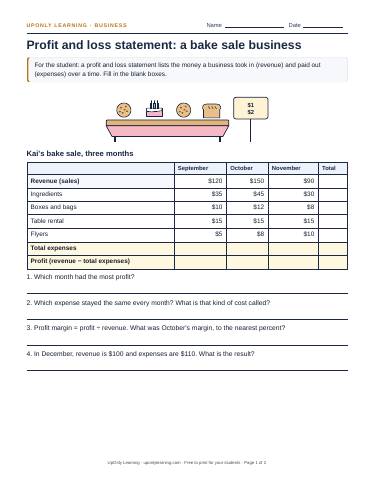
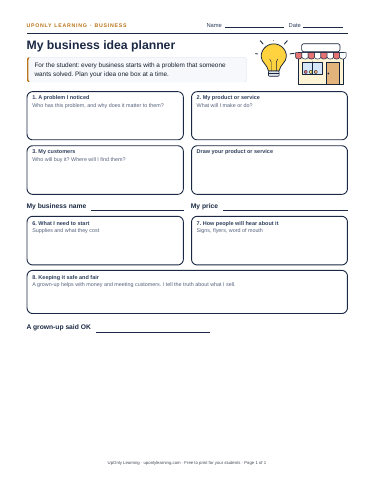
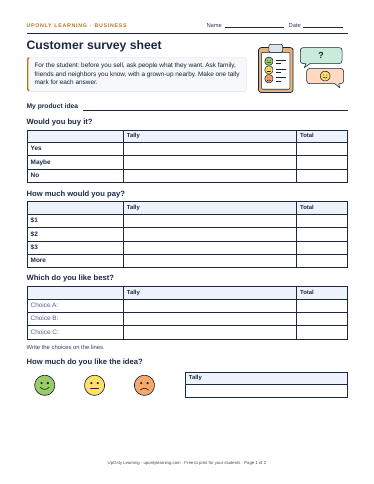
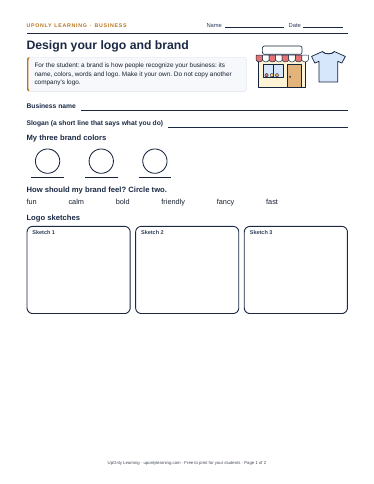
Practice checks. Our business and money workbooks teach.
These questions check a skill. The workbook teaches it.
- TeachesA 40-minute lesson per topic that tells you what to say.
- ExplainsWorked examples and the common mistakes, with fixes.
- ReviewsAnswers with short explanations, and fresh questions.
- PlansEvery topic in teaching order, matched to the standards.
Other grades
Grade 6, other subjects
Questions parents ask
Are these business and money worksheets really free?
Yes. All 50 questions and their answers are on this page, free to print and free to photocopy for your own students. Printing needs only a free account. No card.
Can a teacher or a tutor use these with a class?
Yes. Print and photocopy them for the students you teach. The only thing we ask is that you do not republish them as your own or sell them.
Where are the answers?
Marked beside each question on this page, so it prints as its own answer key. For a clean copy, click Hide answers before you print; click Show answers again to print your answer key.
What grade are these for?
Grade 6. Every other grade from kindergarten to grade 8 has its own page, linked at the foot of this one. If your student finds these hard, try the grade below — that is normal and it is not a problem.
What do the paid workbooks add?
These questions check a skill. The workbook teaches it: a forty-minute lesson that tells you what to say, two or three worked examples, the mistakes students actually make on that skill and how to correct each one, and an explanation beside every answer rather than a bare key.