
UpOnly Learning · free for anyone
Free 8th grade entrepreneurship worksheets with answers
50 questions with the answers, free to print and free to photocopy for your own students. Spotting problems, inventing, prices and profit, customers and honest business, at the level of the grade.
Enjoy them. If you want more, or something we do not have yet, ask on our Share your ideas page and a real person will read it.
Hide the answers to print a clean copy for your student, then show them again to print your answer key.
Entrepreneurship & Business — Grade 8
50 questions · answers marked50 questions · answers hidden
- 1. What is an asset?
- A. What is left for the owners after bills are paid
- B. Money that a business owes to other people
- C. A report that lists the sales for one month
- D. Something of value that a business owns ← Answer
- 2. What is funding?
- A. A list of the items a shop has in stock
- B. Money used to start or grow a business ← Answer
- C. The profit a business keeps each month
- D. Money a customer pays for one item
- 3. What is a pitch?
- A. A short talk that explains a business idea and asks for support ← Answer
- B. A long talk given to workers only after a business has closed down for good
- C. A long report that lists every cost a shop has to pay
- D. A price tag placed on a product in a store window
- 4. What is a supply chain?
- A. The steps and people that turn raw materials into a finished product in a customer's hands ← Answer
- B. The chain of stores that one large company owns and runs in many different cities and towns
- C. The list of prices that a shop posts for its customers
- D. The people who buy a product from a business
- 5. What is risk?
- A. The chance that something will go wrong and cause a loss ← Answer
- B. A loss that is certain to happen to every business in every single month
- C. A payment that is made to buy insurance
- D. Money that is set aside for surprise costs
- 6. What is a social enterprise?
- A. A business whose only goal is the most profit for its owners, whatever the cost to others
- B. A business whose main goal is to solve a social or environmental problem while earning money ← Answer
- C. A charity that depends only on gifts and on grants
- D. A club that has no income and no costs to pay at all
- 7. What is a tax?
- A. A prize that a shop gives out to its most loyal customers every year
- B. Money collected by the government to pay for public services ← Answer
- C. A loan a bank makes to a new business owner
- 8. What is a liability?
- A. The loss in value of old equipment
- B. Something of value that a business owns
- C. Money a business owes to others ← Answer
- D. The part of the business that the owner keeps
- 9. What is an equity investor?
- A. A person who buys one item from a shop
- B. A person who puts money into a business in return for a share of ownership ← Answer
- C. A person who works for the business for a wage
- D. A person who lends money to a business and must be repaid with interest later
- 10. What is market size?
- A. The profit a business keeps from each single sale it makes in a year
- B. The number of workers a business hires for its shop
- C. The number of possible customers times what each might spend ← Answer
- D. The size of the shop where the goods are sold
- 11. What is a supplier?
- A. A bank that lends money to a shop
- B. A customer who buys a finished product
- C. A worker who packs boxes in the back room for delivery to customers
- D. A business that sells materials or parts to another business ← Answer
- 12. What is insurance?
- A. A service where many pay small amounts so the few with a loss are repaid ← Answer
- B. A loan from a bank that a business must pay back later with extra interest
- C. A rule that stops every accident from happening
- 13. What is a nonprofit?
- A. A business that pays all of its surplus money out to its owners at the end of each year
- B. A shop that sells goods only to its own workers and staff
- C. An organization that uses surplus money to serve its mission, not to pay owners ← Answer
- 14. What is a regulation?
- A. A plan that an owner writes for new workers on their very first day
- B. A sale that a shop runs once a year
- C. A rule made by the government that businesses must follow ← Answer
- D. A price a shop picks for its own goods
- 15. What is owner's equity?
- A. The price a customer pays for each item
- B. What is left for the owners after liabilities are subtracted from assets ← Answer
- C. The total of all the money a business owes to its banks, suppliers and workers
- D. The cash a business keeps in its bank account
- 16. What is equity in a business?
- A. A promise to repay a loan with interest
- B. A share of ownership in the business ← Answer
- C. The cost of making each item
- D. The list of a business's debts
- 17. What is traction?
- A. A guess about how many people may like the idea one day
- B. Evidence that the idea works, like sales or sign-ups ← Answer
- C. The cost of making each unit of a product for sale
- 18. What is capacity?
- A. The cost of making one item
- B. The most a business can make in a set time ← Answer
- C. The profit a business keeps in a year
- D. The number of customers who visit a shop
- 19. What is a premium?
- A. The regular payment made to buy insurance ← Answer
- B. The money a business keeps for surprise costs
- C. The amount that an insurer pays after a loss
- 20. What is a mission?
- A. The purpose that an organization exists to serve ← Answer
- B. The profit that a business keeps in each month
- C. The price that a customer pays for each item
- D. The list of all of the products that a shop sells
- 21. What is a license?
- A. A tax that is paid each time a customer buys an item at a shop
- B. Official permission to run a certain kind of business ← Answer
- C. A loan from the government to start a stand
- 22. What is a balance sheet?
- A. A plan for how much money the business will spend
- B. A report of the sales and profit over one month
- C. A list of every customer and what each one bought during the year
- D. A report that lists assets, liabilities and equity on one date ← Answer
- 23. What is crowdfunding?
- A. Raising small amounts of money from many people, usually online ← Answer
- B. Selling shares to one investor only
- C. Borrowing a large sum of money from one bank and repaying it monthly
- D. Using your own savings to start a business
- 24. What is the ask?
- A. The total profit the business hopes to make in a year
- B. The amount of money or help requested, and its use ← Answer
- C. The price a customer pays for one unit of the product
- 25. What is a bottleneck?
- A. The slowest step, which limits how much the whole process can make ← Answer
- B. The last step, where the finished products are sold to the customers
- C. The fastest step in a process
- D. The cost of the materials used
- 26. What is a deductible?
- A. The profit that is left over after a loss
- B. The regular monthly payment that a business makes to buy its insurance
- C. The part of a loss the policyholder pays before insurance pays ← Answer
- D. The money a business keeps aside for surprises
- 27. What is impact?
- A. The total money that a business earns from its sales
- B. The speed at which a shop serves each of its customers
- C. The number of items that sit in a shop's stock
- D. The measurable change made in people's lives or the environment ← Answer
- 28. What is a public good?
- A. A gift that a shop gives only to its best customers, such as coupons
- B. A product that only one shop is able to sell
- C. A service that benefits everyone, such as roads or fire protection ← Answer
- 29. What is cash flow?
- A. The movement of money into and out of a business ← Answer
- B. The share of the business that the owner keeps
- C. The total of the debts that a business has
- D. The value of all the equipment a business owns
- 30. What is collateral?
- A. Something valuable a borrower promises to give up if the loan is not repaid ← Answer
- B. The share of a business that an investor owns after putting money into it
- C. The interest charged on a loan each year
- 31. What is a return for an investor?
- A. A question asked at the end of a pitch by a judge
- B. The price of a product sold to a customer in a shop
- C. What an investor gets back for the money put in ← Answer
- D. The money a business spends on supplies each month
- 32. What is quality control?
- A. Buying materials from the cheapest supplier
- B. Checking products to make sure they meet a standard ← Answer
- C. Raising the price of a product when demand grows
- 33. What is an emergency fund?
- A. A list of the risks that a shop could face
- B. A regular payment that is made to an insurer
- C. Money set aside to cover surprise costs ← Answer
- 34. What is a stakeholder?
- A. Only the bank that lent the money to the business
- B. Only the customers who come in and buy something from the shop every single week
- C. Anyone affected by what a business does, like customers, workers and neighbors ← Answer
- D. Only the person who owns the business and nobody else
- 35. What is consumer protection?
- A. Rules that keep buyers safe and treated fairly ← Answer
- B. Rules that keep one shop from opening near another
- C. Rules that tell shops which goods they must sell
- D. Rules that raise the prices of goods in a shop
- 36. What is depreciation?
- A. The loss in value of equipment as it wears out or ages ← Answer
- B. The money a customer owes to the business
- C. The money a lender charges a business each year on a loan
- D. The profit that a business earns in a year
- 37. What is bootstrapping?
- A. Starting a business with your own money and sales, without outside funding ← Answer
- B. Raising money from many people online
- C. Selling shares of the business to an investor
- D. Borrowing money from a bank before opening and paying it back over many years
- 38. What is due diligence?
- A. The careful checking an investor does before investing ← Answer
- B. A list of the customers who signed up for a test
- C. A pitch speech that lasts for under one minute
- D. A reward for the first customers of a new business
- 39. What are economies of scale?
- A. Lower cost per item when a business makes more of them ← Answer
- B. A government rule that limits how much a business may make each year
- C. Higher cost per item when a business grows
- D. A scale used to weigh finished products
- 40. What does diversify mean?
- A. Sell only to your single largest customer
- B. Spread risk by not relying on one product, customer or supplier ← Answer
- C. Buy everything from only one supplier
- D. Put all of the money into just one product that is selling well right now
- 41. What does sustainable mean for a business?
- A. Able to keep going over time without running out of money ← Answer
- B. Able to sell the very same single product forever without ever changing
- C. Able to give away all of its money in one day
- 42. What is sales tax?
- A. A percent added to the price of goods at the time of purchase ← Answer
- B. A prize paid to the buyer of a certain item
- C. A fee that a shop pays each month to the owner to rent its building
- 43. State the balance sheet equation.
- A. Owner's equity = assets + liabilities
- B. Liabilities = assets + owner's equity
- C. Assets = liabilities + owner's equity ← Answer
- 44. What does an equity investor receive in exchange for money?
- A. A guaranteed repayment plus interest
- B. A share of ownership in the business ← Answer
- C. A fixed wage for working in the shop
- 45. Which is one of the six parts of a pitch?
- A. The speaker's age
- B. The problem ← Answer
- C. The weather
- D. The room size
- 46. Which is part of a candle supply chain?
- A. A bank loan
- B. A wax supplier ← Answer
- C. A school bell
- 47. A shop pays $50 per month for insurance. What does it pay in a year?
- A. $500
- B. $600 ← Answer
- C. $62
- D. $2,600
- 48. Which type of organization depends mostly on donations and grants?
- A. A charity or nonprofit, which relies on gifts and grants ← Answer
- B. A social enterprise, which earns money from its sales
- C. A regular business, which aims at profit for owners
- 49. Which of these is a public good paid for by taxes?
- A. A candy bar sold at a shop on the corner
- B. A road that anyone in town may drive on ← Answer
- C. A pizza ordered for delivery to your home
- 50. A bike business has assets of $200 and liabilities of $50. What is the owner's equity?
- A. $200
- B. $250
- C. $50
- D. $150 ← Answer
What 8th grade entrepreneurship covers
8th grade entrepreneurship at UpOnly Learning is 7 topics, taught in this order: the balance sheet: assets, liabilities, equity, loans, investors and crowdfunding, social enterprise: profit with a purpose, managing business risk and insurance, operations and supply chains, the investor pitch, and taxes and regulation. The 50 questions above are drawn from those topics, with the answer marked beside each one, so you can see what has stuck and what needs another lesson. The workbook teaches each topic with a 40-minute lesson; the free PDF sample has one full topic.
What's inside
- The balance sheet: assets, liabilities, equity: Build a simple balance sheet and show that assets equal liabilities plus equity
- Loans, investors and crowdfunding: Compare ways to fund a business by what each costs the owner
- Social enterprise: profit with a purpose: Explain how a business earns money while solving a community problem and measure its impact
- Managing business risk and insurance: Identify business risks and compare the cost of protection with the cost of loss
- Operations and supply chains: Find the bottleneck and unit cost in a simple supply chain
- The investor pitch: Build a short pitch with numbers and answer hard questions honestly
- Taxes and regulation: Explain why governments tax and regulate businesses and calculate sales and income tax
Keep going
Learn how money works: Money & Economics
Your next step
Entrepreneurship & Business Thinking · Grade 8
$19.99. One-time purchase, no subscription.
177 pages · 840 questions with answers · 7 topics
See it in the storeA real page of Entrepreneurship & Business Thinking · Grade 8
What a Business Owns and Owes: The Balance Sheet
The student will build a simple balance sheet, show that assets equal liabilities plus owner's equity, and explain how it differs from an income statement. · 40 min
“The income statement shows a month. The balance sheet shows a single moment, like a photo of what the business has and owes.”
A shop has assets of $5,000 and liabilities of $3,200. What is the owner's equity?
Answer: 5,000 - 3,200 = $1,800.
Owner's equity is the money the owner has in the bank.
Equity is assets minus liabilities. It is not just cash.
Use physical items to model the sheet. A bike, a loan and a friend's IOU make the equation concrete.
That is one topic of many. The free questions above check a skill; this is the part that teaches it.
Free printables for this grade
Business and money printables that fit this grade, with answer keys where there are answers.
Every printable comes in full color and in black and white line art (low ink, ready to color in).
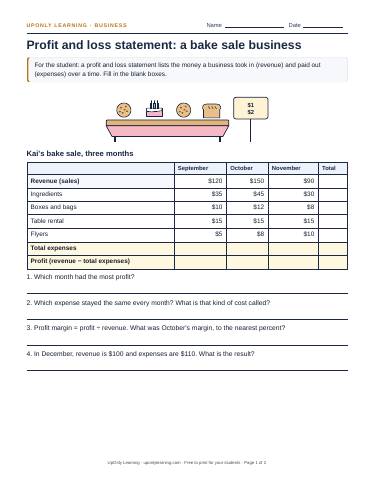
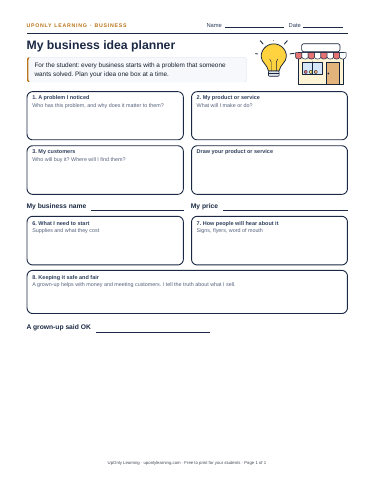
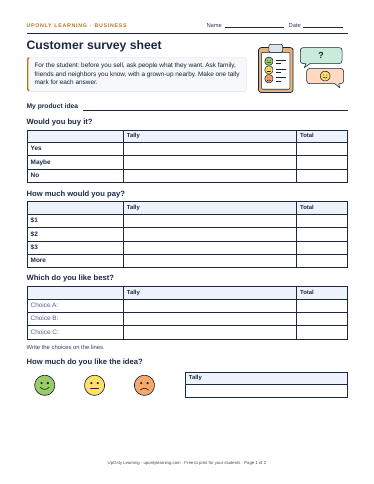
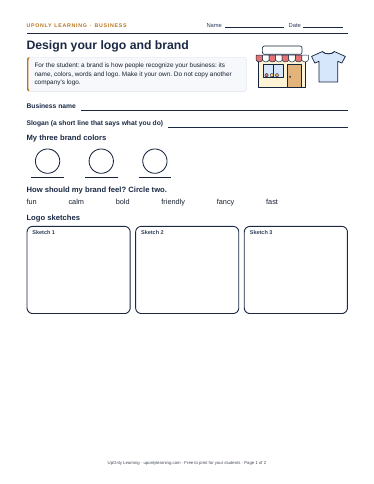
Practice checks. Our business and money workbooks teach.
These questions check a skill. The workbook teaches it.
- TeachesA 40-minute lesson per topic that tells you what to say.
- ExplainsWorked examples and the common mistakes, with fixes.
- ReviewsAnswers with short explanations, and fresh questions.
- PlansEvery topic in teaching order, matched to the standards.
Other grades
Grade 8, other subjects
Questions parents ask
Are these business and money worksheets really free?
Yes. All 50 questions and their answers are on this page, free to print and free to photocopy for your own students. Printing needs only a free account. No card.
Can a teacher or a tutor use these with a class?
Yes. Print and photocopy them for the students you teach. The only thing we ask is that you do not republish them as your own or sell them.
Where are the answers?
Marked beside each question on this page, so it prints as its own answer key. For a clean copy, click Hide answers before you print; click Show answers again to print your answer key.
What grade are these for?
Grade 8. Every other grade from kindergarten to grade 8 has its own page, linked at the foot of this one. If your student finds these hard, try the grade below — that is normal and it is not a problem.
What do the paid workbooks add?
These questions check a skill. The workbook teaches it: a forty-minute lesson that tells you what to say, two or three worked examples, the mistakes students actually make on that skill and how to correct each one, and an explanation beside every answer rather than a bare key.