
UpOnly Learning · free for anyone
Free 1st grade entrepreneurship worksheets with answers
50 questions with the answers, free to print and free to photocopy for your own students. Spotting problems, inventing, prices and profit, customers and honest business, at the level of the grade.
Enjoy them. If you want more, or something we do not have yet, ask on our Share your ideas page and a real person will read it.
Hide the answers to print a clean copy for your student, then show them again to print your answer key.
Entrepreneurship & Business — Grade 1
50 questions · answers marked50 questions · answers hidden
- 1. What is a cost?
- A. Money you find under a sofa
- B. Money you pay to make something ← Answer
- C. Money you get as a birthday gift
- 2. What does earn mean?
- A. To get money by working or selling ← Answer
- B. To grow money on a tree in the yard
- C. To find money lying on the street
- 3. What do we call a person who sees a need and starts something new to help?
- A. A shopper at a store
- B. A customer in line
- C. An entrepreneur ← Answer
- 4. What is a price?
- A. How heavy a bag of food is
- B. How big a box is inside
- C. How much money you pay ← Answer
- 5. What is a pitch?
- A. A game of tag at the park with pals
- B. A short talk about your idea ← Answer
- C. A long nap on a big soft bed
- 6. What is a skill?
- A. Something you hold in your hand
- B. Something you buy at a big toy shop
- C. Something you learned to do well ← Answer
- 7. What is a team?
- A. One person working all alone
- B. A box full of old broken toys
- C. A group working together ← Answer
- 8. What are materials?
- A. The songs you sing while you work
- B. The stuff you use to make a product ← Answer
- C. The people who come to buy your product
- 9. What is income?
- A. Money a person earns ← Answer
- B. A toy a person keeps
- C. A meal a person eats
- 10. What is the first step an entrepreneur takes?
- A. Buy a big store
- B. See a need ← Answer
- C. Count the money
- 11. A banana costs $1. How many dollars is that?
- A. 10 dollars
- B. 1 dollar ← Answer
- C. 2 dollars
- 12. What is the first part of a pitch?
- A. What is it? ← Answer
- B. Where is my hat?
- C. What time is it?
- 13. What is a tool?
- A. A song you sing at bedtime
- B. A feeling you get when you are happy
- C. A thing that helps you do a job ← Answer
- 14. What does specialize mean?
- A. Do one job and get good at it ← Answer
- B. Do every job at the same time
- C. Do no job and take a long nap
- 15. To make lemonade, are lemons a material or a tool?
- A. A tool
- B. A material ← Answer
- C. A helper
- 16. What is one way people earn money?
- A. Taking a long nap
- B. Working at a job ← Answer
- C. Watching the clouds
- 17. In business, a need is...
- A. a toy you already have
- B. a song you like to sing
- C. a problem people have ← Answer
- 18. A book costs $6. How many dollars is that?
- A. 6 dollars ← Answer
- B. 5 dollars
- C. 9 dollars
- 19. What is the second part of a pitch?
- A. Who ate my lunch?
- B. Who does it help? ← Answer
- C. Who is the tallest?
- 20. Is a broom a skill or a tool?
- A. A song
- B. A skill
- C. A tool ← Answer
- 21. Is it usually faster when a team splits up the jobs?
- A. Yes, usually faster ← Answer
- B. No, it never works
- C. No, always slower
- 22. To make lemonade, is a pitcher a material or a tool?
- A. A customer
- B. A material
- C. A tool ← Answer
- 23. What is another way people earn money?
- A. Wishing on a bright star
- B. Hiding coins in a jar
- C. Selling things they make ← Answer
- 24. What is an idea?
- A. A coin in your pocket
- B. A box on a shelf
- C. A plan you think up ← Answer
- 25. A ball costs $3. A kite costs $8. Which costs more?
- A. The kite ← Answer
- B. The ball
- C. They cost the same
- 26. What is the third part of a pitch?
- A. Why do cats nap?
- B. Why is grass green?
- C. Why is it good? ← Answer
- 27. Is knowing how to swim a skill or a tool?
- A. A skill ← Answer
- B. A tool
- C. A toy
- 28. At dinner clean-up, one person clears, one washes, one dries. How many jobs?
- A. 3 jobs ← Answer
- B. 2 jobs
- C. 4 jobs
- 29. Is making something free?
- A. Yes, always free
- B. Yes, on Sundays
- C. No, it has costs ← Answer
- 30. Does money grow on trees?
- A. Yes, on apple trees
- B. No, people earn it ← Answer
- C. Yes, in the spring
- 31. What is a risk?
- A. A prize you always get for free
- B. A chance it might not work ← Answer
- C. A sure win every time
- 32. A cap costs $7. A sock costs $2. Which costs less?
- A. The sock ← Answer
- B. The cap
- C. They cost the same
- 33. How should you speak when you share an idea?
- A. With your mouth full
- B. In a clear voice ← Answer
- C. In a tiny whisper
- 34. Who uses an oven to make bread?
- A. A sailor
- B. A baker ← Answer
- C. A pilot
- 35. What is an assembly line?
- A. A row of workers each doing one step ← Answer
- B. A line of kids waiting for the slide
- C. A line you draw with a ruler and pen
- 36. Which is a material for making a sandwich?
- A. A knife
- B. A plate
- C. Bread ← Answer
- 37. A teacher works at a school. How does she get money?
- A. She picks it up at the park
- B. She gets paid for her work ← Answer
- C. She finds it in her lunch
- 38. Who is a customer?
- A. A person who builds the wooden stand
- B. A person who makes the sign
- C. A person who buys what you sell ← Answer
- 39. What is a market?
- A. A place to take a bath
- B. A place to sleep at night
- C. A place to buy and sell ← Answer
- 40. Where should you look when you give a pitch?
- A. At the ceiling
- B. At the people ← Answer
- C. At the floor
- 41. Who uses scissors and a comb to cut hair?
- A. A plumber
- B. A barber ← Answer
- C. A farmer
- 42. What does trade mean?
- A. Swap what you make for something else ← Answer
- B. Throw away what you make right away
- C. Keep everything you make all to yourself
- 43. Which is a material for painting a sign?
- A. A ladder
- B. Paint ← Answer
- C. A brush
- 44. What is a job?
- A. A nap a person takes at noon
- B. A game a person plays just for fun
- C. Work a person does to earn money ← Answer
- 45. How many steps does an entrepreneur take: see a need, have an idea, take a chance?
- A. 5 steps
- B. 3 steps ← Answer
- C. 2 steps
- 46. What sign do we write before a number of dollars?
- A. =
- B. +
- C. $ ← Answer
- 47. Should a pitch be honest?
- A. No, never
- B. Only on Fridays
- C. Yes, always ← Answer
- 48. Which tool does a carpenter use to hit nails?
- A. A hammer ← Answer
- B. A pillow
- C. A spoon
- 49. On a card team, Ruby folds and Max draws. What is Max's job?
- A. Drawing ← Answer
- B. Folding
- C. Selling
- 50. Which is a tool for making cookies?
- A. A cookie sheet ← Answer
- B. Some butter
- C. Some sugar
What 1st grade entrepreneurship covers
1st grade entrepreneurship at UpOnly Learning is 7 topics, taught in this order: what entrepreneurs do, skills it takes to make things, prices at the market, how people earn money, what it costs to make something, working together: everyone has a job, and telling people about my idea. The 50 questions above are drawn from those topics, with the answer marked beside each one, so you can see what has stuck and what needs another lesson. The workbook teaches each topic with a 40-minute lesson; the free PDF sample has one full topic.
What's inside
- What entrepreneurs do: Explain that entrepreneurs see a need, have an idea and take a chance to start something
- Skills it takes to make things: Describe the skills and tools people need to make goods and give services
- Prices at the market: Read and compare prices and explain why some things cost more
- How people earn money: Explain how people earn income by working and selling
- What it costs to make something: List the things you must pay for to make a product
- Working together: everyone has a job: Show how splitting jobs helps a team make more
- Telling people about my idea: Explain an idea clearly so others understand and get excited
Keep going
Learn how money works: Money & Economics
Your next step
Entrepreneurship & Business Thinking · Grade 1
$19.99. One-time purchase, no subscription.
150 pages · 791 questions with answers · 7 topics
See it in the storeA real page of Entrepreneurship & Business Thinking · Grade 1
What Goes Into It? Counting the Costs
The student will list the things a maker must pay for to make a product, such as materials, tools, a place to work and helpers. · 40 min
“Making something is not free. Today we will find all the things a maker must pay for.”
Kenji wants to make bookmarks to sell. What costs might he have?
Answer: Paper and markers are materials; scissors are a tool. He must pay for these before he can make bookmarks.
If I already have the cups at home, making lemonade is free.
Explain that someone paid for the cups when they were bought. Every material had a cost, even if it was bought earlier.
Keep all numbers small (sums within 10 or 20). The goal is noticing that every product has costs, not doing hard math.
That is one topic of many. The free questions above check a skill; this is the part that teaches it.
Free printables for this grade
Business and money printables that fit this grade, with answer keys where there are answers.
Every printable comes in full color and in black and white line art (low ink, ready to color in).
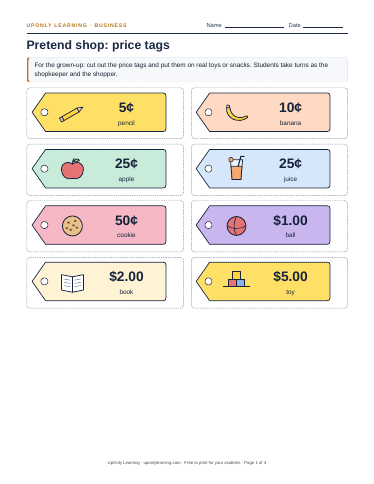
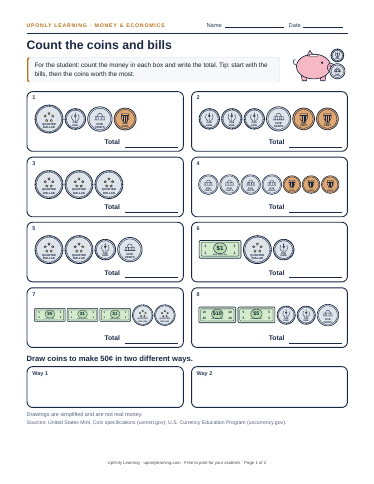
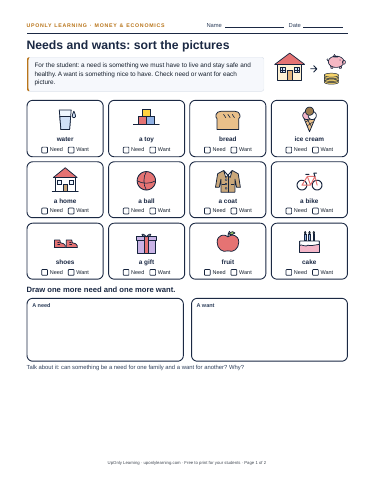
Practice checks. Our business and money workbooks teach.
These questions check a skill. The workbook teaches it.
- TeachesA 40-minute lesson per topic that tells you what to say.
- ExplainsWorked examples and the common mistakes, with fixes.
- ReviewsAnswers with short explanations, and fresh questions.
- PlansEvery topic in teaching order, matched to the standards.
Other grades
Grade 1, other subjects
Questions parents ask
Are these business and money worksheets really free?
Yes. All 50 questions and their answers are on this page, free to print and free to photocopy for your own students. Printing needs only a free account. No card.
Can a teacher or a tutor use these with a class?
Yes. Print and photocopy them for the students you teach. The only thing we ask is that you do not republish them as your own or sell them.
Where are the answers?
Marked beside each question on this page, so it prints as its own answer key. For a clean copy, click Hide answers before you print; click Show answers again to print your answer key.
What grade are these for?
Grade 1. Every other grade from kindergarten to grade 8 has its own page, linked at the foot of this one. If your student finds these hard, try the grade below — that is normal and it is not a problem.
What do the paid workbooks add?
These questions check a skill. The workbook teaches it: a forty-minute lesson that tells you what to say, two or three worked examples, the mistakes students actually make on that skill and how to correct each one, and an explanation beside every answer rather than a bare key.