
UpOnly Learning · free for anyone
Free 7th grade entrepreneurship worksheets with answers
50 questions with the answers, free to print and free to photocopy for your own students. Spotting problems, inventing, prices and profit, customers and honest business, at the level of the grade.
Enjoy them. If you want more, or something we do not have yet, ask on our Share your ideas page and a real person will read it.
Hide the answers to print a clean copy for your student, then show them again to print your answer key.
Entrepreneurship & Business — Grade 7
50 questions · answers marked50 questions · answers hidden
- 1. What is the principal?
- A. The smallest amount a borrower must pay each month
- B. The extra money a bank pays on a saving account
- C. The starting amount of money saved or borrowed ← Answer
- D. The percent charged on a loan for one year
- 2. What is competition?
- A. When one seller is the only real choice that customers have
- B. When a seller gives the whole stock away to everyone
- C. When buyers push to be the first one in the long line
- D. Two or more sellers trying to win the same customers ← Answer
- 3. What is a contract?
- A. An agreement between people that the law can enforce ← Answer
- B. A receipt that shows what a customer bought last week
- C. A promise that nobody in the shop is required to keep
- D. A list of prices that a shop posts near its front door
- 4. What is e-commerce?
- A. Shipping boxes from a warehouse to a store shelf nearby
- B. Buying and selling only inside of a school building
- C. Printing price tags for goods in a shop window display
- D. Buying and selling goods and services over the internet ← Answer
- 5. What does an income statement show?
- A. Revenue, expenses and profit for a period of time ← Answer
- B. The total value of everything a business owns
- C. The list of customers who bought last week
- 6. What is markup?
- A. The amount added to the cost of an item to set its selling price ← Answer
- B. The amount taken off a regular price during a sale
- C. The money a store keeps after paying every bill
- D. The number of items a customer buys at once
- 7. What is a wage?
- A. The skills and knowledge that a person has
- B. Pay for work, usually counted per hour ← Answer
- C. A fixed amount of pay for a whole year
- D. Pay that is left after taxes are taken out
- 8. What is simple interest?
- A. Interest paid only on the principal ← Answer
- B. Interest that is paid once at the end of a loan
- C. Interest that is charged only on credit cards
- D. Interest paid on the principal and on earlier interest
- 9. What is a competitive advantage?
- A. The total amount of money that a business earns in a year
- B. Something a business does better than others ← Answer
- C. Something a business does the same as every other seller
- D. The number of workers a business has on its team
- 10. What are the terms of a contract?
- A. The names of the people who work at the front desk
- B. The dates on which the shop is closed for holidays
- C. The color of the paper the agreement is printed on
- D. The specific promises and conditions in the agreement ← Answer
- 11. What is a platform in online selling?
- A. A box in which a seller ships goods out to a buyer
- B. A bank account that holds the money from all sales
- C. A raised stage where a seller stands up to talk
- D. A website or app where sellers list items for buyers ← Answer
- 12. What is revenue?
- A. Money a customer owes after a return
- B. Money a bank lends to the shop
- C. Money earned from sales ← Answer
- 13. What is markup percent?
- A. The discount divided by the sale price
- B. The markup divided by the cost, written as a percent ← Answer
- C. The cost divided by the markup
- D. The markup divided by the selling price
- 14. What is a salary?
- A. Pay counted for each single hour of work
- B. A fixed amount of pay for a year, usually paid in equal parts ← Answer
- C. Pay that a worker gets only on holidays
- D. The amount taken out of a paycheck for taxes
- 15. What is compound interest?
- A. Interest paid on the principal and on interest already earned ← Answer
- B. Interest paid only on the principal that was first deposited
- C. Interest that stays the same each year no matter what happens
- 16. What is market share?
- A. The amount of profit a business keeps once all costs are paid
- B. The price a business charges for its single best-selling item
- C. The percent of all sales in a market that one business has ← Answer
- 17. What is a breach of contract?
- A. Reading every term before agreeing to it
- B. Failing to do what the contract says ← Answer
- C. Signing the contract in front of a witness
- 18. What is a transaction fee?
- A. A tax that is paid only when a business closes down
- B. A fee a buyer pays once just to enter an online shop
- C. A charge taken for each sale by a platform ← Answer
- 19. What is cost of goods sold?
- A. The price that customers pay for each item
- B. The profit left after all the costs are paid
- C. The direct cost of making or buying the items that were sold ← Answer
- 20. What is a discount?
- A. A group of items sold at a single price
- B. The price that a store paid for an item
- C. An amount taken off the regular price ← Answer
- D. An amount added to the cost of an item
- 21. What is gross pay?
- A. The amount of taxes a worker pays
- B. The pay a worker gets for overtime only
- C. Pay left after taxes are taken out
- D. Pay before anything is taken out ← Answer
- 22. What is an annual rate?
- A. The percent of interest paid in one year ← Answer
- B. The total amount of interest paid over the whole loan
- C. The amount borrowed from the lender at the start
- D. The smallest payment that is due each month
- 23. What is a unique selling point?
- A. A promise that no competitor could ever possibly copy
- B. A list of every product that the business sells
- C. The lowest price that a business can afford to charge
- D. The one clear reason a customer should pick you ← Answer
- 24. What is a deadline?
- A. The date by which something must be done ← Answer
- B. The person who checks that the work is good
- C. The price that is paid once the job is finished
- D. The first day that a worker starts a new job
- 25. What is personal information?
- A. The list of products a platform has on offer for sale
- B. Facts about the weather in your town on a given day
- C. Details that identify you, like your name and address ← Answer
- 26. What is gross profit?
- A. Revenue minus cost of goods sold ← Answer
- B. Revenue minus every expense of the business
- C. Cost of goods sold minus revenue
- D. Revenue plus cost of goods sold
- 27. What is a sale price?
- A. The price the store paid
- B. The price of a bundle
- C. The price after the discount ← Answer
- D. The price before the discount
- 28. What is net pay?
- A. The tax rate that the government sets
- B. Pay left after deductions, also called take-home pay ← Answer
- C. The pay a worker earns in a full year
- D. Pay before anything is taken out
- 29. What is a credit history?
- A. A list of every product that a person has bought
- B. A record of the interest a bank paid on deposits
- C. A statement of how much money is in a savings account
- D. A record of how well someone repaid borrowed money ← Answer
- 30. What is a substitute?
- A. A different product that meets the same need ← Answer
- B. The exact same product from a different shop
- C. A product that costs more than the original
- D. A product that nobody wants to buy
- 31. What does ethics mean?
- A. Rules that tell a shop how to set its prices
- B. Laws that list every crime and its penalty
- C. Principles that guide what is right and fair ← Answer
- D. Facts about how much money a business has earned
- 32. What is phishing?
- A. A message that pretends to be trusted, to trick you into giving private information ← Answer
- B. A list of sales that a platform sends to its sellers each week
- C. A message that thanks a buyer for a recent order and gives a receipt
- 33. What is an operating expense?
- A. A cost of running the business that is not the cost of making the product ← Answer
- B. The money earned from selling each shirt
- C. The profit left over at the end of the month
- 34. What is a bundle?
- A. An item with a markup added
- B. Several items sold together at one price ← Answer
- C. One item sold at a very low price
- D. A discount that applies to all items
- 35. What is a deduction?
- A. The number of hours that a worker puts in
- B. An amount taken out of pay, such as taxes ← Answer
- C. An amount added to a worker's pay as a bonus
- D. A raise that a worker earns for good work
- 36. What is a minimum payment?
- A. The smallest amount due each month to stay in good standing ← Answer
- B. The most a borrower is allowed to pay each month
- C. The first deposit a saver puts into a new account
- D. The total interest earned on a savings account
- 37. What is a monopoly?
- A. A market with hundreds of small sellers competing hard
- B. A market where one seller has little or no competition ← Answer
- C. A market where every seller charges exactly the same price
- 38. What is a conflict of interest?
- A. A personal interest that could get in the way of acting fairly for others ← Answer
- B. Two shops that sell the same product on one busy street
- C. A rule that stops every worker from taking a lunch break
- 39. What is encryption?
- A. Printing a message in very small letters to hide it
- B. Deleting a message right after a buyer has read it
- C. Scrambling data so only the right person can read it ← Answer
- D. Sending a message to every buyer on a list at once
- 40. What is net profit?
- A. The cost of goods sold plus all expenses
- B. What is left after all costs and expenses are subtracted from revenue ← Answer
- C. Revenue minus the cost of goods sold only
- 41. What is a price anchor?
- A. A higher price shown first to make another price look more reasonable ← Answer
- B. The cost of an item to the store
- C. A price that never changes
- D. The lowest price a store is able to charge
- 42. What is human capital?
- A. The tools and machines that a worker uses
- B. The skills, knowledge and health a person has that help them earn income ← Answer
- C. The money a business keeps in a bank
- 43. Who pays interest in a loan?
- A. The borrower pays interest to the lender ← Answer
- B. The lender pays interest to the borrower
- C. The bank pays interest to the government
- D. Nobody pays interest on a loan
- 44. What do customers often gain from competition?
- A. Higher prices and fewer choices to pick between
- B. Just one single brand to buy in every store
- C. Longer waits at the counter and weaker service
- D. Lower prices, better products and more choice ← Answer
- 45. Which part of a contract names who is making the deal?
- A. The penalty
- B. The payment
- C. The parties ← Answer
- D. The deadline
- 46. Which is a benefit of selling online?
- A. It means that no buyer will ever ask a question
- B. It removes every cost of running a small business
- C. It guarantees that every item you list sells quickly
- D. It can reach more customers than a single shop can ← Answer
- 47. Which item comes first on an income statement?
- A. Revenue ← Answer
- B. Net profit
- C. Gross profit
- D. Operating expenses
- 48. Selling price equals cost plus what?
- A. The anchor
- B. The discount
- C. The bundle
- D. The markup ← Answer
- 49. Ana earns $14 per hour and works 10 hours. What is her gross pay?
- A. $168
- B. $24
- C. $140 ← Answer
- D. $100
- 50. Who earns interest on a savings account?
- A. The bank earns interest from the saver
- B. The saver earns interest from the bank ← Answer
- C. The government earns interest from the saver
What 7th grade entrepreneurship covers
7th grade entrepreneurship at UpOnly Learning is 7 topics, taught in this order: accounts, compound interest and credit, reading the income statement, competition and your competitive edge, selling online and staying safe, contracts and fair dealing, markup, discounts and bundles, and jobs, wages and skills. The 50 questions above are drawn from those topics, with the answer marked beside each one, so you can see what has stuck and what needs another lesson. The workbook teaches each topic with a 40-minute lesson; the free PDF sample has one full topic.
What's inside
- Accounts, compound interest and credit: Compare simple and compound interest and explain how credit and borrowing costs work
- Reading the income statement: Find gross profit and net profit from revenue and costs
- Competition and your competitive edge: Explain how competition shapes price and quality and write a clear unique selling point
- Selling online and staying safe: Count the costs of online selling and apply rules for protecting information and spotting scams
- Contracts and fair dealing: Identify the parts of a contract and use ethical reasoning in business choices
- Markup, discounts and bundles: Set prices with markup percent and check profit after discounts and bundles
- Jobs, wages and skills: Calculate gross and net pay and explain how skills raise earning power
Keep going
Learn how money works: Money & Economics
Your next step
Entrepreneurship & Business Thinking · Grade 7
$19.99. One-time purchase, no subscription.
176 pages · 840 questions with answers · 7 topics
See it in the storeA real page of Entrepreneurship & Business Thinking · Grade 7
Money Over Time: Accounts, Interest and Credit
The student will compare simple and compound interest on savings, explain how credit and borrowing costs work, and describe how repaying on time builds a credit history. · 40 min
“Money can grow or shrink with time. Today you learn the rules that decide which way it goes.”
Find the simple interest on $800 at 3% for 4 years.
Answer: 800 × 0.03 × 4 = $96. The total is $896.
Compound interest and simple interest give the same answer.
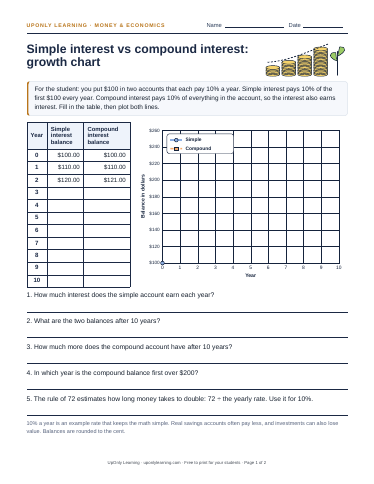
Compound interest earns interest on earlier interest, so it grows faster after the first year.
Round the interest to the nearest cent only at the end. Let the student use a calculator after they can explain each step.
That is one topic of many. The free questions above check a skill; this is the part that teaches it.
Free printables for this grade
Business and money printables that fit this grade, with answer keys where there are answers.
Every printable comes in full color and in black and white line art (low ink, ready to color in).
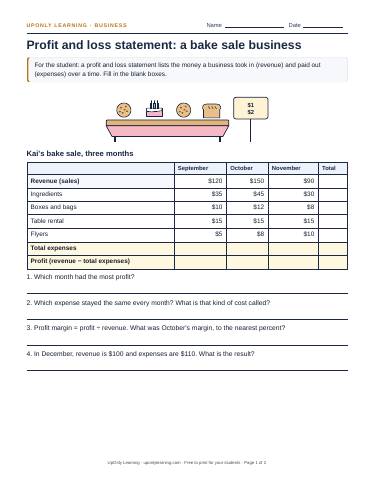
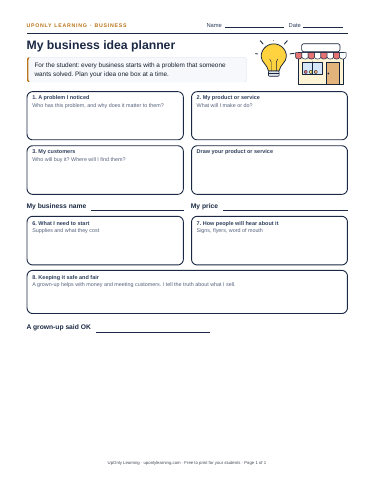
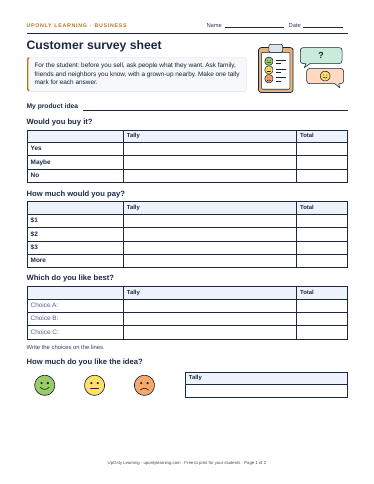
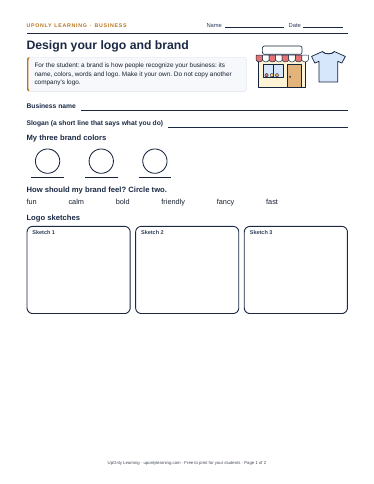
Practice checks. Our business and money workbooks teach.
These questions check a skill. The workbook teaches it.
- TeachesA 40-minute lesson per topic that tells you what to say.
- ExplainsWorked examples and the common mistakes, with fixes.
- ReviewsAnswers with short explanations, and fresh questions.
- PlansEvery topic in teaching order, matched to the standards.
Other grades
Grade 7, other subjects
Questions parents ask
Are these business and money worksheets really free?
Yes. All 50 questions and their answers are on this page, free to print and free to photocopy for your own students. Printing needs only a free account. No card.
Can a teacher or a tutor use these with a class?
Yes. Print and photocopy them for the students you teach. The only thing we ask is that you do not republish them as your own or sell them.
Where are the answers?
Marked beside each question on this page, so it prints as its own answer key. For a clean copy, click Hide answers before you print; click Show answers again to print your answer key.
What grade are these for?
Grade 7. Every other grade from kindergarten to grade 8 has its own page, linked at the foot of this one. If your student finds these hard, try the grade below — that is normal and it is not a problem.
What do the paid workbooks add?
These questions check a skill. The workbook teaches it: a forty-minute lesson that tells you what to say, two or three worked examples, the mistakes students actually make on that skill and how to correct each one, and an explanation beside every answer rather than a bare key.