
UpOnly Learning · free for anyone
Free 3rd grade entrepreneurship worksheets with answers
50 questions with the answers, free to print and free to photocopy for your own students. Spotting problems, inventing, prices and profit, customers and honest business, at the level of the grade.
Enjoy them. If you want more, or something we do not have yet, ask on our Share your ideas page and a real person will read it.
Hide the answers to print a clean copy for your student, then show them again to print your answer key.
Entrepreneurship & Business — Grade 3
50 questions · answers marked50 questions · answers hidden
- 1. What is a business plan?
- A. A sign that shows the prices of everything
- B. A list of every customer's name and phone number
- C. A written plan for what a business will sell and how ← Answer
- D. A piggy bank where the business keeps its money
- 2. What is a buyer?
- A. A person who sets every price alone
- B. A person who makes things in a shop
- C. A person who pays to get something ← Answer
- D. A person who gives things away free
- 3. What is competition in business?
- A. A race that sellers run in the park
- B. Sellers trying to win the same customers ← Answer
- C. Buyers trying to get the same toy first
- D. Sellers working together on one stand all day
- 4. What is customer feedback?
- A. What customers say they think of your product ← Answer
- B. The money customers pay for a product
- C. The list of supplies a business must buy each week
- D. The sign a business puts on its stand
- 5. What is opportunity cost?
- A. Every choice you did not pick
- B. The price tag on what you buy
- C. The next-best choice you give up ← Answer
- D. The thing you liked the very most
- 6. What is a prototype?
- A. A customer who tries everything first
- B. A quick, simple model you build to test ← Answer
- C. A list of prices for all your products
- D. A finished product sold in every store
- 7. What is a start-up cost?
- A. Money customers give as a tip at the stand
- B. Money spent to get ready before the first sale ← Answer
- C. Money left over at the end of a busy day
- D. Money a business gets from its very first sale
- 8. Which is one of the five parts of our one-page plan?
- A. Homework
- B. Weather
- C. Bedtime
- D. Customer ← Answer
- 9. What is a seller?
- A. A person who keeps all their things at home
- B. A person who trades a good for money ← Answer
- C. A person who pays for everything
- D. A person who only shops at stores
- 10. What is a competitor?
- A. Another seller after the same customers ← Answer
- B. A helper who works at your own stand
- C. A friend who gives you free supplies to use
- D. A customer who buys from you a lot
- 11. Which is a better feedback question?
- A. 'Don't you think these are really, really great?'
- B. 'You love my cookies, right?'
- C. 'My cookies are the best, yes?'
- D. 'What would make my cookies better?' ← Answer
- 12. Why do people have to make choices?
- A. Stores only sell one thing at a time
- B. Choices are only for grown-ups
- C. Money grows back every single day
- D. They cannot have everything they want ← Answer
- 13. What does it mean to brainstorm?
- A. Think of lots of ideas without judging yet ← Answer
- B. Pick the one best idea right away alone
- C. Throw out every idea that sounds silly
- D. Wait quietly until someone tells you
- 14. What is a budget?
- A. A box that holds coins after a sale
- B. A plan for how to spend your money ← Answer
- C. A list of all your customers' names
- D. A sign that shows prices to buyers
- 15. Which list shows the five parts of the plan?
- A. Customer, school, bus, lunch, recess
- B. Product, customer, price, costs, goal ← Answer
- C. Price, snack, friend, toy, game
- D. Product, weather, color, name, song
- 16. Nia sells muffins to Mr. Diaz. Who is the seller?
- A. Mr. Diaz
- B. Nia ← Answer
- C. Both of them
- D. Neither of them
- 17. Two kids on the same street both sell lemonade. Are they competitors?
- A. No, they live on the same street
- B. Yes, but only on rainy days at noon
- C. Yes, they want the same customers ← Answer
- D. No, lemonade stands never compete
- 18. A customer says your bookmark tore easily. What is the best first thing to say?
- A. 'Then go buy one somewhere else.'
- B. 'You must have broken it.'
- C. 'Thank you for telling me.' ← Answer
- D. 'No, it did not tear at all.'
- 19. What word means not having enough time, money or things for everything you want?
- A. Customer
- B. Scarcity ← Answer
- C. Budget
- D. Profit
- 20. During brainstorming, should you say 'That's a bad idea'?
- A. No, write every idea down first ← Answer
- B. Yes, to make the list much shorter
- C. No, you should not say anything
- D. Yes, so you only keep good ideas
- 21. Which is a start-up cost for a lemonade stand?
- A. A sunny day for selling
- B. The money from selling cups
- C. A pitcher to mix the lemonade ← Answer
- D. A thank-you from a customer
- 22. In 'Lily will sell dog treats to dog owners on her street,' who is the customer?
- A. The dog treats in the bag
- B. The street where she lives
- C. Dog owners on her street ← Answer
- D. Lily, who makes the treats
- 23. Omar buys a kite from Ruth's stand. Who is the buyer?
- A. Ruth
- B. The kite
- C. The stand
- D. Omar ← Answer
- 24. A bakery and a shoe store are on the same block. Are they competitors?
- A. No, they sell different things ← Answer
- B. No, shoe stores never have buyers
- C. Yes, they are on the same block
- D. Yes, all stores always compete
- 25. What is a survey?
- A. A sign that shows the prices of things
- B. A plan for how to spend your money
- C. A box where you keep your coins
- D. A set of questions you ask many people ← Answer
- 26. Kim can play tag or jump rope at recess. She picks tag. What does she give up?
- A. Playing tag
- B. All of recess
- C. Jumping rope ← Answer
- D. Nothing at all
- 27. Which is a better first prototype for a backpack hook?
- A. One made of cardboard and tape ← Answer
- B. One made of gold by a jeweler
- C. One that is never built at all
- D. One made of metal in a big factory
- 28. Which is a start-up cost for a dog-washing business?
- A. The money a customer pays
- B. A happy, clean dog
- C. A dog owner's phone call
- D. A bucket and a brush ← Answer
- 29. In 'Lily will sell dog treats to dog owners,' what is the product?
- A. Dog owners
- B. Dog treats ← Answer
- C. Lily
- D. The street
- 30. Do buyers usually want a higher price or a lower price?
- A. A higher price
- B. A lower price ← Answer
- C. No price at all
- D. The same price always
- 31. Which is an honest way to win customers?
- A. Take a rival's supplies
- B. Tell lies about others
- C. Break a rival's sign
- D. Make a better product ← Answer
- 32. What is a tally chart used for?
- A. Adding up the cost of supplies
- B. Writing a thank-you note
- C. Counting answers with marks ← Answer
- D. Drawing a picture of a stand
- 33. Is opportunity cost always money?
- A. Yes, it is only ever dollars
- B. Yes, it is only ever cents
- C. No, it is only for stores
- D. No, it can be time or fun too ← Answer
- 34. What is a test?
- A. Hiding something so nobody sees it
- B. Selling something before you make it
- C. Trying something out to see if it works ← Answer
- D. Throwing something away before trying it
- 35. Is a start-up cost money coming in or money going out?
- A. Money coming in
- B. Money going out ← Answer
- C. Both at the same time
- D. Neither of these
- 36. Which part answers 'How much will I charge?'
- A. Customer
- B. Product
- C. Price ← Answer
- D. Goal
- 37. Do sellers usually want a higher price or a lower price?
- A. A lower price
- B. Any price at all
- C. A higher price ← Answer
- D. No price at all
- 38. Which is NOT a fair way to compete?
- A. Saying untrue things about a rival ← Answer
- B. Lowering your price a little
- C. Giving very friendly service
- D. Making your cookies taste even better
- 39. Why should a business ask customers what they think?
- A. To learn how to make things better ← Answer
- B. To make customers feel bored
- C. To keep customers from coming back
- D. To make prices go up a lot
- 40. When you rank your choices, which one is the opportunity cost?
- A. The one that costs the most
- B. The very last one on the list
- C. The one you picked first
- D. The one right after your pick ← Answer
- 41. Are silly ideas allowed in a brainstorm?
- A. No, only serious ideas are allowed
- B. Yes, they can lead to great ideas ← Answer
- C. No, silly ideas waste everyone's time
- D. Yes, but only if a grown-up says so
- 42. What does 'total' mean on a list of start-up costs?
- A. The money you get from sales
- B. All the costs added together ← Answer
- C. The cheapest item on the list
- D. The cost of the first item only
- 43. Which part answers 'Who will buy it?'
- A. Customer ← Answer
- B. Product
- C. Price
- D. Costs
- 44. When does a sale happen?
- A. When the seller puts a price tag on the item
- B. When buyer and seller agree on a price ← Answer
- C. When the buyer looks at the item
- D. When the buyer walks into the store
- 45. Who usually wins when businesses compete fairly?
- A. Nobody
- B. Only the biggest store
- C. Only the newest store
- D. Customers ← Answer
- 46. Should you argue when a customer gives tough feedback?
- A. No, just ignore what they said
- B. No, listen and say thank you ← Answer
- C. Yes, ask them to leave now
- D. Yes, tell them they are wrong
- 47. Raj can have an apple or a pear for snack. He eats the apple. What is his opportunity cost?
- A. His lunch
- B. The apple
- C. The pear ← Answer
- D. Both fruits
- 48. Which material is good for a quick prototype?
- A. Solid gold from a shop
- B. Cardboard from a used box ← Answer
- C. Glass from a window
- D. Thick steel from a mill
- 49. What does 'over budget' mean?
- A. Spending more than you planned to spend ← Answer
- B. Having money left over after shopping
- C. Planning to spend less than you have
- D. Spending exactly what you planned
- 50. Which part answers 'What will I sell?'
- A. Product ← Answer
- B. Customer
- C. Price
- D. Goal
What 3rd grade entrepreneurship covers
3rd grade entrepreneurship at UpOnly Learning is 7 topics, taught in this order: a simple business plan, buyers, sellers and prices, competition: making it better, opportunity cost, start-up costs and budgets, listening to customer feedback, and brainstorming and prototypes. The 50 questions above are drawn from those topics, with the answer marked beside each one, so you can see what has stuck and what needs another lesson. The workbook teaches each topic with a 40-minute lesson; the free PDF sample has one full topic.
What's inside
- A simple business plan: Write a one-page plan: product, customer, price, costs and goal
- Buyers, sellers and prices: Explain how buyers and sellers agree on prices and why prices change
- Competition: making it better: Explain how competition leads businesses to improve quality and price
- Opportunity cost: Identify the next-best choice you give up when you decide
- Start-up costs and budgets: List start-up costs and make a budget for a small business
- Listening to customer feedback: Ask customers what they think and use it to improve
- Brainstorming and prototypes: Brainstorm many ideas, pick one and build a quick model to test
Keep going
Learn how money works: Money & Economics
Your next step
Entrepreneurship & Business Thinking · Grade 3
$19.99. One-time purchase, no subscription.
177 pages · 840 questions with answers · 7 topics
See it in the storeA real page of Entrepreneurship & Business Thinking · Grade 3
My One-Page Business Plan
The student will write a one-page business plan that names the product, the customer, the price, the costs and a clear goal, and check the money math in the plan. · 40 min
“A business plan is like a map for your business. Today you will make your own.”
Lily's costs are flour $3.50, peanut butter $4.00 and bags $1.50. She sells 10 bags of dog treats at $2.00 each. What are her total costs, sales and profit?
Answer: Costs: $3.50 + $4.00 + $1.50 = $9.00. Sales: 10 × $2.00 = $20.00. Profit: $20.00 - $9.00 = $11.00.
All the money from sales is profit.
Show that costs come out first. If you sell $20.00 and spent $9.00, only $11.00 is profit.
Keep prices simple, like $1.00, $1.25, $1.50 or $2.00, so the money math stays at grade level and the focus stays on planning.
That is one topic of many. The free questions above check a skill; this is the part that teaches it.
Free printables for this grade
Business and money printables that fit this grade, with answer keys where there are answers.
Every printable comes in full color and in black and white line art (low ink, ready to color in).
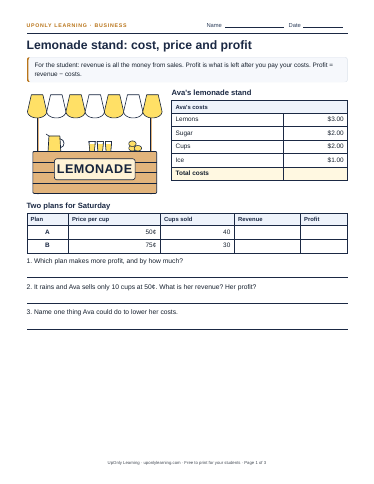
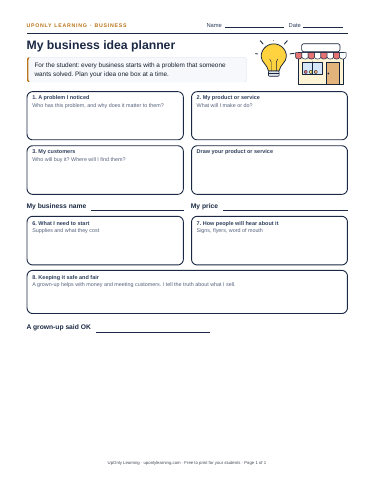
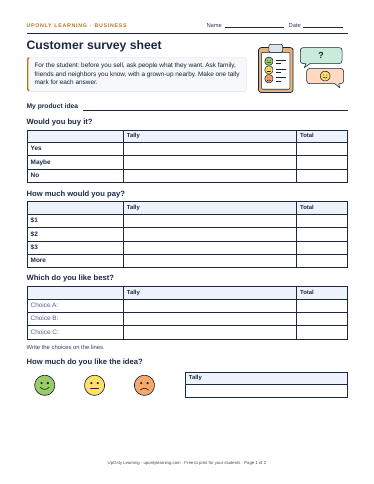
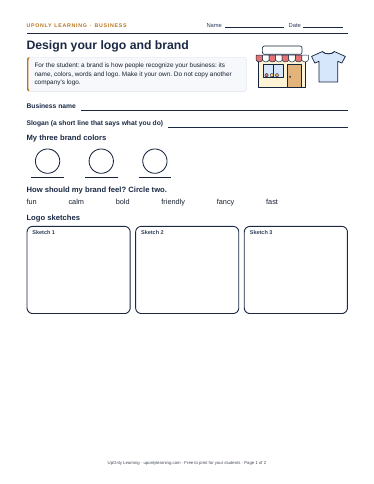
Practice checks. Our business and money workbooks teach.
These questions check a skill. The workbook teaches it.
- TeachesA 40-minute lesson per topic that tells you what to say.
- ExplainsWorked examples and the common mistakes, with fixes.
- ReviewsAnswers with short explanations, and fresh questions.
- PlansEvery topic in teaching order, matched to the standards.
Other grades
Grade 3, other subjects
Questions parents ask
Are these business and money worksheets really free?
Yes. All 50 questions and their answers are on this page, free to print and free to photocopy for your own students. Printing needs only a free account. No card.
Can a teacher or a tutor use these with a class?
Yes. Print and photocopy them for the students you teach. The only thing we ask is that you do not republish them as your own or sell them.
Where are the answers?
Marked beside each question on this page, so it prints as its own answer key. For a clean copy, click Hide answers before you print; click Show answers again to print your answer key.
What grade are these for?
Grade 3. Every other grade from kindergarten to grade 8 has its own page, linked at the foot of this one. If your student finds these hard, try the grade below — that is normal and it is not a problem.
What do the paid workbooks add?
These questions check a skill. The workbook teaches it: a forty-minute lesson that tells you what to say, two or three worked examples, the mistakes students actually make on that skill and how to correct each one, and an explanation beside every answer rather than a bare key.