
UpOnly Learning · free for anyone
Free 5th grade entrepreneurship worksheets with answers
50 questions with the answers, free to print and free to photocopy for your own students. Spotting problems, inventing, prices and profit, customers and honest business, at the level of the grade.
Enjoy them. If you want more, or something we do not have yet, ask on our Share your ideas page and a real person will read it.
Hide the answers to print a clean copy for your student, then show them again to print your answer key.
Entrepreneurship & Business — Grade 5
50 questions · answers marked50 questions · answers hidden
- 1. What is an import?
- A. A good a family makes for itself at home
- B. A good brought into a country from another ← Answer
- C. A good made and sold in the same town
- D. A good a country sends away to sell
- 2. When a business scales up, what does it do?
- A. Grows so it can serve many more customers ← Answer
- B. Shrinks so it serves only a few people
- C. Raises prices so fewer people buy
- D. Closes its doors for the whole season
- 3. What is a loan?
- A. Money a business earns from selling goods
- B. Money you get now and must pay back later ← Answer
- C. Money a saver puts into a bank account
- D. A gift of money you never have to return
- 4. What is a risk in business?
- A. The money a customer pays at a stand
- B. A promise that a plan will surely work
- C. A list of supplies you need to buy
- D. A chance that things may not go as hoped ← Answer
- 5. When two people talk to reach an agreement they both accept, what are they doing?
- A. Specializing
- B. Borrowing
- C. Advertising
- D. Negotiating ← Answer
- 6. What is a pitch?
- A. A sign that shows only the price of one product
- B. A song that plays while customers shop in a store
- C. A long book that lists every last detail of a business
- D. A short talk that explains an idea and why it works ← Answer
- 7. Which of these is a social business?
- A. A bakery that sells bread and keeps every crumb of the profit
- B. A store that closes so no one can buy any bread
- C. A bakery that sells bread and gives some to a pantry ← Answer
- D. A family that bakes bread only for its own dinner
- 8. What does trade mean?
- A. Keeping everything you make for yourself
- B. Making every good you need on your own
- C. Hiding goods so no one else can get them
- D. Giving something to get something else ← Answer
- 9. Which word means the most a business can make or do in a set time?
- A. Bulk
- B. Capacity ← Answer
- C. Quality
- D. Revenue
- 10. Who is the borrower in a loan?
- A. The bank that hands out the money
- B. The person who keeps the loan as a gift
- C. The one who gets the money and repays it ← Answer
- D. The worker who counts cash at the bank
- 11. Which word means bouncing back after a setback?
- A. Resilience ← Answer
- B. Interest
- C. Inventory
- D. Revenue
- 12. What is an offer in a deal?
- A. The money a bank lends a store
- B. The last word, which cannot change
- C. What you suggest, like a price ← Answer
- D. A secret you never tell anyone
- 13. Which word means a first line that grabs the listener's attention?
- A. Feedback
- B. Hook ← Answer
- C. Price
- D. Goal
- 14. What is a community?
- A. The people and places around you ← Answer
- B. Money saved in a bank account
- C. A single store on a busy street
- D. Only the people in your own family
- 15. A baker bakes only bread and buys everything else she needs. What is she doing?
- A. Importing goods
- B. Borrowing money
- C. Specializing ← Answer
- D. Donating
- 16. Buying a large amount at once, often for a lower cost per item, is called buying in what?
- A. Bulk ← Answer
- B. Debt
- C. Credit
- D. Pieces
- 17. Who is the lender in a loan?
- A. The business that receives the money
- B. The person who builds the bank's vault
- C. The bank or person who gives the money ← Answer
- D. The shopper who buys from the business
- 18. Which word means sticking with a goal even when it gets hard?
- A. Donation
- B. Advertising
- C. Competition
- D. Perseverance ← Answer
- 19. Which word means a new offer made in answer to someone else's offer?
- A. Counteroffer ← Answer
- B. Discount
- C. Deposit slip
- D. Interest rate
- 20. In a pitch, what is the problem?
- A. The date by which you want to reach your goal
- B. The price you charge for each item
- C. The need or trouble your business fixes ← Answer
- D. The name of the person who listens
- 21. Which word means the good change a business makes in the community?
- A. Income
- B. Inventory
- C. Interest
- D. Impact ← Answer
- 22. Which word means needing each other for goods?
- A. Interdependence ← Answer
- B. Specialization
- C. Export
- D. Resource
- 23. A person a business pays to do work is called what?
- A. A competitor
- B. A customer
- C. An employee ← Answer
- D. An investor
- 24. What is a deposit?
- A. Money you take out of a bank
- B. Money a bank charges for a loan
- C. Money a store owes its workers
- D. Money you put into a bank ← Answer
- 25. What is a setback?
- A. A prize you win for reaching a goal early, before the date
- B. A new customer who visits your stand
- C. A sign that tells people your prices
- D. A problem that slows you down on the way to a goal ← Answer
- 26. In a win-win deal, who gets something they want?
- A. Only the seller
- B. Only the buyer
- C. Neither side
- D. Both sides ← Answer
- 27. In a pitch, what is the solution?
- A. The product or service that fixes the problem ← Answer
- B. The time it takes to give the pitch
- C. The money an investor might give you
- D. The question a listener asks you at the very end
- 28. What does it mean to donate?
- A. To give money or goods to help others ← Answer
- B. To trade goods with another country far away
- C. To sell goods for the highest price
- D. To borrow money and pay it back later
- 29. What does the word global mean?
- A. Having to do with one single store
- B. Having to do with one family only
- C. Having to do with the whole world ← Answer
- D. Having to do with one small town
- 30. Which word means to grow into new places, new times or new products?
- A. Shrink
- B. Repay
- C. Deposit
- D. Expand ← Answer
- 31. What does it mean to repay a loan?
- A. To ask the bank for even more money
- B. To pay back the money you borrowed ← Answer
- C. To save coins in a jar at home
- D. To spend the money on a new item
- 32. Which is a smart risk?
- A. Buying supplies without a plan
- B. Spending all of your savings on the very first day
- C. Making a small test batch before a big one ← Answer
- D. Ignoring what customers tell you
- 33. Which word means each side gives up a little to reach a deal?
- A. Export
- B. Capacity
- C. Interest
- D. Compromise ← Answer
- 34. What is a target customer?
- A. A store that sells the same things
- B. Anyone who walks past your house
- C. The group most likely to buy from you ← Answer
- D. The person who makes the supplies you use
- 35. Which word means able to keep going for a long time?
- A. Borrowed
- B. Imported
- C. Sustainable ← Answer
- D. Specialized
- 36. A shirt in a US closet has a tag that says 'Made in India'. For the United States, what is the shirt?
- A. A deposit
- B. An import ← Answer
- C. A resource
- D. An export
- 37. Which word means how good a product or service is?
- A. Quality ← Answer
- B. Quantity
- C. Capacity
- D. Profit
- 38. Which word means the extra money a borrower pays for using a lender's money?
- A. Credit
- B. Profit
- C. Interest ← Answer
- D. Deposit
- 39. Which is a careless risk?
- A. Asking a few neighbors to try a free sample before you sell
- B. Making 10 cards to see if people like them
- C. Buying 200 cups before anyone tastes your lemonade ← Answer
- D. Planning what to do if the first try flops
- 40. In negotiating, what is someone's 'interest'?
- A. The extra money paid on a loan
- B. The real reason they want something ← Answer
- C. The price written on the tag
- D. The number of items they will buy
- 41. Which of these is the clearest goal?
- A. Sell a whole lot of cards
- B. Be the best card seller
- C. Make cards that people like
- D. Sell 40 cards by May 1 ← Answer
- 42. Which word means a person who helps for free?
- A. Investor
- B. Volunteer ← Answer
- C. Customer
- D. Employee
- 43. A US farm sells soybeans to a buyer in Japan. For the United States, what are the soybeans?
- A. A loan
- B. A resource
- C. An export ← Answer
- D. An import
- 44. What is a growth plan?
- A. Steps that show how a business will get bigger ← Answer
- B. A list of the owner's favorite foods
- C. A chart of how a seed grows into a plant
- D. A note asking customers to buy less
- 45. Which word means being trusted to borrow because you paid back on time before?
- A. Interest
- B. Expense
- C. Credit ← Answer
- D. Deposit
- 46. What is an entrepreneur?
- A. A person who never tries anything new
- B. A person who starts a business and takes on its risk ← Answer
- C. A worker who is paid by a bank to keep its money safe at night
- D. A person who only buys things at a store
- 47. What is a walk-away plan?
- A. A trick to make the other side give up
- B. What you will do if no fair deal is found ← Answer
- C. A map for walking to the store and back
- D. A plan to leave without paying for things
- 48. What is an investor?
- A. A person who buys just one item and then goes back home
- B. A person who gives money to help a business grow ← Answer
- C. A person who teaches the owner how to read
- D. A person who writes the sign for a business
- 49. Which word means the money left after all costs are paid?
- A. Profit ← Answer
- B. Sales
- C. Price
- D. Donation
- 50. A Japanese company buys soybeans grown in the United States. For Japan, what are the soybeans?
- A. A profit
- B. An export
- C. A product of Japan
- D. An import ← Answer
What 5th grade entrepreneurship covers
5th grade entrepreneurship at UpOnly Learning is 7 topics, taught in this order: the entrepreneur mindset: risk and resilience, banks, loans and interest, trade around the world, growing a business: scaling up, negotiating and win-win deals, businesses that help the community, and pitch day: presenting my business plan. The 50 questions above are drawn from those topics, with the answer marked beside each one, so you can see what has stuck and what needs another lesson. The workbook teaches each topic with a 40-minute lesson; the free PDF sample has one full topic.
What's inside
- The entrepreneur mindset: risk and resilience: Explain smart risks, learning from failure and sticking with a goal
- Banks, loans and interest: Explain how businesses borrow, why interest is charged and how to repay
- Trade around the world: Explain how specialization and trade connect businesses across countries
- Growing a business: scaling up: Plan how a small business could serve more customers
- Negotiating and win-win deals: Practice negotiating so both sides gain
- Businesses that help the community: Design a business idea that also solves a community problem
- Pitch day: presenting my business plan: Present a business idea with problem, solution, customer, price and goal
Keep going
Learn how money works: Money & Economics
Your next step
Entrepreneurship & Business Thinking · Grade 5
$19.99. One-time purchase, no subscription.
183 pages · 840 questions with answers · 7 topics
See it in the storeA real page of Entrepreneurship & Business Thinking · Grade 5
Around the World in a Lunchbox: Specialization and Trade
The student will explain how countries and businesses specialize in what they produce best, trade imports and exports with each other, and show with numbers how specialization and trade can let everyone have more. · 40 min
“The things in our house come from all over the world. Today you discover why countries trade with each other.”
A pair of sneakers in your closet says 'Made in Vietnam'. Is it an import or an export for the United States? What is it for Vietnam?
Answer: For the United States it is an import, because it was brought in from another country. For Vietnam it is an export, because Vietnam made it and sent it out to sell.
Trade means one country wins and the other loses.
In a fair trade both sides get something they want more than what they gave. Use the island puzzle: after specializing and trading, both islands can have more.
The label hunt works best with clothing tags and fruit stickers. Keep the focus on why trade happens rather than on memorizing country names.
That is one topic of many. The free questions above check a skill; this is the part that teaches it.
Free printables for this grade
Business and money printables that fit this grade, with answer keys where there are answers.
Every printable comes in full color and in black and white line art (low ink, ready to color in).
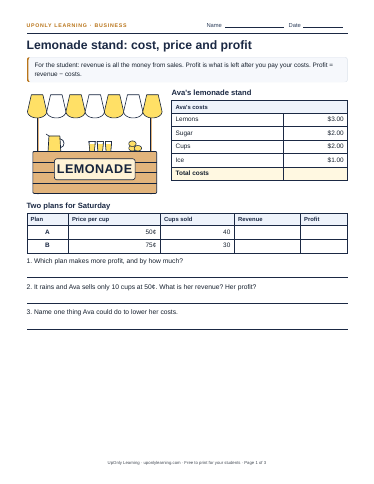
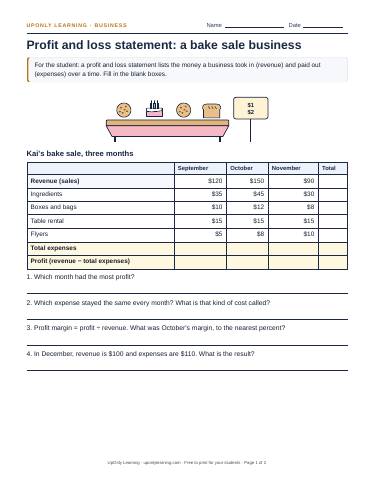
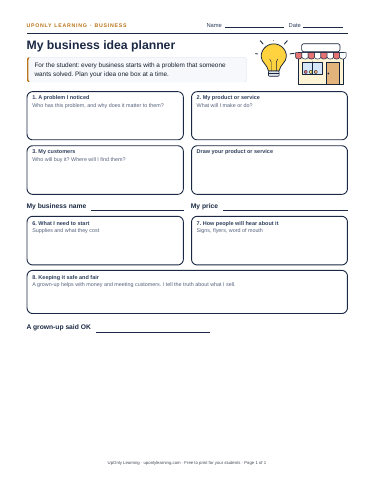
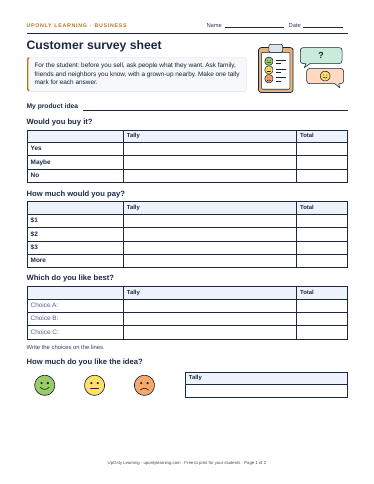
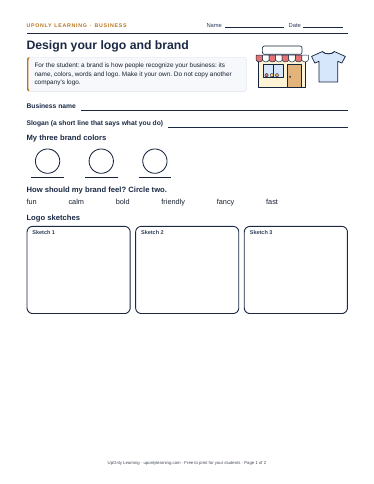
Practice checks. Our business and money workbooks teach.
These questions check a skill. The workbook teaches it.
- TeachesA 40-minute lesson per topic that tells you what to say.
- ExplainsWorked examples and the common mistakes, with fixes.
- ReviewsAnswers with short explanations, and fresh questions.
- PlansEvery topic in teaching order, matched to the standards.
Other grades
Grade 5, other subjects
Questions parents ask
Are these business and money worksheets really free?
Yes. All 50 questions and their answers are on this page, free to print and free to photocopy for your own students. Printing needs only a free account. No card.
Can a teacher or a tutor use these with a class?
Yes. Print and photocopy them for the students you teach. The only thing we ask is that you do not republish them as your own or sell them.
Where are the answers?
Marked beside each question on this page, so it prints as its own answer key. For a clean copy, click Hide answers before you print; click Show answers again to print your answer key.
What grade are these for?
Grade 5. Every other grade from kindergarten to grade 8 has its own page, linked at the foot of this one. If your student finds these hard, try the grade below — that is normal and it is not a problem.
What do the paid workbooks add?
These questions check a skill. The workbook teaches it: a forty-minute lesson that tells you what to say, two or three worked examples, the mistakes students actually make on that skill and how to correct each one, and an explanation beside every answer rather than a bare key.