
UpOnly Learning · free for anyone
Free 2nd grade entrepreneurship worksheets with answers
50 questions with the answers, free to print and free to photocopy for your own students. Spotting problems, inventing, prices and profit, customers and honest business, at the level of the grade.
Enjoy them. If you want more, or something we do not have yet, ask on our Share your ideas page and a real person will read it.
Hide the answers to print a clean copy for your student, then show them again to print your answer key.
Entrepreneurship & Business — Grade 2
50 questions · answers marked50 questions · answers hidden
- 1. What is a benefit?
- A. Something you give up when you choose
- B. Something good you get from a choice ← Answer
- C. A list of every store in town
- D. A price tag on a toy
- 2. What is a customer?
- A. A place where products are kept
- B. A person who buys or uses a product ← Answer
- C. A tool used to build a product
- D. A person who makes and sells the product
- 3. What is a plan?
- A. A snack you eat at lunch time
- B. A sign that only shows a price and nothing else
- C. A list of what you will do and how ← Answer
- D. A kind of coin
- 4. What is profit?
- A. Money left after costs are taken away from sales ← Answer
- B. The price you write on a sign
- C. Money you spend on supplies
- D. All the money customers pay you before anything is spent
- 5. What are resources?
- A. Things used to make goods and services ← Answer
- B. People who buy things at a store
- C. Only the money in a piggy bank
- D. Signs that tell the price of a toy at the store
- 6. Why does a stand put up a sign?
- A. To show the owner's favorite color and nothing else
- B. To keep customers far away
- C. To hide the price from people
- D. To tell customers what is sold ← Answer
- 7. What is a mistake?
- A. Something that did not go as planned ← Answer
- B. A prize you win for doing well
- C. A sign with the price of lemonade on it
- D. A tool that fixes broken toys
- 8. What is a cost of a choice?
- A. What you get for free
- B. A gift from a friend
- C. What you give up ← Answer
- D. The good part of a choice you enjoy most
- 9. At a lemonade stand, who is the customer?
- A. The table under the stand
- B. The person buying a cup ← Answer
- C. The kid pouring the cup
- D. The lemons in the pitcher
- 10. A business-day plan has three parts. Which list names them?
- A. Colors, shapes and sizes
- B. Steps, supplies and a schedule ← Answer
- C. Snacks, naps and games
- D. Customers, coins and clouds in the sky
- 11. What is money in?
- A. Money that a store pays to buy your supplies for you
- B. Money you spend on cups
- C. Money customers pay you ← Answer
- D. Money you lose on a bad day
- 12. What is a natural resource?
- A. Something that comes from nature ← Answer
- B. A worker doing a job
- C. A tool that people built
- D. A machine in a big factory far away
- 13. What does 'ad' stand for?
- A. Adventure story
- B. Advertisement ← Answer
- C. Address
- D. Addition
- 14. Do business owners make mistakes?
- A. Only kids do
- B. No, never
- C. Yes, everyone does ← Answer
- D. Only on a rainy day when the stand is closed
- 15. Jo picks a pear instead of a plum. What did Jo give up?
- A. The pear
- B. The plum ← Answer
- C. Nothing at all, because fruit is free
- D. Both fruits
- 16. Who is the best customer for a baby bottle?
- A. A high school runner
- B. A parent of a baby ← Answer
- C. A teacher of grade five
- D. A pilot flying a plane
- 17. What is a schedule?
- A. A list of prices
- B. A list of times and what happens ← Answer
- C. A picture of the stand with a big sun on it
- D. A kind of supply
- 18. What is money out?
- A. Money customers give you
- B. The profit you keep
- C. Money you spend to run the business ← Answer
- D. Coins you find on the ground near the stand
- 19. What is a human resource?
- A. A hammer on a shelf
- B. A person and the work they do ← Answer
- C. A tree growing tall in the forest
- D. A rock found in a river
- 20. Which letters are easier to read from far away?
- A. Letters drawn very small in pencil
- B. Faint letters
- C. Tiny letters
- D. Big letters ← Answer
- 21. What is the first step after a mistake?
- A. Ask what went wrong ← Answer
- B. Hide the mistake from everyone forever
- C. Give up right away
- D. Blame a friend
- 22. Ali plays outside instead of reading. What is the cost?
- A. Fresh air and sunshine in the yard
- B. A new bike
- C. Fun outside
- D. Time to read ← Answer
- 23. Who is the best customer for a dog collar?
- A. A fish owner
- B. A dog owner ← Answer
- C. A cat owner
- D. A bird owner
- 24. What are supplies?
- A. Things you need to run the business ← Answer
- B. The times you open
- C. Friends who walk by and wave at the stand
- D. The money customers pay
- 25. Buying lemons for a stand is money in or money out?
- A. Money out ← Answer
- B. Neither, it is free
- C. Profit
- D. Money in
- 26. What is a capital resource?
- A. Sunshine on a warm summer morning
- B. Water from a lake
- C. A tool or machine made by people ← Answer
- D. A farmer at work
- 27. Which sign is easier to read?
- A. One with a few big words ← Answer
- B. One with many tiny words
- C. One with no words at all
- D. One with words written in light pencil
- 28. What is the second step after a mistake?
- A. Cry and stop
- B. Pretend it never happened
- C. Do the exact same thing again without thinking
- D. Ask what you learned ← Answer
- 29. Which is a cost that is not money?
- A. Dollars
- B. Coins
- C. A five-dollar bill from the bank
- D. Time ← Answer
- 30. Who is most likely to buy soccer shin guards?
- A. A swimmer
- B. A piano player at a show
- C. A soccer player ← Answer
- D. A painter
- 31. What are steps in a plan?
- A. The things you do, in order ← Answer
- B. The coins you count at the end of the day
- C. The prices on a sign
- D. The stairs at your house
- 32. A customer pays $2 for a cookie. Is that money in or money out?
- A. Money in ← Answer
- B. A cost of the stand
- C. A loss
- D. Money out
- 33. Sort it: a lake. Natural, human or capital?
- A. Human resource
- B. Capital resource
- C. Not a resource at all
- D. Natural resource ← Answer
- 34. What should a sign for a stand tell?
- A. What you ate for breakfast this morning
- B. Your shoe size
- C. Your pet's name
- D. What you sell and the price ← Answer
- 35. What is the third step after a mistake?
- A. Quit the business
- B. Plan what to change next time ← Answer
- C. Forget about it
- D. Change nothing and hope it gets better by itself
- 36. Bea buys a ball with her $4. What is the benefit?
- A. She gets a ball to play with ← Answer
- B. She cannot buy candy now
- C. She has $4 less
- D. She gives up her money
- 37. Which detective question asks about the customer?
- A. Where is the closet?
- B. What color is the box?
- C. How tall is the shelf?
- D. Who is it for? ← Answer
- 38. What is a checklist?
- A. A bill from a store
- B. A list of times
- C. A list you tick off as you finish ← Answer
- D. A drawing of the stand with no words
- 39. Rafi's cookie stand takes in $6 and spends $2. What is the profit?
- A. $4 ← Answer
- B. $6
- C. $2
- D. $8
- 40. What kind of resource is a tree?
- A. Natural resource ← Answer
- B. Capital resource
- C. Not a resource at all
- D. Human resource
- 41. Which is one of the four parts of a clear sign?
- A. The price ← Answer
- B. Your phone game score
- C. A list of every toy in your room
- D. A long story
- 42. What does improve mean?
- A. Leave it just the same as it was before
- B. Make something worse
- C. Make something better ← Answer
- D. Throw it away
- 43. Bea buys a ball with her $4. What is a cost?
- A. Playing catch with her friends at the park
- B. A new ball
- C. The fun of playing
- D. Her $4 ← Answer
- 44. Which of these is a need?
- A. Water when you are thirsty ← Answer
- B. A sticker with a star
- C. A second toy truck to keep
- D. A shiny new hat pin
- 45. Which comes first: putting out the cups or pouring for a customer?
- A. Counting money
- B. Cleaning up after everyone goes home
- C. Pouring for a customer
- D. Putting out the cups ← Answer
- 46. A bracelet stand sells $9 of bracelets. Beads cost $4. How much profit?
- A. $5 ← Answer
- B. $13
- C. $6
- D. $4
- 47. Which kind of resource is a wrench: natural, human or capital?
- A. Capital resource ← Answer
- B. Not a resource at all
- C. Human resource
- D. Natural resource
- 48. Which color pair is easiest to read?
- A. Black on white ← Answer
- B. Light pink on light orange
- C. Gray on gray
- D. Yellow on white
- 49. What does feedback mean?
- A. A snack for your pet
- B. A kind of money
- C. The price you pay for supplies at the store
- D. What people tell you about how it went ← Answer
- 50. Can you have everything you want at once?
- A. Yes, always
- B. Only on weekends and holidays
- C. Yes, if you wish hard
- D. No, so we make choices ← Answer
What 2nd grade entrepreneurship covers
2nd grade entrepreneurship at UpOnly Learning is 7 topics, taught in this order: who is my customer?, benefits and costs of choices, money in, money out: profit, signs, ads and getting noticed, resources: natural, human and capital, fixing mistakes and trying again, and planning a kid business day. The 50 questions above are drawn from those topics, with the answer marked beside each one, so you can see what has stuck and what needs another lesson. The workbook teaches each topic with a 40-minute lesson; the free PDF sample has one full topic.
What's inside
- Who is my customer?: Pick who a product is for and what they need or like
- Benefits and costs of choices: Weigh what you gain and what you give up when you choose
- Money in, money out: profit: Subtract costs from sales to find profit with simple numbers
- Signs, ads and getting noticed: Design a clear sign or poster that tells customers what you sell
- Resources: natural, human and capital: Sort resources into natural, human and capital and see how they make products
- Fixing mistakes and trying again: Learn from what went wrong and improve the next try
- Planning a kid business day: Make a simple plan with steps, supplies and a schedule for a business day
Keep going
Learn how money works: Money & Economics
Your next step
Entrepreneurship & Business Thinking · Grade 2
$19.99. One-time purchase, no subscription.
173 pages · 840 questions with answers · 7 topics
See it in the storeA real page of Entrepreneurship & Business Thinking · Grade 2
The Choice Scale
The student will name the benefits (what you gain) and the costs (what you give up) of a choice, and use them to explain which choice is better for a goal. · 40 min
“Every time you choose, you get something and you give something up. Let's look at both sides.”
Tomas can play a video game for 30 minutes or help his aunt bake cookies. What is a benefit and a cost of baking cookies?
Answer: Benefit: he learns to bake and gets cookies. Cost: he gives up the 30 minutes of video game time.
A cost is only money.
Time and the other thing you could have picked are costs too. If you watch a show, you give up that time to play outside.
Say costs out loud in daily life, like 'If we stop for gas, the cost is 10 minutes.' Children learn that costs are not only money.
That is one topic of many. The free questions above check a skill; this is the part that teaches it.
Free printables for this grade
Business and money printables that fit this grade, with answer keys where there are answers.
Every printable comes in full color and in black and white line art (low ink, ready to color in).
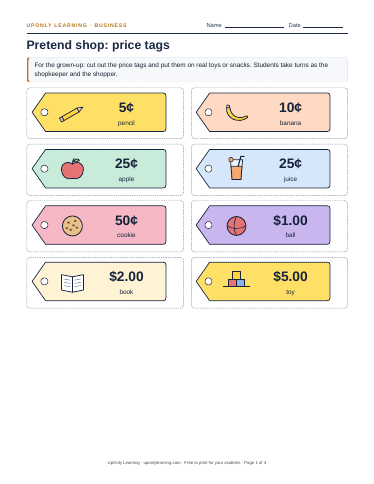
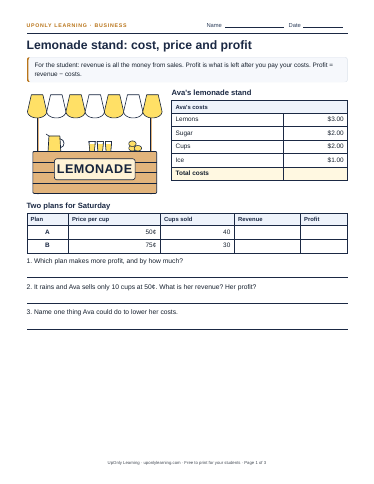
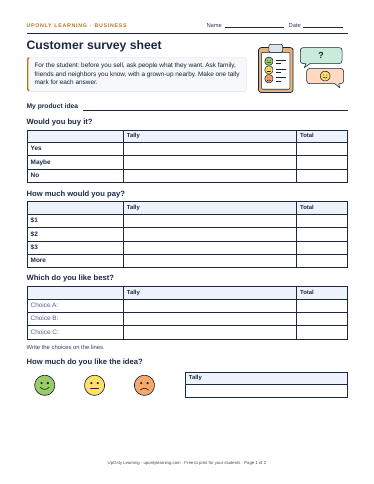
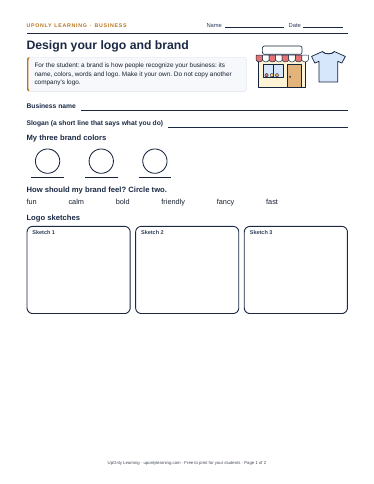
Practice checks. Our business and money workbooks teach.
These questions check a skill. The workbook teaches it.
- TeachesA 40-minute lesson per topic that tells you what to say.
- ExplainsWorked examples and the common mistakes, with fixes.
- ReviewsAnswers with short explanations, and fresh questions.
- PlansEvery topic in teaching order, matched to the standards.
Other grades
Grade 2, other subjects
Questions parents ask
Are these business and money worksheets really free?
Yes. All 50 questions and their answers are on this page, free to print and free to photocopy for your own students. Printing needs only a free account. No card.
Can a teacher or a tutor use these with a class?
Yes. Print and photocopy them for the students you teach. The only thing we ask is that you do not republish them as your own or sell them.
Where are the answers?
Marked beside each question on this page, so it prints as its own answer key. For a clean copy, click Hide answers before you print; click Show answers again to print your answer key.
What grade are these for?
Grade 2. Every other grade from kindergarten to grade 8 has its own page, linked at the foot of this one. If your student finds these hard, try the grade below — that is normal and it is not a problem.
What do the paid workbooks add?
These questions check a skill. The workbook teaches it: a forty-minute lesson that tells you what to say, two or three worked examples, the mistakes students actually make on that skill and how to correct each one, and an explanation beside every answer rather than a bare key.