
Money & Economics · free reference
Part 11: Spot scams, protect your identity and understand insurance
Scams and fraud, Protecting your identity, Insurance basics and Giving and sharing. Every fact lists its source, and you can share a link to any topic.
Scams and fraud
In short: Scammers pretend to be from an organization you know, say there is a problem or a prize, pressure you to act fast and tell you how to pay. Stop and talk to someone you trust.[1]
Facts
- If something feels wrong, stop and talk to someone you trust.[1]K–2
- Scammers pretend to be from a group you know.[1]3–5
- Scammers say there is a problem, or that you won a prize.[1]3–5
- Scammers pressure you to act right away, before you have time to think.[1]3–5
- Scammers tell you to pay in a certain way.[1]3–5
- Do not give your personal or money information to anyone who asks when you did not expect it.[1]6–8
- Anyone who pressures you to pay or to give them your personal information is a scammer.[1]6–8
Go deeper: for teens and grown-ups (2)
Key words in three languages
| English | Spanish | Portuguese |
|---|---|---|
| fraud[3] | fraude[4] | fraude[5] |
| personal information[1] | not sourced yet | informações pessoais[6] |
Each word cites a page that uses it.
Practice this
- Life Skills practice questions, Grade 3Questions from every Life Skills topic in the grade, with answers · freeFree
- Life Skills practice questions, Grade 6Questions from every Life Skills topic in the grade, with answers · freeFree
- Lesson: Online safety and screen timeGrade 3 · full lesson with practice and a checkMembers
- Lesson: Digital citizenship and online safetyGrade 6 · full lesson with practice and a checkMembers
Members-only lessons are marked. The practice pages by grade and The Business You Build check are free.
Sources (6)
- Federal Trade Commission, Consumer Advice · How To Avoid a Scam · consumer.ftc.gov/articles/how-avoid-scam (checked Oct 27, 2026)
- Federal Trade Commission · FTC Testifies before Joint Economic Committee on Agency’s Efforts to Combat Fraud · ftc.gov/news-events/news/press-releases/2026/03/ftc-testifies-joint-economic-committee-agencys-efforts-combat-fraud (page updated Mar 25, 2026; checked Oct 27, 2026)
- FINRA (Financial Industry Regulatory Authority) · Crypto Assets – Risks · finra.org/investors/investing/investment-products/crypto-assets/risks (checked Oct 27, 2026)
- Consumer Financial Protection Bureau · Glossary of English-Spanish financial terms (Spanish style guide and glossary) · files.consumerfinance.gov/f/documents/cfpb_adult-fin-ed_spanish-style-guide-glossary.pdf (checked Oct 27, 2026)
- Wikipédia em português · Cartão de crédito · pt.wikipedia.org/wiki/Cart%C3%A3o_de_cr%C3%A9dito (checked Oct 27, 2026)
- Wikipédia em português · Roubo de identidade · pt.wikipedia.org/wiki/Roubo_de_identidade (checked Oct 27, 2026)
See something we should correct about “Scams and fraud”? Tell us.
Protecting your identity
In short: Most children do not have a credit report, so one in a child’s name is a warning sign. Parents can get a free credit freeze for a child under 16.[1]
Facts
- Child identity theft can be reported to the FTC at IdentityTheft.gov.[1]6–8
Go deeper: for teens and grown-ups (6)
- Some young people first learn of identity theft when they are turned down for a student loan because of bad credit.[1]Teens
- Most children under 18 do not have a credit report, so one in a child’s name can be a warning sign.[1]Grown-ups
- A letter from the IRS about unpaid income taxes for your child can be a sign of child identity theft.[1]Grown-ups
- So can a call about your child’s overdue bill for an account you never opened.[1]Grown-ups
- If your child is under 16, you can ask for a free credit freeze.[1]Grown-ups
- Ask questions before giving anyone your child’s Social Security number.[1]Grown-ups
Key words in three languages
| English | Spanish | Portuguese |
|---|---|---|
| identity theft[1] | robo de identidad[2] | not sourced yet |
| credit report[3] | informe de crédito[2] | not sourced yet |
Each word cites a page that uses it.
Practice this
- Life Skills practice questions, Grade 8Questions from every Life Skills topic in the grade, with answers · freeFree
- Lesson: Digital footprint, privacy and spotting misinformationGrade 8 · full lesson with practice and a checkMembers
Members-only lessons are marked. The practice pages by grade and The Business You Build check are free.
Sources (3)
- Federal Trade Commission, Consumer Advice · How To Protect Your Child From Identity Theft · consumer.ftc.gov/articles/how-protect-your-child-identity-theft (checked Oct 27, 2026)
- Consumer Financial Protection Bureau · Glossary of English-Spanish financial terms (Spanish style guide and glossary) · files.consumerfinance.gov/f/documents/cfpb_adult-fin-ed_spanish-style-guide-glossary.pdf (checked Oct 27, 2026)
- Consumer Financial Protection Bureau · How do I get a free copy of my credit reports? · consumerfinance.gov/ask-cfpb/how-do-i-get-a-free-copy-of-my-credit-reports-en-5 (checked Oct 27, 2026)
See something we should correct about “Protecting your identity”? Tell us.
Insurance basics
In short: With insurance, you pay a premium, and you often pay a deductible before the insurance starts to pay.[1][2]
Facts
- A premium is the amount you pay for insurance, for example every month for health insurance.[1]6–8
Go deeper: for teens and grown-ups (6)
- A deductible is the amount you pay for covered care before your insurance plan starts to pay.[2]Teens
- With a $2,000 deductible, you pay the first $2,000 of covered services yourself.[2]Teens
- Homeowners and renters insurance do not usually cover flood damage.[3]Teens
- Besides the premium, health plans usually have other costs, such as a deductible, copayments and coinsurance.[1]Grown-ups
- The plan with the lowest monthly premium may not be the best match for you.[1]Grown-ups
- Most flood insurance policies start only after a 30-day waiting period.[3]Grown-ups
Key words in three languages
| English | Spanish | Portuguese |
|---|---|---|
| insurance[1] | seguro[4] | seguro[5] |
| premium[1] | prima[4] | prêmio[5] |
| deductible[2] | deducible[4] | franquia[5] |
Each word cites a page that uses it.
Practice this
- Business practice questions, Grade 8Questions from every Business topic in the grade, with answers · freeFree
- Lesson: Managing business risk and insuranceGrade 8 · full lesson with practice and a checkMembers
Members-only lessons are marked. The practice pages by grade and The Business You Build check are free.
Sources (5)
- HealthCare.gov (Centers for Medicare & Medicaid Services) · Glossary: Premium · healthcare.gov/glossary/premium (checked Oct 27, 2026)
- HealthCare.gov (Centers for Medicare & Medicaid Services) · Glossary: Deductible · healthcare.gov/glossary/deductible (checked Oct 27, 2026)
- Federal Emergency Management Agency (FEMA) · Don’t Wait: Buy Flood Insurance Today · fema.gov/print/txt/node/330656 (page updated May 1, 2018; checked Oct 27, 2026)
- Consumer Financial Protection Bureau · Glossary of English-Spanish financial terms (Spanish style guide and glossary) · files.consumerfinance.gov/f/documents/cfpb_adult-fin-ed_spanish-style-guide-glossary.pdf (checked Oct 27, 2026)
- Wikipédia em português · Seguro · pt.wikipedia.org/wiki/Seguro (checked Oct 27, 2026)
See something we should correct about “Insurance basics”? Tell us.
Giving and sharing
In short: Giving is part of money, too. Americans gave $592.50 billion to charity in 2024, most of it from individual people.[1]
Facts
- Americans gave $592.50 billion to charity in 2024.[1]6–8
- Most of it came from individual people: $392.45 billion, about two-thirds of all giving.[1]6–8
Go deeper: for teens and grown-ups (3)
- Religious groups received the most, $146.54 billion, and human services groups received $91.15 billion.[1]Teens
- People who itemize their tax deductions may deduct gifts of money or property to qualified organizations.[2]Grown-ups
- The IRS Tax Exempt Organization Search tool lets you look up a charity.[2]Grown-ups
Key words in three languages
Each word cites a page that uses it.
Practice this
- Life Skills practice questions, Grade 3Questions from every Life Skills topic in the grade, with answers · freeFree
- Lesson: Budgeting my allowanceGrade 3 · full lesson with practice and a checkMembers
Members-only lessons are marked. The practice pages by grade and The Business You Build check are free.
Sources (5)
- Indiana University Lilly Family School of Philanthropy (for Giving USA Foundation) · Giving USA 2025: U.S. charitable giving grew to $592.50 billion in 2024 · philanthropy.indianapolis.iu.edu/news-events/news/_news/2025/giving-usa-2025.html (page updated Jun 24, 2025; checked Oct 27, 2026)
- Internal Revenue Service · Charitable contribution deductions · irs.gov/charities-non-profits/charitable-organizations/charitable-contribution-deductions (page updated Jun 28, 2026; checked Oct 27, 2026)
- Federal Reserve Education (Federal Reserve System) · What Is Money? · federalreserveeducation.org/teaching-resources/economics/money/what-is-money (checked Oct 27, 2026)
- Consumer Financial Protection Bureau · Glossary of English-Spanish financial terms (Spanish style guide and glossary) · files.consumerfinance.gov/f/documents/cfpb_adult-fin-ed_spanish-style-guide-glossary.pdf (checked Oct 27, 2026)
- Wikipédia em português · Inflação · pt.wikipedia.org/wiki/Infla%C3%A7%C3%A3o (checked Oct 27, 2026)
See something we should correct about “Giving and sharing”? Tell us.
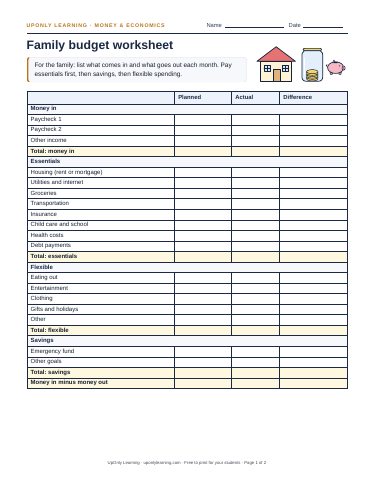
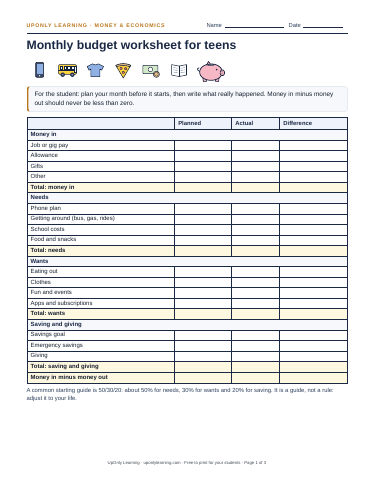
Free printables for this part
Printables that go with the topics on this page.
Every printable comes in full color and in black and white line art (low ink, ready to color in).
Questions parents ask
How can kids spot a scam?
Scammers pretend to be from a group you know.[1] Scammers say there is a problem, or that you won a prize.[1] Scammers pressure you to act right away, before you have time to think.[1] Scammers tell you to pay in a certain way.[1] If something feels wrong, stop and talk to someone you trust.[1]
How do I protect my child’s identity?
Most children under 18 do not have a credit report, so one in a child’s name can be a warning sign.[2] If your child is under 16, you can ask for a free credit freeze.[2] Ask questions before giving anyone your child’s Social Security number.[2] Child identity theft can be reported to the FTC at IdentityTheft.gov.[2]
What is a deductible in insurance?
A premium is the amount you pay for insurance, for example every month for health insurance.[3] A deductible is the amount you pay for covered care before your insurance plan starts to pay.[4] With a $2,000 deductible, you pay the first $2,000 of covered services yourself.[4]
Sources for these answers (4)
- Federal Trade Commission, Consumer Advice · How To Avoid a Scam · consumer.ftc.gov/articles/how-avoid-scam (checked Oct 27, 2026)
- Federal Trade Commission, Consumer Advice · How To Protect Your Child From Identity Theft · consumer.ftc.gov/articles/how-protect-your-child-identity-theft (checked Oct 27, 2026)
- HealthCare.gov (Centers for Medicare & Medicaid Services) · Glossary: Premium · healthcare.gov/glossary/premium (checked Oct 27, 2026)
- HealthCare.gov (Centers for Medicare & Medicaid Services) · Glossary: Deductible · healthcare.gov/glossary/deductible (checked Oct 27, 2026)