
Money & Economics · free reference
Part 1: What is money? Coins, bills and the history of money
What money does, The history of money, U.S. coins, U.S. paper money, How money is made and Digital money. Every fact lists its source, and you can share a link to any topic.
What money does
In short: Money is what we use to buy things. It lets people trade, measure what things are worth and save for later.[1]
Facts
- Money is what people use to buy things.[1]K–2
- People earn money by working, and they need money to buy things.[2]K–2
- Money is something people trade for the things they want. Economists call this a medium of exchange.[1]K–2
- Dollars are accepted as payment everywhere in the United States. Other countries use other kinds of money.[1]K–2
- Money also works like a measuring stick: in the United States, we can say what something is worth in dollars. Economists call this a unit of account.[1]3–5
- Money can be kept and used later. Economists call this a store of value.[1]3–5
- Money can be split into smaller amounts. That is how we make change, by breaking big bills into smaller bills and coins.[1]3–5
Key words in three languages
| English | Spanish | Portuguese |
|---|---|---|
| money[1] | dinero[3] | dinheiro[4] |
| medium of exchange[1] | medio de intercambio[5] | meio de troca[6] |
| unit of account[1] | unidad de cuenta[5] | unidade de conta[6] |
| store of value[1] | reserva de valor[5] | reserva de valor[6] |
Each word cites a page that uses it.
Practice this
- Life Skills practice questions, Grade 1Questions from every Life Skills topic in the grade, with answers · freeFree
- Business practice questions, KindergartenQuestions from every Business topic in the grade, with answers · freeFree
- Lesson: Earning, saving and spendingGrade 1 · full lesson with practice and a checkMembers
- Lesson: Trading and swappingKindergarten · full lesson with practice and a checkMembers
Members-only lessons are marked. The practice pages by grade and The Business You Build check are free.
Sources (6)
- Federal Reserve Education (Federal Reserve System) · What Is Money? · federalreserveeducation.org/teaching-resources/economics/money/what-is-money (checked Oct 27, 2026)
- Consumer Financial Protection Bureau · Money as You Grow: Young children · consumerfinance.gov/consumer-tools/money-as-you-grow/young-children (checked Oct 27, 2026)
- Consumer Financial Protection Bureau · Glossary of English-Spanish financial terms (Spanish style guide and glossary) · files.consumerfinance.gov/f/documents/cfpb_adult-fin-ed_spanish-style-guide-glossary.pdf (checked Oct 27, 2026)
- Wikipédia em português · Inflação · pt.wikipedia.org/wiki/Infla%C3%A7%C3%A3o (checked Oct 27, 2026)
- Wikipedia en español · Dinero · es.wikipedia.org/wiki/Dinero (checked Oct 27, 2026)
- Wikipédia em português · Dinheiro · pt.wikipedia.org/wiki/Dinheiro (checked Oct 27, 2026)
See something we should correct about “What money does”? Tell us.
The history of money
In short: The U.S. Mint was created in 1792, today’s paper money printer has made all U.S. bills since 1862, and the penny was made for spending for 232 years. Today our money works because people trust it.[1][2][3]
Facts
- Congress created the United States Mint in 1792. The Mint became part of the Treasury Department in 1873.[1]3–5
- The penny was one of the first coins the U.S. Mint made after it was set up in 1792.[4]3–5
- The first five-cent coin the Mint made was silver, not nickel. It was called a “half disme” and was much smaller than today’s nickel.[4]3–5
- The quarter was first made in 1796, as a silver coin.[4]3–5
- The Bureau of Engraving and Printing has designed and printed all U.S. paper money since 1862.[2]3–5
- The United States made pennies for everyday spending for 232 years. That run ended on November 12, 2025.[1]3–5
- The national motto was not added to U.S. paper money until 1957.[2]6–8
- The biggest note the Bureau ever printed was a $100,000 Gold Certificate, Series 1934.[2]6–8
- U.S. money is not backed by gold or silver. It works because people trust that it has value.[3]6–8
- That trust rests largely on the Federal Reserve, the central bank, which decides how much money there is.[3]6–8
- Money has to be hard to get. If it grew on trees, everyone would grow it and it would lose its value.[3]6–8
Key words in three languages
Each word cites a page that uses it.
Practice this
- Business practice questions, KindergartenQuestions from every Business topic in the grade, with answers · freeFree
- Lesson: Trading and swappingKindergarten · full lesson with practice and a checkMembers
Each word cites a page that uses it.
Sources (8)
- United States Mint · United States Mint Hosts Historic Ceremonial Strike for Final Production of the Circulating One-Cent Coin · usmint.gov/news/press-releases/united-states-mint-hosts-historic-ceremonial-strike-for-final-production-of-the-circulating-one-cent-coin (page updated Nov 12, 2025; checked Oct 27, 2026)
- Bureau of Engraving and Printing (U.S. Treasury) · Currency FAQs · bep.gov/currency/faqs (checked Oct 27, 2026)
- Federal Reserve Education (Federal Reserve System) · What Is Money? · federalreserveeducation.org/teaching-resources/economics/money/what-is-money (checked Oct 27, 2026)
- United States Mint · Coin Specifications · usmint.gov/learn/coins-and-medals/circulating-coins/coin-specifications (checked Oct 27, 2026)
- Banco Central Europeo · Nuestro dinero · ecb.europa.eu/euro/intro/html/index.es.html (checked Oct 27, 2026)
- Banco Central Europeu · O nosso dinheiro · ecb.europa.eu/euro/intro/html/index.pt.html (checked Oct 27, 2026)
- Wikipedia en español · Dinero · es.wikipedia.org/wiki/Dinero (checked Oct 27, 2026)
- Wikipédia em português · Dinheiro · pt.wikipedia.org/wiki/Dinheiro (checked Oct 27, 2026)
See something we should correct about “The history of money”? Tell us.
U.S. coins
In short: U.S. coins are different in metal, size and edge. The dime is smaller than the nickel even though it is worth more, and pennies are no longer made for spending, but the ones we have still count.[1][2]
Facts
- Pennies are no longer made for spending, but you can still spend the pennies you have.[2]K–2
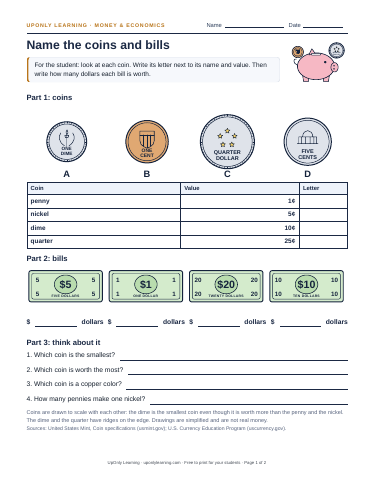
- The dime is smaller than the nickel, even though it is worth more: 17.91 millimeters across, next to 21.21 for the nickel.[1]K–2
- Feel the edges: the dime has 118 little ridges (reeds) and the quarter has 119. The penny and the nickel have plain edges.[1]K–2
- New pennies are now made only for collectors’ coin sets.[1]3–5
- Over the past decade, the cost of making one penny rose from 1.42 cents to 3.69 cents, more than the coin is worth.[2]3–5
- The Mint estimates there are about 300 billion pennies already out in the world.[2]3–5
- Stores can still set prices in one-cent steps.[2]3–5
- The penny is mostly zinc. Only 2.5 percent of it is copper.[1]3–5
- The nickel is actually mostly copper: 75 percent copper and 25 percent nickel.[1]3–5
- A quarter weighs 5.67 grams and is 24.26 millimeters across.[1]3–5
- The dime showed President Franklin D. Roosevelt from 1946 to 2025, and his portrait returns to it in 2027.[1]3–5
- The golden Sacagawea dollar coin came out in 2000.[1]3–5
- A mint mark is a letter on a coin that shows where it was made. A coin with no mint mark usually comes from Philadelphia.[3]3–5
- The penny, dime, quarter, half dollar and dollar are “clad” coins, made in layers around an inner core of copper. The nickel is the only coin in everyday use that is not clad.[1]6–8
- Since 2002, half dollars have been made mostly for collectors’ coin sets.[1]6–8
- The golden dollar coin is not gold. It is 88.5 percent copper, with zinc, manganese and nickel, and its outer layer of manganese brass gives it the golden color.[1]6–8
Key words in three languages
Each word cites a page that uses it.
Practice this
- Life Skills practice questions, KindergartenQuestions from every Life Skills topic in the grade, with answers · freeFree
- Life Skills practice questions, Grade 2Questions from every Life Skills topic in the grade, with answers · freeFree
- Lesson: Coins, needs and wantsKindergarten · full lesson with practice and a checkMembers
- Lesson: Counting money and making changeGrade 2 · full lesson with practice and a checkMembers
Members-only lessons are marked. The practice pages by grade and The Business You Build check are free.
Sources (6)
- United States Mint · Coin Specifications · usmint.gov/learn/coins-and-medals/circulating-coins/coin-specifications (checked Oct 27, 2026)
- United States Mint · United States Mint Hosts Historic Ceremonial Strike for Final Production of the Circulating One-Cent Coin · usmint.gov/news/press-releases/united-states-mint-hosts-historic-ceremonial-strike-for-final-production-of-the-circulating-one-cent-coin (page updated Nov 12, 2025; checked Oct 27, 2026)
- United States Mint · Mint Marks · usmint.gov/learn/collecting-basics/mint-marks (checked Oct 27, 2026)
- Wikipedia en español · Dinero · es.wikipedia.org/wiki/Dinero (checked Oct 27, 2026)
- Banco Central Europeu · O nosso dinheiro · ecb.europa.eu/euro/intro/html/index.pt.html (checked Oct 27, 2026)
- Banco Central Europeo · Nuestro dinero · ecb.europa.eu/euro/intro/html/index.es.html (checked Oct 27, 2026)
See something we should correct about “U.S. coins”? Tell us.
U.S. paper money
In short: Dollar bills are made of cotton and linen, not paper. Each one shows a famous American, and big bills last much longer than small ones.[1][2]
Facts
- Dollar bills are not made of regular paper. They are 75 percent cotton and 25 percent linen, a cloth.[1]K–2
- Every bill weighs about one gram, whatever it is worth.[1]K–2
- The $1 bill shows George Washington, the 1st U.S. president. Its back shows the Great Seal of the United States.[1]K–2
- The $2 bill shows Thomas Jefferson, the 3rd president, on the front and the Declaration of Independence on the back.[1]K–2
- The $5 bill shows Abraham Lincoln, the 16th president, with the Lincoln Memorial on the back.[1]K–2
- A bill can be folded forward and back about 4,000 times before it tears.[1]3–5
- Alexander Hamilton, on the $10 bill, was never president. He was the 1st Secretary of the Treasury.[1]3–5
- The $20 bill shows Andrew Jackson, the 7th president, with the White House on the back.[1]3–5
- The $50 bill shows Ulysses Grant, the 18th president, with the U.S. Capitol on the back.[1]3–5
- Benjamin Franklin, on the $100 bill, was a statesman, not a president. The back shows Independence Hall.[1]3–5
- Martha Washington is the only woman whose portrait has been on a U.S. paper note.[1]3–5
- The U.S. government has never made a $1 million bill.[1]3–5
- Old designs of U.S. money still count as money: every design stays legal tender, no matter when it was made.[3]3–5
- A $1 bill lasts about 7.2 years before it wears out and is replaced.[2]3–5
- A $100 bill lasts about 24 years, because people often keep big bills as a store of value instead of spending them.[2]3–5
- At the end of 2025 there was about $2,394.9 billion in U.S. paper money in circulation, and $1,988.8 billion of it was in $100 bills.[4]6–8
Key words in three languages
Each word cites a page that uses it.
Practice this
- Life Skills practice questions, Grade 2Questions from every Life Skills topic in the grade, with answers · freeFree
- Lesson: Counting money and making changeGrade 2 · full lesson with practice and a checkMembers
Members-only lessons are marked. The practice pages by grade and The Business You Build check are free.
Sources (9)
- Bureau of Engraving and Printing (U.S. Treasury) · Currency FAQs · bep.gov/currency/faqs (checked Oct 27, 2026)
- Board of Governors of the Federal Reserve System · How long is the life span of U.S. paper money? · federalreserve.gov/faqs/how-long-is-the-life-span-of-us-paper-money.htm (page updated Jul 17, 2025; checked Oct 27, 2026)
- U.S. Currency Education Program (Federal Reserve Board) · The Seven Denominations · uscurrency.gov/denominations (checked Oct 27, 2026)
- Board of Governors of the Federal Reserve System · Currency in Circulation: Value · federalreserve.gov/paymentsystems/coin_currcircvalue.htm (checked Oct 27, 2026)
- Wikipedia en español · Dinero · es.wikipedia.org/wiki/Dinero (checked Oct 27, 2026)
- Wikipédia em português · Dinheiro · pt.wikipedia.org/wiki/Dinheiro (checked Oct 27, 2026)
- United States Mint · United States Mint Hosts Historic Ceremonial Strike for Final Production of the Circulating One-Cent Coin · usmint.gov/news/press-releases/united-states-mint-hosts-historic-ceremonial-strike-for-final-production-of-the-circulating-one-cent-coin (page updated Nov 12, 2025; checked Oct 27, 2026)
- Banco Central Europeo · Nuestro dinero · ecb.europa.eu/euro/intro/html/index.es.html (checked Oct 27, 2026)
- Banco Central Europeu · O nosso dinheiro · ecb.europa.eu/euro/intro/html/index.pt.html (checked Oct 27, 2026)
See something we should correct about “U.S. paper money”? Tell us.
How money is made
In short: The Bureau of Engraving and Printing makes all U.S. paper money. New designs and hidden features, like watermarks and security threads, make bills hard to fake.[1][2]
Facts
- U.S. paper money is made by the Bureau of Engraving and Printing, part of the U.S. Treasury.[3]3–5
- The Bureau of Engraving and Printing is the only maker of U.S. paper money.[1]3–5
- The Bureau prints billions of dollars in new bills every year.[3]3–5
- Hold a $10 bill up to the light and you can see a watermark portrait of Alexander Hamilton from both sides.[2]3–5
- The main reason bills get new designs is to stay ahead of counterfeiters, people who make fake money.[1]6–8
- The $5 bill has a security thread inside it that glows blue under ultraviolet (UV) light.[2]6–8
- The $100 bill has a 3-D security ribbon and a bell in an inkwell that changes color.[2]6–8
Key words in three languages
Each word cites a page that uses it.
Practice this
We do not have a lesson on this yet. The facts above are the teaching here.
Sources (5)
- Bureau of Engraving and Printing (U.S. Treasury) · Currency FAQs · bep.gov/currency/faqs (checked Oct 27, 2026)
- U.S. Currency Education Program (Federal Reserve Board) · The Seven Denominations · uscurrency.gov/denominations (checked Oct 27, 2026)
- Bureau of Engraving and Printing (U.S. Treasury) · About the BEP · bep.gov/about (checked Oct 27, 2026)
- Wikipedia en español · Dinero · es.wikipedia.org/wiki/Dinero (checked Oct 27, 2026)
- Wikipédia em português · Dinheiro · pt.wikipedia.org/wiki/Dinheiro (checked Oct 27, 2026)
See something we should correct about “How money is made”? Tell us.
Digital money
In short: Most payments today are made with cards and phones, not cash. Payment apps are handy, but always check the amount and the person before you pay.[1][2]
Facts
- Cash was used for only 14 percent of payments in 2024.[1]3–5
- Before you send money in a payment app, check the amount and the person you picked.[2]3–5
- In 2024, people in the United States made about 48 payments a month on average.[1]6–8
- Cards were used most: credit cards for 35 percent of payments and debit cards for 30 percent.[1]6–8
- People made an average of 11 payments a month with a mobile phone in 2024.[1]6–8
- Be careful sending money to, or getting money from, someone you do not know.[2]6–8
- Set up a payment app to ask for a passcode, PIN or fingerprint before every payment.[2]6–8
Go deeper: for teens and grown-ups (2)
Key words in three languages
| English | Spanish | Portuguese |
|---|---|---|
| payment[1] | pago[4] | pagamento[5] |
| cash[1] | dinero en efectivo[4] | not sourced yet |
| debit card[1] | tarjeta de débito[4] | cartões de débito[5] |
Each word cites a page that uses it.
Practice this
- Life Skills practice questions, Grade 4Questions from every Life Skills topic in the grade, with answers · freeFree
- Lesson: Smart shopping: comparing pricesGrade 4 · full lesson with practice and a checkMembers
Members-only lessons are marked. The practice pages by grade and The Business You Build check are free.
Sources (5)
- Federal Reserve Financial Services · 2025 Diary of Consumer Payment Choice · frbservices.org/news/research/2025-findings-from-the-diary-of-consumer-payment-choice (page updated May 2025; checked Oct 27, 2026)
- Consumer Financial Protection Bureau · Helpful tips for using mobile payment services and avoiding risky mistakes · consumerfinance.gov/archive/blog/helpful-tips-using-mobile-payment-services-and-avoiding-risky-mistakes (page updated Sep 13, 2018; checked Oct 27, 2026)
- Board of Governors of the Federal Reserve System · FedNow Service · federalreserve.gov/paymentsystems/fednow_about.htm (page updated Jul 20, 2023; checked Oct 27, 2026)
- Consumer Financial Protection Bureau · Glossary of English-Spanish financial terms (Spanish style guide and glossary) · files.consumerfinance.gov/f/documents/cfpb_adult-fin-ed_spanish-style-guide-glossary.pdf (checked Oct 27, 2026)
- Wikipédia em português · Cartão de crédito · pt.wikipedia.org/wiki/Cart%C3%A3o_de_cr%C3%A9dito (checked Oct 27, 2026)
See something we should correct about “Digital money”? Tell us.
Free printables for this part
Printables that go with the topics on this page.
Every printable comes in full color and in black and white line art (low ink, ready to color in).
Questions parents ask
Why can’t the government just print more money?
Money only works if it is hard to get. As the Federal Reserve’s education site puts it, if money grew on trees, everyone would grow it and it would lose its value[1]. The amount of money is set by the central bank, the Federal Reserve, and people’s trust in money rests largely on it[1]. When the prices of the things we buy go up over time, that is inflation[2].
What is the history of money? (for kids)
In the United States, Congress created the U.S. Mint in 1792[3], and the government has printed all U.S. paper money since 1862[4]. Pennies were made for spending for 232 years, until November 12, 2025[3]. Today U.S. money is not backed by gold or silver: it works because people trust it[1].
What is money, in simple words?
Money is what people use to buy things.[1] Money is something people trade for the things they want. Economists call this a medium of exchange.[1] Money also works like a measuring stick: in the United States, we can say what something is worth in dollars. Economists call this a unit of account.[1] Money can be kept and used later. Economists call this a store of value.[1]
Can you still spend pennies?
The United States made pennies for everyday spending for 232 years. That run ended on November 12, 2025.[3] Pennies are no longer made for spending, but you can still spend the pennies you have.[3] Stores can still set prices in one-cent steps.[3]
Sources for these answers (4)
- Federal Reserve Education (Federal Reserve System) · What Is Money? · federalreserveeducation.org/teaching-resources/economics/money/what-is-money (checked Oct 27, 2026)
- Board of Governors of the Federal Reserve System · Economy at a Glance: Inflation (PCE) · federalreserve.gov/economy-at-a-glance-inflation-pce.htm (page updated Aug 2, 2024; checked Oct 27, 2026)
- United States Mint · United States Mint Hosts Historic Ceremonial Strike for Final Production of the Circulating One-Cent Coin · usmint.gov/news/press-releases/united-states-mint-hosts-historic-ceremonial-strike-for-final-production-of-the-circulating-one-cent-coin (page updated Nov 12, 2025; checked Oct 27, 2026)
- Bureau of Engraving and Printing (U.S. Treasury) · Currency FAQs · bep.gov/currency/faqs (checked Oct 27, 2026)