
Money & Economics · free reference
Part 5: Saving money and how banks work
Why save, How banks and credit unions work, Keeping deposits safe, Banking in America and Emergency savings. Every fact lists its source, and you can share a link to any topic.
Why save
In short: Saving means putting money aside so you can buy something later. Adding a little at a time helps your savings grow.[1][2][3]
Facts
- Sometimes you have to wait and save up before you can buy something you want.[1]K–2
- A savings account is a place to keep money and make it grow by adding to it a little at a time.[3]K–2
- Kids can start a habit of putting money aside for things they want.[2]3–5
Go deeper: for teens and grown-ups (1)
- For young children, the CFPB names persistence, sticking with something, as a money milestone parents can watch for.[1]Grown-ups
Key words in three languages
Each word cites a page that uses it.
Practice this
- Life Skills practice questions, Grade 1Questions from every Life Skills topic in the grade, with answers · freeFree
- Life Skills practice questions, Grade 3Questions from every Life Skills topic in the grade, with answers · freeFree
- How to teach kids about money, age by ageBlog guide · what to teach at each ageFree
- Lesson: Earning, saving and spendingGrade 1 · full lesson with practice and a checkMembers
- Lesson: Budgeting my allowanceGrade 3 · full lesson with practice and a checkMembers
Each word cites a page that uses it.
Sources (6)
- Consumer Financial Protection Bureau · Money as You Grow: Young children · consumerfinance.gov/consumer-tools/money-as-you-grow/young-children (checked Oct 27, 2026)
- Consumer Financial Protection Bureau · Money as You Grow: School-age children to preteens · consumerfinance.gov/consumer-tools/money-as-you-grow/middle-childhood (checked Oct 27, 2026)
- Federal Deposit Insurance Corporation, Money Smart News for Kids · What Is a Bank? · fdic.gov/resources/consumers/money-smart/money-smart-news/kids/documents/ch1.pdf (checked Oct 27, 2026)
- Wikipedia en español · Educación financiera · es.wikipedia.org/wiki/Educaci%C3%B3n_financiera (checked Oct 27, 2026)
- Wikipédia em português · Educação financeira · pt.wikipedia.org/wiki/Educa%C3%A7%C3%A3o_financeira (checked Oct 27, 2026)
- Wikipédia em português · Finanças pessoais · pt.wikipedia.org/wiki/Finan%C3%A7as_pessoais (checked Oct 27, 2026)
See something we should correct about “Why save”? Tell us.
How banks and credit unions work
In short: Banks and credit unions take deposits and make loans. Credit unions are not-for-profit and owned by their members.[1][2]
Facts
- A bank is a business that takes in deposits and makes loans.[1]K–2
- When you put your money in a bank, it is called a deposit.[1]K–2
- Like banks, credit unions take deposits, make loans and offer other money services.[2]3–5
- At a credit union, one member’s savings becomes another member’s loan.[2]3–5
- Credit unions are not-for-profit groups that exist to serve their members.[2]6–8
- A credit union is owned and controlled by its members, the people who use it, and they elect a volunteer board to run it.[2]6–8
Go deeper: for teens and grown-ups (1)
- Members of a credit union share a common bond, called its “field of membership.”[2]Teens
Key words in three languages
| English | Spanish | Portuguese |
|---|---|---|
| bank[1] | banco[3] | banco[4] |
| deposit[1] | depósito[3] | depósito[4] |
| loan[1] | préstamo[3] | empréstimo[5] |
| credit union[2] | cooperativa de crédito[3] | cooperativa de crédito[6] |
Each word cites a page that uses it.
Practice this
- Life Skills practice questions, Grade 5Questions from every Life Skills topic in the grade, with answers · freeFree
- Business practice questions, Grade 5Questions from every Business topic in the grade, with answers · freeFree
- Lesson: Saving, banks and interestGrade 5 · full lesson with practice and a checkMembers
- Lesson: Banks, loans and interestGrade 5 · full lesson with practice and a checkMembers
Members-only lessons are marked. The practice pages by grade and The Business You Build check are free.
Sources (6)
- Federal Deposit Insurance Corporation, Money Smart News for Kids · What Is a Bank? · fdic.gov/resources/consumers/money-smart/money-smart-news/kids/documents/ch1.pdf (checked Oct 27, 2026)
- National Credit Union Administration, MyCreditUnion.gov · How is a credit union different from a bank? · mycreditunion.gov/about/what-credit-union/how-credit-union-different-bank-text-version (checked Oct 27, 2026)
- Consumer Financial Protection Bureau · Glossary of English-Spanish financial terms (Spanish style guide and glossary) · files.consumerfinance.gov/f/documents/cfpb_adult-fin-ed_spanish-style-guide-glossary.pdf (checked Oct 27, 2026)
- Wikipédia em português · Banco · pt.wikipedia.org/wiki/Banco (checked Oct 27, 2026)
- Wikipédia em português · Juro · pt.wikipedia.org/wiki/Juro (checked Oct 27, 2026)
- Wikipédia em português · Cooperativa de crédito · pt.wikipedia.org/wiki/Cooperativa_de_cr%C3%A9dito (checked Oct 27, 2026)
See something we should correct about “How banks and credit unions work”? Tell us.
Keeping deposits safe
In short: Money in an insured bank or credit union is protected up to $250,000. Since 1933, nobody has lost a penny of FDIC-insured money. Investments like stocks are not covered.[1][2]
Facts
- Money you put in an insured bank is safe.[3]K–2
- The FDIC insures deposits up to at least $250,000 per depositor, for each ownership category, at each insured bank.[1]3–5
- Since the FDIC began in 1933, nobody has lost a penny of money that the FDIC insured.[1]3–5
- Money in a federally insured credit union is protected up to $250,000 by the National Credit Union Share Insurance Fund.[2]3–5
- No one has lost a single penny of insured deposits at a federally insured credit union.[2]3–5
- FDIC insurance covers deposit accounts, such as checking accounts, savings accounts, CDs and money market deposit accounts.[1]6–8
- FDIC insurance does not cover investments such as stocks, bonds, mutual funds or crypto, even when a bank sells them.[1]6–8
Go deeper: for teens and grown-ups (2)
Key words in three languages
Each word cites a page that uses it.
Practice this
- Life Skills practice questions, Grade 5Questions from every Life Skills topic in the grade, with answers · freeFree
- Lesson: Saving, banks and interestGrade 5 · full lesson with practice and a checkMembers
Members-only lessons are marked. The practice pages by grade and The Business You Build check are free.
Sources (5)
- Federal Deposit Insurance Corporation · Understanding Deposit Insurance · fdic.gov/resources/deposit-insurance/understanding-deposit-insurance (checked Oct 27, 2026)
- National Credit Union Administration · Share Insurance Coverage · ncua.gov/consumers/share-insurance-coverage (checked Oct 27, 2026)
- Federal Deposit Insurance Corporation, Money Smart News for Kids · What Is a Bank? · fdic.gov/resources/consumers/money-smart/money-smart-news/kids/documents/ch1.pdf (checked Oct 27, 2026)
- Consumer Financial Protection Bureau · Glossary of English-Spanish financial terms (Spanish style guide and glossary) · files.consumerfinance.gov/f/documents/cfpb_adult-fin-ed_spanish-style-guide-glossary.pdf (checked Oct 27, 2026)
- Wikipédia em português · Banco · pt.wikipedia.org/wiki/Banco (checked Oct 27, 2026)
See something we should correct about “Keeping deposits safe”? Tell us.
Banking in America
In short: Most U.S. households have a bank or credit union account, but in 2023 about 4.2 percent did not, most often because they did not have enough money for minimum balance rules.[1]
Facts
- In 2023, 4.2 percent of U.S. households, about 5.6 million, had no bank or credit union account.[1]6–8
- Almost half of households with a bank account (48.3 percent) used mobile banking as their main way to reach it.[1]6–8
Go deeper: for teens and grown-ups (3)
- The reason unbanked households gave most often was not having enough money to meet minimum balance rules (42.3 percent).[1]Teens
- From 2011 to 2023, the share of households with no account fell by almost half.[1]Teens
- Another 14.2 percent of households, about 19.0 million, were what the FDIC calls underbanked.[1]Grown-ups
Key words in three languages
Each word cites a page that uses it.
Practice this
- Life Skills practice questions, Grade 5Questions from every Life Skills topic in the grade, with answers · freeFree
- Lesson: Saving, banks and interestGrade 5 · full lesson with practice and a checkMembers
Each word cites a page that uses it.
Sources (5)
- Federal Deposit Insurance Corporation · 2023 FDIC National Survey of Unbanked and Underbanked Households: Executive Summary · fdic.gov/household-survey/2023-fdic-national-survey-unbanked-and-underbanked-households-executive-summary (page updated Nov 2024; checked Oct 27, 2026)
- World Bank · The Global Findex Database 2025 · worldbank.org/en/publication/globalfindex (checked Oct 27, 2026)
- Consumer Financial Protection Bureau · Glossary of English-Spanish financial terms (Spanish style guide and glossary) · files.consumerfinance.gov/f/documents/cfpb_adult-fin-ed_spanish-style-guide-glossary.pdf (checked Oct 27, 2026)
- Federal Deposit Insurance Corporation, Money Smart News for Kids · What Is a Bank? · fdic.gov/resources/consumers/money-smart/money-smart-news/kids/documents/ch1.pdf (checked Oct 27, 2026)
- Wikipédia em português · Banco · pt.wikipedia.org/wiki/Banco (checked Oct 27, 2026)
See something we should correct about “Banking in America”? Tell us.
Emergency savings
In short: Emergency savings are money set aside for surprises. In 2025, 63 percent of U.S. adults said they would cover a surprise $400 expense with cash or its equivalent.[1][2]
Facts
- In 2025, 63 percent of U.S. adults said they would cover a surprise $400 expense with cash or its equivalent, the same as in 2024.[1]Teens
- CFPB research found that even small amounts of savings you can reach quickly can make a big difference.[2]Teens
- In the same survey, 73 percent of adults said they were doing at least okay financially.[1]Grown-ups
- Prices were a worry for most: 91 percent called them a major or minor concern.[1]Grown-ups
Key words in three languages
Each word cites a page that uses it.
Practice this
- Life Skills practice questions, Grade 7Questions from every Life Skills topic in the grade, with answers · freeFree
- Lesson: Saving goals, compound interest and the basics of creditGrade 7 · free sample lessonFree
Each word cites a page that uses it.
Sources (5)
- Board of Governors of the Federal Reserve System · Federal Reserve Board issues Economic Well-Being of U.S. Households in 2025 report · federalreserve.gov/newsevents/pressreleases/other20260513a.htm (page updated May 13, 2026; checked Oct 27, 2026)
- Consumer Financial Protection Bureau · CFPB Announces Start Small, Save Up Initiative · consumerfinance.gov/about-us/newsroom/cfpb-announces-start-small-save-initiative (page updated Feb 25, 2019; checked Oct 27, 2026)
- Federal Deposit Insurance Corporation, Money Smart News for Kids · What Is a Bank? · fdic.gov/resources/consumers/money-smart/money-smart-news/kids/documents/ch1.pdf (checked Oct 27, 2026)
- Wikipedia en español · Educación financiera · es.wikipedia.org/wiki/Educaci%C3%B3n_financiera (checked Oct 27, 2026)
- Wikipédia em português · Finanças pessoais · pt.wikipedia.org/wiki/Finan%C3%A7as_pessoais (checked Oct 27, 2026)
See something we should correct about “Emergency savings”? Tell us.
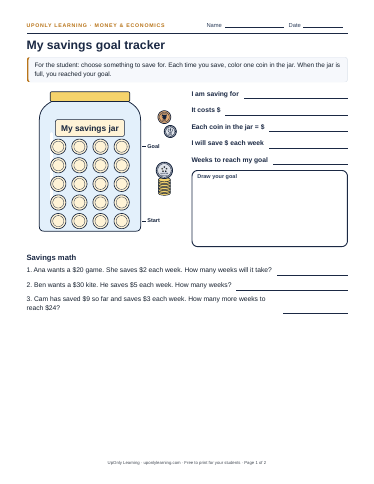
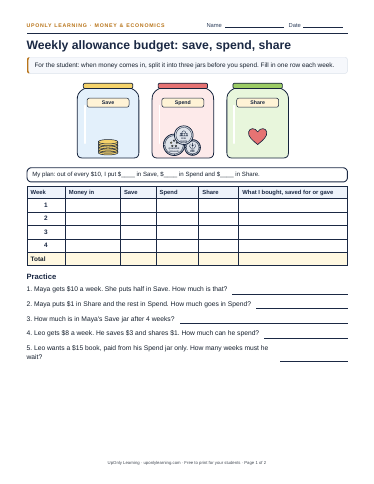
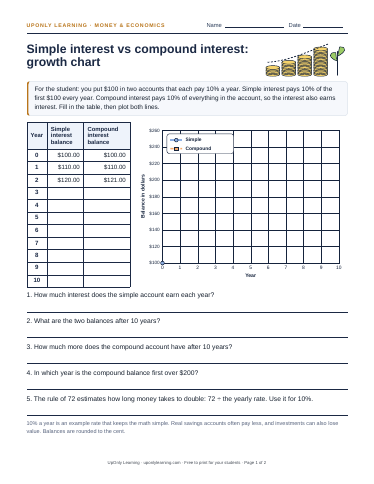
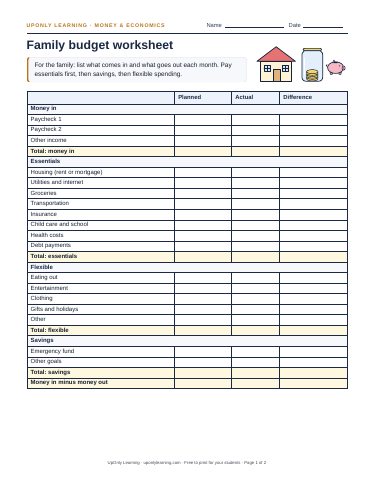
Free printables for this part
Printables that go with the topics on this page.
Every printable comes in full color and in black and white line art (low ink, ready to color in).
Questions parents ask
At what age can a child open a bank or savings account?
Ask the bank or credit union you are thinking about: its age rules, any fees and whether an adult must be on the account. What our sources say: a bank is a business that takes deposits and makes loans[1], a savings account is a place to keep money and help it grow a little at a time[1], and money in an insured bank is protected up to at least $250,000 per depositor[2]. Families can also open custodial (UTMA/UGMA) accounts, which the child owns and an adult manages[3].
How can I teach my child to save?
Start with waiting: sometimes you have to wait and save up before you can buy something you want[4]. School-age kids can start a habit of putting money aside for things they want[5], and a savings account helps money grow when you add a little at a time[1].
How do banks work, explained for kids?
A bank is a business that takes in deposits and makes loans.[1] When you put your money in a bank, it is called a deposit.[1] At a credit union, one member’s savings becomes another member’s loan.[6] Credit unions are not-for-profit groups that exist to serve their members.[6]
Is money safe in a bank?
The FDIC insures deposits up to at least $250,000 per depositor, for each ownership category, at each insured bank.[2] Since the FDIC began in 1933, nobody has lost a penny of money that the FDIC insured.[2] Money in a federally insured credit union is protected up to $250,000 by the National Credit Union Share Insurance Fund.[7] FDIC insurance does not cover investments such as stocks, bonds, mutual funds or crypto, even when a bank sells them.[2]
Sources for these answers (7)
- Federal Deposit Insurance Corporation, Money Smart News for Kids · What Is a Bank? · fdic.gov/resources/consumers/money-smart/money-smart-news/kids/documents/ch1.pdf (checked Oct 27, 2026)
- Federal Deposit Insurance Corporation · Understanding Deposit Insurance · fdic.gov/resources/deposit-insurance/understanding-deposit-insurance (checked Oct 27, 2026)
- FINRA (Financial Industry Regulatory Authority) · UTMA and UGMA Accounts (2019 Report on Examination Findings and Observations) · finra.org/rules-guidance/guidance/reports/2019-report-exam-findings-and-observations/utma-and-ugma (page updated 2019; checked Oct 27, 2026)
- Consumer Financial Protection Bureau · Money as You Grow: Young children · consumerfinance.gov/consumer-tools/money-as-you-grow/young-children (checked Oct 27, 2026)
- Consumer Financial Protection Bureau · Money as You Grow: School-age children to preteens · consumerfinance.gov/consumer-tools/money-as-you-grow/middle-childhood (checked Oct 27, 2026)
- National Credit Union Administration, MyCreditUnion.gov · How is a credit union different from a bank? · mycreditunion.gov/about/what-credit-union/how-credit-union-different-bank-text-version (checked Oct 27, 2026)
- National Credit Union Administration · Share Insurance Coverage · ncua.gov/consumers/share-insurance-coverage (checked Oct 27, 2026)